

A hotel buyout means one group takes exclusive use of an entire property, blocking all rooms and common areas from other guests for the duration of their stay. If you’re planning a destination wedding, a corporate offsite, a multi-generational family reunion, or an influencer retreat and you want the property entirely to yourselves, a buyout is the cleanest way to get there. Boutique properties in the 8–25 room range can start in the low thousands per night; high-end resort buyouts can run tens of thousands per night or more. The first step is requesting a direct buyout proposal from the property, or contacting a specialist like Hiddendoortravel to negotiate one on your behalf.
Demand for exclusive-use arrangements has risen steadily since 2020, with some intimate lodge portfolios reporting buyouts at roughly 40% of their bookings. That shift has made properties more comfortable with the format, but it has also tightened availability at the most desirable boutique properties, especially for peak-season dates.
Key Takeaways
A hotel buyout delivers genuine value when your group fills most of the property, the event runs across multiple days, and privacy or program control is a priority.
| Point | Details |
|---|---|
| Full vs. partial buyout | A full buyout blocks the entire property; a partial hire reserves a wing while the rest stays open. |
| Budget beyond rooms | Hotels use a revenue-replacement model: budget for F&B minimums, staffing, overtime, taxes, and gratuities on top of the base room rate. |
| Lead time matters | Boutique buyouts need 12–18 months for peak dates; popular destinations and festival weekends require up to 24 months. |
| Contract red flags | Negotiate tiered cancellation, attrition thresholds, force majeure carve-outs, and a written definition of what counts toward F&B minimums. |
| Hiddendoortravel | Hiddendoortravel handles property sourcing, contract review, and on-site coordination for groups planning exclusive-use events. |
Table of Contents
- What does a hotel buyout actually include?
- Is a hotel buyout right for your event?
- How does the hotel buyout process work, step by step?
- How much does a hotel buyout cost?
- What contract terms should you negotiate?
- What vendor policies will affect your event design?
- Operational logistics you need to confirm before arrival
- Pros and cons of buying out a hotel
- How far in advance should you book a hotel buyout?
- When does hiring a specialist agency make sense?
- Your property walkthrough and sales call checklist
- When a buyout is worth the premium
- Hiddendoortravel handles the hard parts of a hotel buyout
- Sources
What does a hotel buyout actually include?
A full buyout means the property closes its doors to all other guests. Every room, every F&B outlet, the pool, the spa, the public areas, and the grounds are yours. No strangers at breakfast. No competing events in the ballroom. The property’s staff works exclusively for your group for the contracted period.
A partial buyout (sometimes called a wing hire or floor hire) reserves a defined section of the property while the rest remains open to the public. This is more common at larger hotels where a full buyout would be prohibitively expensive, and it can work well for corporate groups that need a dedicated meeting wing without requiring total privacy.
Typical inclusions in a full buyout:
- All guest rooms and suites for the contracted nights
- Exclusive use of all public areas (lobby, pool, gardens, terraces)
- F&B outlets during agreed service hours
- On-site parking and arrival areas
- Dedicated front desk and concierge staff
Common exclusions to confirm:
- Spa and wellness facilities (often billed separately or require a minimum spend)
- Third-party tenants or restaurants within the property that operate independently
- Overflow parking or valet arrangements beyond the property’s own lot
- Any pre-existing reservations the property has not yet resolved
A 12-room boutique inn in the Hudson Valley operates very differently from a 60-room resort in Scottsdale. At the boutique end, a buyout typically means one kitchen, one dining room, and a single events team handling everything. At the resort level, you may be buying out multiple F&B concepts, a spa, and a pool complex, each with its own staffing and minimum spend requirements. Both qualify as buyouts, but the contract complexity and total cost are in entirely different categories.
Is a hotel buyout right for your event?
Boutique properties in the 8–25 room range are the most practical starting point for most groups, because the scale makes exclusivity both achievable and intimate. A group of 30–50 guests filling a 15-room property pays for every room and gets a genuinely private experience. The per-person math often compares favorably to booking individual rooms at a larger hotel, especially once you factor in the coordination savings.
Events that benefit most from a buyout:
- Multi-day destination weddings where guests are staying on-site and the program runs across multiple days and meals
- Corporate offsites and leadership retreats requiring confidentiality, focused programming, and no outside interruptions
- Family reunions and milestone celebrations (anniversaries, birthdays) where the group wants a shared home base
- Influencer and brand activations needing controlled visual environments and exclusive access to all spaces
Group size matters, but it’s not the only variable. A group of 20 guests at a 10-room property is a natural fit. A group of 20 guests trying to buy out a 60-room resort is paying for 40 empty rooms, which rarely makes financial sense unless the property offers a minimum-revenue model that happens to align with your budget.
When a buyout is probably not the right call:
- Your group fills fewer than 60–70% of the property’s rooms
- The event is a single evening with no overnight component
- Guests are spread across multiple cities and a central hotel location matters more than exclusivity
- Budget constraints make the revenue-replacement model unworkable
Pro Tip: If your group is too small for a full buyout but privacy is still a priority, ask the property about a wing hire or a soft buyout, where they agree not to sell the remaining rooms after a certain date. Some independent properties will do this informally for groups that represent significant F&B revenue.
When a room block at a larger hotel is the better answer, the tradeoff is straightforward: you lose the exclusive-use experience but gain flexibility on room count, cancellation terms, and price per room. For events where the program is concentrated in a separate venue and the hotel is purely for sleeping, a room block usually wins on cost.
How does the hotel buyout process work, step by step?
The process from first inquiry to final reconciliation typically runs through six distinct phases. Knowing what to expect at each stage prevents the most common delays.
Phase 1: Inquiry
Send a structured brief to the property’s sales team. A strong inquiry includes:
- Your event dates (with one or two flexible alternatives if possible)
- Estimated guest count and room count needed
- Event type and a one-paragraph program description
- F&B expectations (number of meals, style of service, dietary considerations)
- Any outside vendors you plan to bring in
- Your target budget range or a request for the property’s buyout rate card
Phase 2: Proposal
The property responds with a buyout proposal. Expect it to include a room-night rate or flat exclusive-use fee, F&B minimums per meal period, a deposit schedule, and a preliminary contract outline. Review the proposal against the itemized cost checklist in the budgeting section below before responding.
Phase 3: Site walkthrough
Before signing anything, visit the property in person or arrange a detailed video walkthrough. This is when you confirm load-in access, kitchen capacity, power availability, staging areas, and guest flow. Bring your event brief and walk every space your program will use.
Phase 4: Negotiation and contract
Negotiate the terms (see the contract section below for the specific clauses that matter most), then execute the contract with the agreed deposit.
Phase 5: Pre-arrival coordination
- Submit a final rooming list 30–60 days before arrival
- Confirm vendor access windows and load-in schedule
- Schedule a pre-arrival walkthrough call with operations 2–3 weeks out
- Distribute a guest communication with arrival instructions, parking details, and check-in times
Phase 6: On-site execution and reconciliation
During the event, a dedicated property liaison should be your single point of contact. After checkout, the property reconciles actual F&B spend against minimums, calculates any attrition charges, and issues a final invoice. Review every line before paying.
How much does a hotel buyout cost?
Hotels price buyouts using one of two primary models, and understanding which model a property uses changes how you budget.
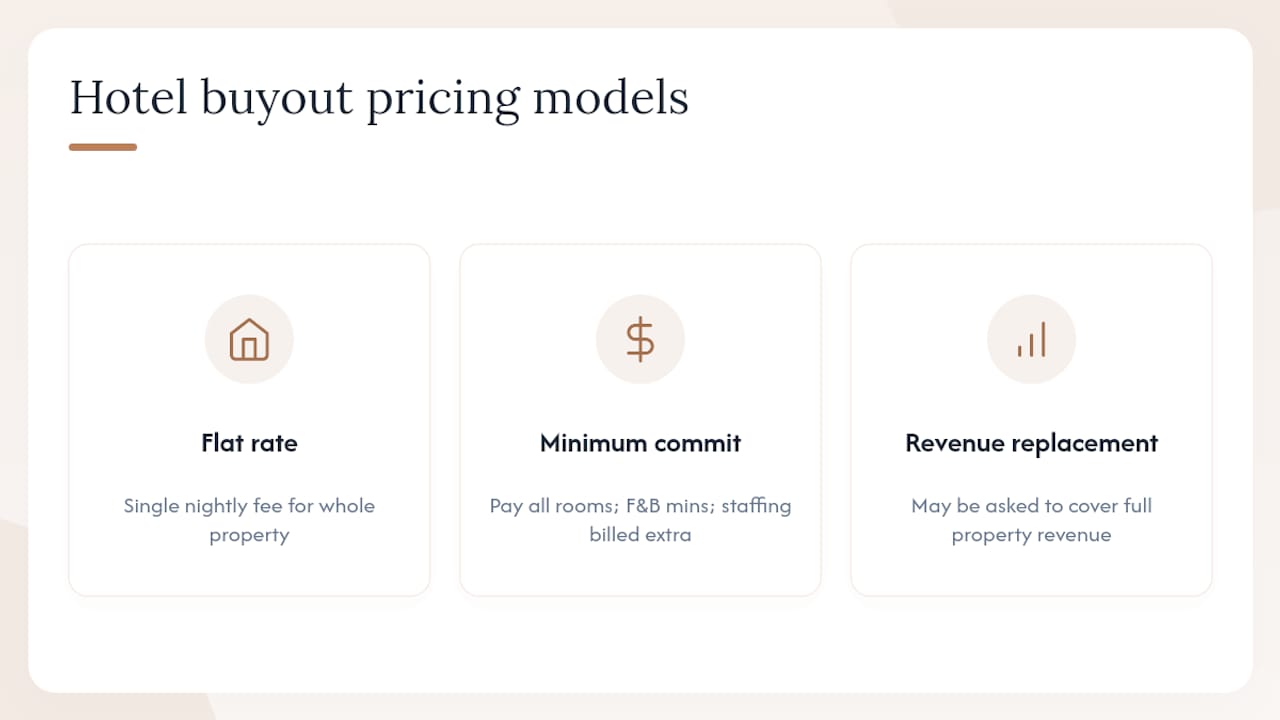
Model 1: Flat exclusive-use rate. The property quotes a single nightly fee for the entire property, regardless of how many rooms you actually use. This is common at boutique properties and private-island resorts.
Model 2: Minimum room-night commitment plus F&B minimums. You commit to paying for all rooms at a set rate, plus separate F&B minimums for each meal period or event. Staffing, security, and overtime are typically billed separately on top of these minimums.
A frequent financial misunderstanding is expecting to pay only for rooms. Hotels often require groups to compensate for expected earnings across food, beverage, spa, and other outlets, effectively a revenue-replacement model. A property that normally generates $8,000 per night across rooms, the restaurant, and the bar will expect your buyout to cover that full figure, not just the room revenue.
Sample budget ranges
| Property type | Rooms | Approx. nightly buyout range | Per-person estimate (30 guests) |
|---|---|---|---|
| Boutique inn | 8–12 rooms | low thousands per night–$8,000 | $100 per night–$267 |
| Midscale boutique resort | 20–30 rooms | tens of thousands per night | $400–$1,167 per night |
| High-end resort | 40–60 rooms | $40,000–$100,000+ | $1,333 or more per night |
These figures cover the base room rate only. Costs can range dramatically from low thousands to well over $100,000 per night depending on property type and location.
Line items to include in every buyout budget:
- Base room-night cost or flat exclusive-use fee
- F&B minimums per meal period (breakfast, lunch, dinner, bar service)
- Staffing and overtime charges (kitchen, front desk, housekeeping, security)
- Event security (often required separately from hotel security)
- Resort fees, destination fees, and applicable taxes
- AV equipment rental and technical support
- Outside vendor corkage, set-up fees, or access fees
- Gratuities (typically 18–22% on F&B; confirm whether it’s included or added)
- Damage deposit (refundable, but it ties up cash)
Pro Tip: Always request a fully itemized quote, not just a total figure. Properties sometimes bundle staffing and overtime into a single line labeled “event services,” which makes it impossible to negotiate individual components. Ask for every line item broken out separately before you respond to the proposal.
What contract terms should you negotiate?
Contracts for hotel buyouts frequently include nonrefundable deposits, attrition penalties, and minimum F&B or event spend obligations. Understanding what counts toward those minimums is one of the most common sources of disputes, and it’s worth resolving in writing before you sign.
Key contract clauses to review and negotiate:
- Deposit schedule: Most properties require 25–50% at signing, with the balance due 30–90 days before arrival. Confirm whether any portion is refundable and under what conditions.
- Cancellation tiers: Push for tiered cancellation language (e.g., 100% refund if cancelled 12+ months out, 50% at 6–12 months, nonrefundable inside 6 months) rather than a flat nonrefundable clause. Many properties will accept tiered terms, especially for off-peak dates.
- Attrition: If your contract is structured as a room-night commitment, attrition language determines what you owe if your group shrinks. Negotiate the attrition threshold down to 80% or lower, and confirm the penalty calculation method (percentage of lost revenue vs. flat fee per room).
- F&B minimums: Confirm exactly what counts toward the minimum. Does the welcome reception count? Do staff meals count? Does the minibar count? Get the definition in writing.
- Force majeure: Standard force majeure language covers natural disasters and acts of war. Push to include travel disruptions (airline cancellations, government travel advisories), vendor failure, and public health emergencies as qualifying events. Without this language, you may owe the full contract value even if guests cannot travel.
- Liability and insurance: Most properties require the group to carry event liability insurance, typically $1–2 million per occurrence. Confirm the required coverage limits and whether the property needs to be named as an additional insured.
- Damage deposit: Negotiate a cap on the damage deposit and confirm the timeline for its return (typically 7–14 days after checkout).
Pro Tip: Ask the property to define “F&B minimum” in the contract body, not just in the proposal email. Verbal assurances that “everything counts” are not enforceable. If the property’s restaurant operates under a separate license, its revenue may not count toward your minimum at all.
Hotels commonly build revenue-replacement and line-item charges into buyout quotes, so planners should request a detailed itemized breakdown and review attrition and force majeure language closely before signing.
What vendor policies will affect your event design?
Most properties have vendor policies that directly constrain what you can bring in and how much creative control you actually have. These policies vary widely, and discovering them after signing is expensive.
Common in-house restrictions:
- Exclusive catering: Many properties, particularly resort-style hotels, require you to use their in-house catering for all food and beverage. Outside caterers are either prohibited or subject to a corkage/buy-out fee that can run $15–$40 per person.
- Preferred vendor lists: Some properties maintain a list of approved vendors for florals, AV, photography, and entertainment. Working outside the list may require additional insurance documentation or a fee.
- Alcohol licensing: If the property holds the liquor license for the event, outside alcohol is typically prohibited. Confirm whether you can bring in a specialty bar service and what the licensing implications are.
- Entertainment restrictions: Noise curfews, amplified music cutoff times, and restrictions on open flames (fire performers, sparklers) are common. Get the exact cutoff time in writing, not just “we’re flexible.”
Operational constraints that affect your program:
- Kitchen capacity and the maximum number of covers per service period
- Staff overtime rules (most union properties charge time-and-a-half after 10 PM or before 7 AM)
- Elevator and loading dock access windows for vendors bringing in equipment
- Generator or external power requirements for large production builds
Questions to ask sales and operations before signing:
- What is the latest time amplified music is permitted outdoors?
- Are there any pre-existing reservations or events on adjacent dates that affect load-in?
- Which vendors are on the preferred list, and what is the process for approving an outside vendor?
- What is the kitchen’s maximum covers per service, and how does that affect multi-course dinner timing?
Operational logistics you need to confirm before arrival
The gap between a signed contract and a smooth event day is almost always filled by logistics that were never confirmed in writing. These are the specifics that derail event days.
Rooming and arrival logistics:
- Submit a final rooming list with room-type preferences and special requests 30–60 days out
- Negotiate early check-in for key guests (wedding party, executives, family leads) in writing
- Confirm late checkout terms and whether a holding room is available for luggage
- Assign a single point of contact for rooming changes and communicate it to your guests
Guest flow and access control:
- Confirm whether the property will post signage at entrances and key decision points
- Establish a dedicated arrival lane or check-in desk for your group if the property has a shared lobby
- Agree on a security staffing ratio for evening events and confirm who provides it
Transportation and parking:
- Confirm total parking capacity and whether valet is included or billed separately
- If guests are arriving from multiple locations, map shuttle routes and confirm the property’s loading zone capacity
- For airport transfers, confirm whether the property has a preferred ground transportation vendor
AV, power, and bandwidth:
- Request the property’s Wi-Fi bandwidth specs and confirm whether a dedicated network is available for your group
- Identify all 20-amp and 50-amp power drops in event spaces and confirm access for your AV vendor
- Confirm whether the property’s in-house AV team has right of first refusal or whether you can bring in your own
Staging and load-in:
- Confirm the loading dock dimensions and whether a freight elevator is available
- Establish load-in and load-out windows in the contract, not just verbally
- Confirm whether overnight storage is available for vendor equipment
Pro Tip: Schedule a dedicated walkthrough call with the property’s operations manager, not just the sales contact, 2–3 weeks before arrival. Sales teams sell; operations teams execute. The operations manager will surface constraints the sales team never mentioned, and you want to know about them before the event, not during it.
For groups managing complex multi-destination logistics, the principles behind designing a multi-destination luxury trip apply directly to coordinating guest arrivals from different cities.
Pros and cons of buying out a hotel
| Factor | Full buyout | Room block |
|---|---|---|
| Privacy | Complete — no outside guests | Partial — other guests present |
| Program control | Full control of all spaces and timing | Limited to contracted meeting space |
| Guest experience | Unified, cohesive for all attendees | Variable — guests interact with hotel’s other guests |
| Cost | Higher total spend; better per-person value when group fills property | Lower total spend; higher per-person flexibility |
| Availability lead time | 12–24 months for popular properties | 6–12 months typical |
| Attrition risk | High — you’re committed to the full property | Moderate — room block attrition is negotiable |
| Coordination complexity | Simpler on-site (one team, one property) | Can be complex if guests spread across multiple hotels |
Guest demographics matter too. A multi-generational family reunion where grandparents and young children are sharing the property benefits enormously from the absence of strangers. A corporate leadership offsite where confidential strategy discussions are happening in common areas needs the exclusivity a buyout provides. A single-night gala where guests are not staying over does not.
How far in advance should you book a hotel buyout?
Lead times for buyouts are longer than most planners expect, and the gap between “I’d like to do this” and “I need to sign a contract” is where most opportunities are lost.
Domestic properties may be flexible with 6 months to a year, but popular destinations and festival dates often require one to two years’ lead time. That guidance applies to boutique properties in high-demand markets (Napa Valley, Aspen, Palm Beach, Tulum-adjacent US properties) even more than to larger hotels, because boutique properties have fewer dates to sell and are often booked by repeat clients who inquire early.
Recommended lead times by event type:
- Destination wedding at a boutique property: 12–18 months minimum; 18–24 months for peak-season dates (May–October in most US markets)
- Corporate offsite at a midscale resort: 6–12 months for weekday dates; 9–15 months for weekend dates
- Family reunion or milestone celebration: 6–12 months for most boutique properties; longer for holiday weekends
- Festival or city-event dates (Super Bowl weekend, Coachella, major trade shows): 18–24 months, and expect premium pricing regardless of negotiation
Seasonality and negotiation leverage:
Off-peak and weekday dates give you real negotiating power. A boutique property that commands $8,000 per night in July may accept $5,000 in January for a midweek buyout. Offering flexible dates, particularly a Thursday–Sunday window instead of a Friday–Sunday window, can reduce the average daily rate or eliminate F&B minimums driven by peak-weekend demand.
Many properties do not list buyout availability on OTAs. A direct inquiry to the sales team often reveals dates that appear sold out on Expedia or Booking.com but are actually available for an exclusive-use arrangement. Always call or email the property directly before concluding a date is unavailable.
When does hiring a specialist agency make sense?
For a straightforward boutique buyout with a small guest list and a simple program, a motivated planner can manage the process directly. For anything more complex, the ROI of hiring a specialist shifts quickly.
Advisors who handle buyouts often negotiate a net, all-inclusive price with the property and charge a planner fee or margin in the 15–30% range depending on the scope of work. That fee sounds significant until you consider what it covers: supplier relationships that produce better rates, contract review that catches attrition and force majeure traps, logistics coordination that prevents day-of failures, and on-site management that lets the host actually attend their own event.
What a specialist agency typically handles:
- Initial property sourcing and buyout feasibility assessment
- Negotiation of the base rate, F&B minimums, and attrition thresholds
- Contract review and red-flag identification (force majeure, cancellation tiers, liability language)
- Vendor sourcing and coordination (catering, AV, florals, entertainment, transportation)
- Rooming list management and pre-arrival guest communications
- On-site coordination and liaison with property operations
- Post-event reconciliation review
When agency support delivers the highest return:
- Multi-day programs with complex F&B requirements and multiple vendor categories
- International or destination properties where the planner has no existing supplier relationships
- Events with high-profile guests where privacy and security protocols matter
- Contracts with unfamiliar legal language or unusual liability structures
Hiddendoortravel’s buyout clients consistently avoid the two most expensive mistakes in this process: signing contracts with inadequate force majeure language and underestimating total F&B spend against minimums. Both errors are preventable with the right review before signing.
Hiddendoortravel works directly with boutique and resort properties to negotiate exclusive-use arrangements, and its team reviews every contract before a client signs. For readers weighing whether to engage an agency, the elite travel agency advantages that apply to bespoke trips apply equally to buyout planning: supplier access, contract expertise, and the ability to resolve problems before they become crises.
Fee transparency matters. Ask any agency to explain whether they earn a commission from the property, charge a flat planning fee, or use a net-rate model where they mark up the negotiated price. All three models are legitimate; what matters is that you understand the structure before engaging.
Your property walkthrough and sales call checklist
Use this checklist on every sales call and site visit. Copy it into your inquiry email or bring it to the walkthrough.
Sales call questions
- What is the property’s current buyout rate for our dates, and is that a flat rate or a minimum room-night commitment?
- What F&B minimums apply, and what exactly counts toward them?
- What is the deposit schedule and cancellation policy?
- Are there any pre-existing reservations on our dates that would need to be resolved?
- What is the property’s preferred vendor list, and what is the process for approving outside vendors?
- What are the noise curfews and amplified music cutoff times?
- What insurance coverage does the group need to carry?
Site walkthrough checklist
Spaces and flow:
- Walk every event space with your program in mind; confirm ceiling heights, power access, and natural light
- Identify the guest ingress and egress points and confirm they can be staffed or secured
- Walk the back-of-house route from the loading dock to each event space
Technical and operational:
- Confirm the location of all 20-amp and 50-amp power drops
- Test Wi-Fi speed in the primary event space and confirm whether a dedicated network is available
- Confirm loading dock dimensions and freight elevator capacity
- Identify overnight storage options for vendor equipment
Vendor and staffing:
- Meet the operations manager, not just the sales contact
- Confirm kitchen capacity and maximum covers per service
- Ask about staff overtime rules and cutoff times
Written confirmations to request
- Itemized proposal with every line broken out separately
- Sample contract with all standard clauses included
- Event-day staffing plan showing roles and hours
- Written confirmation of load-in and load-out windows
- Written confirmation of any verbal agreements made during the walkthrough
When a buyout is worth the premium
The case for a buyout is clearest when the event’s value proposition depends on the experience being shared, not just attended. A destination wedding where guests are together from Thursday dinner through Sunday brunch is a fundamentally different event from one where guests check into separate hotels and converge only for the ceremony. The buyout makes the former possible.

What planners underestimate is how much the absence of strangers changes the energy of an event. When a corporate leadership team has a resort to themselves, conversations that would never happen in a hotel lobby happen at the pool bar. When a family reunion fills a boutique inn, the property becomes the event, not just the backdrop.
The boutique vs. resort question comes down to program complexity and guest count. Boutique properties in the 8–25 room range are the right call when intimacy and simplicity matter more than amenities. A 12-room inn with one kitchen and one dining room is easy to program and easy to staff. A 50-room resort with three F&B concepts, a spa, and a pool complex gives you more to work with but also more to coordinate and more minimum-spend obligations to meet.
Engaging an agency is worth it when the contract is complex, the destination is unfamiliar, or the stakes are high enough that a planning error would be genuinely costly. The planners who regret hiring an agency are rare. The ones who regret not hiring one are not.
Hiddendoortravel handles the hard parts of a hotel buyout
Negotiating a hotel buyout from scratch, without existing supplier relationships or contract expertise, is where most planners lose money. Hiddendoortravel’s buyout planning service covers the full process: property sourcing, rate negotiation, contract review, vendor coordination, and on-site support. Clients receive an itemized proposal review, a contract red-flag report, and a dedicated planner who manages the property relationship from inquiry through final reconciliation.
The agency works on a transparent fee structure, and every client understands whether the agency earns a commission from the property, charges a flat planning fee, or uses a combination of both before any agreement is signed. For groups planning a destination wedding, corporate offsite, or multi-day private retreat, this is the difference between a contract that protects you and one that exposes you to five-figure attrition penalties.
Contact Hiddendoortravel through the luxury travel agency page to request a buyout consultation and get a direct proposal for your dates.
Sources
These sources were used to build this guide and are worth reading directly if you want to verify pricing models, contract terms, or industry trends:
- How to Book a Hotel Buyout | TravelAge West
- Hotel Buyouts: Renting an entire venue for the company event | Surf Office
- Should You Buy Out a Hotel for Your Destination Wedding? Pros, Cons & Costs
- What’s the Difference Between a Hotel Buyout and a Room Block? | Brides
- What Is a Hotel Buyout? Complete Guide for 2026