

The single best approach to planning a luxury beach getaway is anchor-led and concierge-coordinated: choose one core priority, build every decision around it, and lock the highest-demand elements first. That sequence alone prevents the scattered, compromised trips that plague even well-funded travelers who start with a destination instead of a purpose.
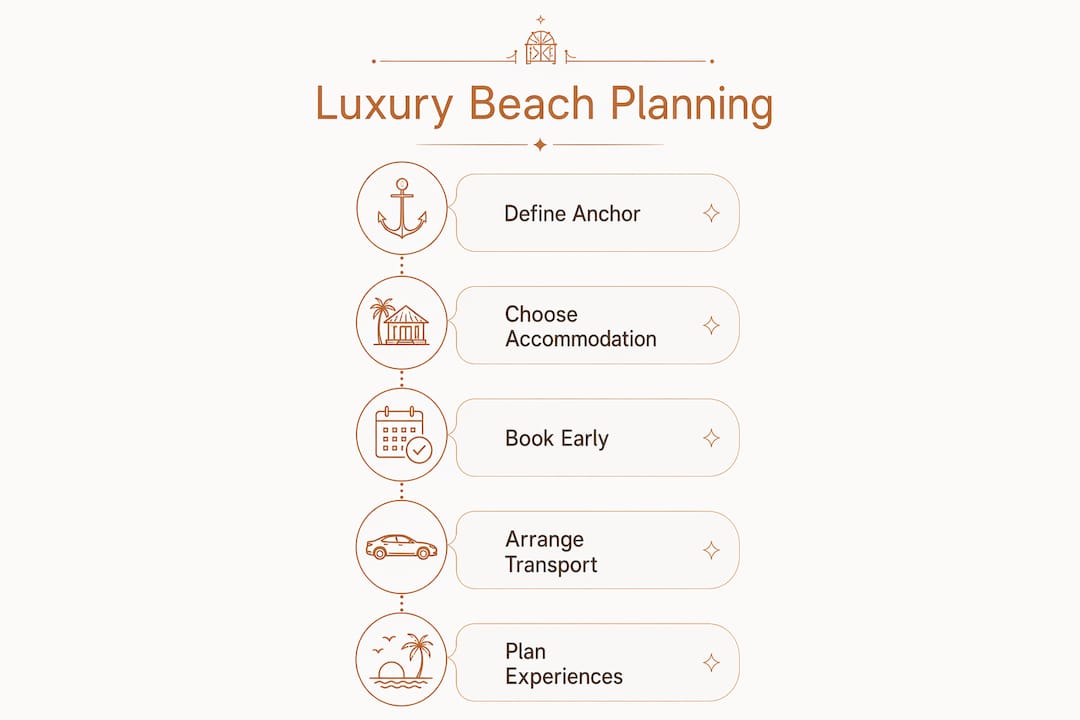
Your 5-step planning roadmap:
- Decide your anchor. Privacy, wellness, culinary, family, or adventure. One only.
- Pick a destination type that serves that anchor (private island, Gulf Coast estate, Hawaiian villa collection).
- Select a lodging category and verify management credentials before you commit a deposit.
- Lock transport and key transfers — private aviation, helicopter, or charter — before they sell out.
- Confirm bookings and brief your concierge on pre-arrival provisioning at least 30 days out.
Quick actions you can take right now: Block two potential date windows, name your anchor, and shortlist two lodging categories (private estate vs. luxury resort, for example). That prep takes ten minutes and cuts your planning timeline in half.
Pro Tip: When locking a high-demand property, always request flexible cancellation terms in writing before signing. A villa with a stunning listing and no on-site manager is a liability, not a luxury.
Table of Contents
- What is your trip’s anchor, and why does it matter?
- Which U.S. coastal destinations deliver genuine luxury?
- Which accommodation type fits your anchor?
- How far ahead should you book each element?
- What should a luxury beach vacation actually cost?
- How do you handle transport, transfers, and on-arrival logistics?
- Which experiences actually elevate a luxury beach trip?
- Three sample itineraries to visualize your trip
- How Hiddendoortravel plans and delivers a worry-free luxury beach trip
- Key Takeaways
- The trade-offs no planning guide will tell you about
- Hiddendoortravel: your next step toward a bespoke beach trip
What is your trip’s anchor, and why does it matter?
An anchor is the single non-negotiable priority that drives every downstream decision. Without one, anchor-led planning reduces scope creep and keeps lodging and logistics aligned with what guests actually came for. With one, your destination shortlist shrinks from twenty options to three, and your budget allocates itself.

Here is how each anchor converts into concrete selection criteria:
| Anchor | Key Selection Criteria | What to Demand |
|---|---|---|
| Privacy | Staff-to-guest ratio, gated perimeter, no shared beach | Minimum 1:2 staff ratio, private beach access, NDAs for staff |
| Wellness | On-site spa, treatment rooms, certified practitioners | Dedicated wellness director, daily programming, organic provisioning |
| Culinary | Private chef, full kitchen specs, local sourcing | Chef credentials, tasting menu capability, wine cellar or sommelier |
| Family | Multi-bedroom layout, child-safe pool, kids’ programming | Childproofing confirmation, babysitting credentials, activity coordinators |
| Adventure | Proximity to marine reserves, gear storage, guide access | Vetted local guides, equipment inventory, weather contingency plans |
A privacy anchor, for example, points you toward a private island or gated estate rather than a beachfront resort corridor. An adventure anchor, by contrast, favors a property close to a marine reserve or surf break, where a resort with gear storage and guide relationships outperforms a secluded villa with no operational infrastructure.
Pro Tip: Ask any villa listing agent to confirm the on-site manager’s credentials and staffing levels before you review photos. A professionally managed bespoke estate has documented emergency procedures and a named 24/7 contact. A luxury-adjacent rental has a cleaning crew and a lockbox.
The role of personalization in trip design is exactly this: not aesthetic customization, but operational alignment between what you value most and how the property actually runs.
Which U.S. coastal destinations deliver genuine luxury?
The best U.S. luxury beach destinations each serve a distinct anchor. Matching the right coast to your priority is faster than comparing amenity lists.
-
Florida Gulf Coast — Palm Beach and Naples. The Gulf Coast delivers calm water, ultra-private estates, and one of the most developed luxury villa markets in the country. Palm Beach suits culinary and social anchors; Naples and its surrounding barrier islands lean toward privacy and family. Peak season runs from late fall through early spring; hurricane season generally spans summer to fall.
-
Miami and the Florida Keys. Miami’s South Beach corridor and Fisher Island serve nightlife, culinary, and social anchors with world-class dining and art access. The Keys pivot sharply toward marine adventure: private charters, reef diving, and sport fishing. Shoulder seasons offer opportunities for lower rates and fewer crowds.
-
California’s Central Coast and Malibu. Malibu and Big Sur serve privacy and wellness anchors with dramatic coastal scenery, proximity to top-tier spa properties, and a strong private estate market. Access is almost entirely by road or helicopter; no major commercial airport sits close. Best windows are May through June and September through October, avoiding summer fog and peak holiday traffic.
-
Hawaii — Maui, Kauaʻi, and the Big Island. Maui’s Wailea corridor is the most developed luxury resort market in Hawaii, with multiple five-star properties, private villa collections, and excellent culinary programming. Kauaʻi offers the most dramatic privacy and natural scenery, with fewer crowds and a smaller property inventory. The Big Island adds volcanic landscape access and some of the best snorkeling in the Pacific. All three islands require a transpacific flight; private aviation from the mainland is available but adds significant cost. Explore remote destination options if a private-island style experience is the goal.
-
Montauk and the Hamptons, New York. Gurney’s Montauk Resort sits on one of the most dramatic oceanfront stretches on the East Coast, and the broader Hamptons market offers private estates within two hours of New York City. This corridor suits social, culinary, and short-break anchors. Peak demand is during the summer months; it is advised to book estates well in advance for these periods.
- Hurricane windows to note: Atlantic and Gulf Coast properties face elevated risk from June through November. The Pacific Coast and Hawaii are largely outside the Atlantic hurricane belt, though winter swells affect surf conditions.
- Private island access: U.S. territories including the U.S. Virgin Islands and Puerto Rico offer private island-style properties with domestic travel convenience and no passport requirement for U.S. citizens.
Which accommodation type fits your anchor?
| Type | Best Anchor Fit | Core Advantage | Main Limitation |
|---|---|---|---|
| Private villa/estate | Privacy, culinary, family | Full property control, private staff | Requires vetting; no resort backup |
| Luxury resort | Wellness, culinary, social | On-demand services, F&B variety | Shared spaces, less seclusion |
| Boutique hotel | Wellness, cultural | Intimate scale, curated design | Limited room for large groups |
| Private yacht | Adventure, romance, privacy | Mobility, total seclusion at anchor | Weather-dependent, space constraints |
Private villas and estates give you the most control but demand the most vetting. Before signing, confirm: named on-site manager with 24/7 contact, documented staffing levels, private chef capability, secure perimeter, and written emergency procedures. A villa that cannot answer those questions in writing is not ready for a high-end stay.
Luxury resorts deliver consistent service infrastructure and are the right call when your group wants variety — multiple dining venues, spa programming, kids’ clubs, and activity desks — without the operational responsibility of a private property. The trade-off is shared spaces and less privacy.
Boutique beachfront properties often punch above their size on design and personal service. Small-property collections can highlight sustainability and local character in ways large resorts cannot, and they tend to have higher staff-to-guest ratios. The limitation is capacity: they rarely accommodate groups larger than 10–12.
Private yacht charters work best as a mobility layer — either as the primary accommodation for a sailing itinerary or as a day-charter addition to a villa or resort stay. Verify operator credentials, insurance, baggage limits, and daylight-only transfer restrictions before booking.
- Hybrid options worth considering: resort villas with private staff (common in Wailea and Palm Beach) and yacht-plus-villa combos where the yacht serves as a day platform and the estate provides overnight stability.
Pro Tip: For a private estate, request the operational playbook before arrival: supplier contacts, maintenance standards, and the manager’s direct line. The gap between five-star hotel service and private-villa reality is almost always an operational one, not a design one.
How far ahead should you book each element?
| Element | Recommended Lead Time | Deposit Norm |
|---|---|---|
| Signature private estate (peak season) | 9–12 months | 25% on signing |
| Overwater villa or private island resort | 6–12 months | 25% on signing |
| High-end resort (peak holiday weeks) | 4–6 months | 1 night to full stay |
| Private jet / charter flight | 3–6 months | full prepayment |
| Yacht charter (crewed, peak season) | 4–6 months | 25% on signing |
| Helicopter or seaplane transfer | 4 weeks | Full prepayment common |
| Private chef (standalone booking) | 6 weeks | 25% on signing |
High-demand private islands and signature villas often require the longest lead times. Professional planners mitigate risk by negotiating flexible cancellation terms and staged payments at the time of booking, not after. If a property insists on fully non-refundable deposits with no flexibility, that is a contract flag worth escalating.
- If prime options are sold out: Shoulder-season swaps (early May in Hawaii, late September in the Hamptons) often free up inventory and reduce rates without sacrificing quality. Managed estate collections sometimes hold back unreleased inventory for agency partners.
- Staging payments: Spread deposits across multiple suppliers rather than paying everything upfront. An agency with preferred-partner relationships can often negotiate payment schedules that protect your cash flow.
Pro Tip: Book private aviation and yacht charters before finalizing the villa. Losing a charter slot because the estate took three weeks to confirm is one of the most common and avoidable planning mistakes in luxury trip planning.

What should a luxury beach vacation actually cost?
Budget ranges vary widely by destination, group size, and lodging type. The figures below reflect spend drivers rather than fixed prices, since actual costs depend on market, season, and supplier.
| Trip Type | Primary Cost Drivers | Where to Splurge | Where to Save |
|---|---|---|---|
| Private villa weekend (4–6 guests) | Villa rental, private chef, transfers | Chef and private aviation | Off-peak dates, bundled provisioning |
| Resort week (2 guests) | Suite rate, F&B, spa, activities | Spa programming, private dining | Loyalty points for room upgrades |
| Yacht day charter (6–10 guests) | Charter fee, fuel, crew gratuity | Full-day vs. half-day | Shared charter if privacy is not the anchor |
Where to splurge for outsized impact:
- Private transfers and aviation. The arrival experience sets the tone for everything that follows.
- Private chef or chef’s table experience. Culinary moments are the most consistently recalled part of any luxury trip.
- Privacy and staffing. A higher staff-to-guest ratio is the single biggest differentiator between a luxury-adjacent stay and a genuinely bespoke one.
Where to save without hurting the experience:
- Off-peak scheduling. Shoulder season at a top property beats peak season at a second-tier one.
- Bundled resort credits. Many luxury resorts offer pre-arrival packages that include F&B credits, spa allowances, and transfers at better value than booking each separately.
- Loyalty points for room category upgrades, not for base room rates. Points rarely unlock the best suites; preferred-partner channels often do.
Invisible costs to ask about upfront: Fuel surcharges on yacht and aviation charters, supplier service fees, staff gratuities (typically 15–20% of villa rental on private estates), and local occupancy or tourism taxes. Always ask for a total landed cost before signing.
Pro Tip: Preferred-partner programs typically add non-price value — complimentary breakfasts, resort credits, and upgrade pathways — that can make an agency-mediated booking a better net deal than a superficially lower direct rate.
How do you handle transport, transfers, and on-arrival logistics?
Frictionless arrival is not a luxury detail. It is the operational foundation that determines whether the trip feels like what you paid for from the first hour.
- Private jet vs. premium scheduled: Private aviation makes sense for groups of four or more traveling to destinations with limited commercial service (the Keys, Kauaʻi, Montauk). For two travelers flying to a major hub like Honolulu or Miami, a premium cabin on a scheduled carrier often delivers comparable comfort at a fraction of the cost.
- Regional charters and helicopter hops: Ideal for the final leg — Maui to Lānaʻi, Miami to a Keys property, or LAX to a Malibu estate. Confirm daylight-only transfer restrictions before scheduling late arrivals.
- Seaplanes: Available in select markets (the Maldives model has limited U.S. equivalents, though some Florida and Pacific Northwest operators run seaplane transfers). Verify operator credentials and insurance before booking.
- Yacht positioning: If a crewed yacht is part of the itinerary, confirm its positioning port and transit time well before arrival day. A yacht that needs 18 hours to reposition is not available for a morning departure.
Ground concierge and luggage staging are the invisible connective tissue of a door-to-villa experience. A named ground contact who meets guests at the aircraft, handles customs and baggage, and delivers everything to the villa before the group arrives is worth every dollar of the service fee.
Confirm travel protection and supplier liability coverage for all bespoke services before departure. Standard travel insurance rarely covers private charter cancellations or villa damage deposits at full value; ask your agency about supplemental coverage options.
Pro Tip: Always verify that your transport provider carries adequate liability insurance and that the policy covers the specific service type — a yacht charter operator’s marine policy and a private aviation operator’s air carrier certificate are different documents. Ask for both.
Which experiences actually elevate a luxury beach trip?
The experiences that consistently produce the strongest memories share one trait: they are impossible to replicate at home and require local access or expertise to execute well.
- Private yacht half-day with a marine naturalist guide
- Chef’s table dinner on the beach, with a custom tasting menu and local wine or spirits pairings
- Private spa programming: a full-day sequence of treatments designed around the guest, not a menu
- Guided dive or snorkel in a protected marine reserve with a certified naturalist
- Sunrise or sunset cultural immersion (a private luau, a local fishing village tour, a chef’s market run)
Booking and weather considerations:
- Reserve private dining experiences and chef’s table slots at least 4–6 weeks out; the best private chefs in high-demand markets book faster than the villas they work in.
- Marine excursions depend on weather windows. Build in a backup day and confirm the cancellation and rescheduling policy before you pay.
- Spa programming at boutique properties often requires advance notice for specialist practitioners. Ask whether the spa director can design a custom sequence rather than pulling from a standard menu.
- For high-profile guests, confirm scoped guest lists, private staging areas, and vetted local guides before any public-facing excursion.
Layering experiences for a fluid itinerary: The rhythm that works best is one high-intensity curated experience per day, with the rest of the day unstructured. Back-to-back programmed activities erode the sense of ease that defines a luxury stay. A morning dive, a long lunch, an afternoon on the water, and a private dinner is a full day. Two guided excursions, a spa session, and a cooking class is a schedule.
Pro Tip: Ask your concierge or agency to pre-stage gear, confirm weather windows 48 hours out, and hold a backup experience slot. The difference between a seamless trip and a frustrating one is almost always in that 48-hour confirmation window.
Three sample itineraries to visualize your trip
-
Couples wellness retreat — Maui, 5 nights. A private villa in Wailea with a dedicated wellness concierge, ocean-view yoga deck, and in-villa spa treatments. Day one: arrival by private charter from Honolulu, pre-staged provisioning with organic groceries and local flowers. Days two and three: morning spa sessions, afternoon snorkel in Molokini Crater with a marine naturalist, private sunset dinner on the lanai. Day four: helicopter tour of the Road to Hāna coastline, followed by a chef’s tasting menu. Day five: open. Budget drivers: villa rental and private chef are the largest line items; lock both 6–9 months out. Swap the helicopter for a private catamaran if weather conflicts.
-
Multigenerational family week — Florida Gulf Coast, 7 nights. A six-bedroom private estate on a barrier island near Naples, with a pool, private beach, and on-site activity coordinator. Daily rhythm: morning beach and water sports, afternoon downtime, evening family dinners prepared by the private chef. Mid-week: a private boat charter to a nearby marine sanctuary for snorkeling. One evening: a private fireside dinner on the beach with a local storyteller. Budget drivers: estate rental, private chef, and the boat charter. Lock the estate 9–12 months out for peak season. If the estate is unavailable, a resort villa collection with private staff is the closest substitute.
-
Friends adventure long weekend — Florida Keys, 4 nights. A boutique waterfront property in Islamorada, with direct dock access and a crewed sport fishing charter booked for day two. Day one: arrival by private charter from Miami, afternoon reef snorkel. Day two: full-day offshore fishing charter. Day three: kayaking through a backcountry mangrove preserve, followed by a private chef dinner featuring the day’s catch. Day four: open morning, afternoon departure. Budget drivers: sport fishing charter and private aviation from Miami. Book the charter 4–6 months out; it is the hardest element to replace. A bespoke itinerary approach works especially well for adventure-anchored trips where logistics are tightly sequenced.
- For any itinerary, identify the single hardest-to-replace element (private chef, yacht, signature villa) and book it first. Everything else can flex around it.
How Hiddendoortravel plans and delivers a worry-free luxury beach trip
Hiddendoortravel’s planning process starts with a discovery call that defines the anchor, guest profile, mobility needs, and non-negotiables before any destination is proposed. That sequence matters: common planning mistakes like under-vetting villa management or skipping pre-arrival provisioning almost always happen when a destination is chosen before the operational requirements are understood.
The agency’s process from first contact to post-trip:
- Discovery call: anchor definition, guest count, dates, budget range, top three non-negotiables
- Supplier vetting: management credentials, staffing levels, emergency procedures, insurance verification
- Proposal and booking agreement: staged payment schedule, flexible cancellation terms where available
- Pre-arrival provisioning: pantry stocked to guest preference, vintages secured, gear pre-staged
- On-site support: named concierge contact, 24/7 manager access, supplier coordination
- Post-trip follow-up: debrief and preference capture for future trips
Why agency access changes the outcome: Working with a luxury travel agency unlocks preferred-partner benefits — complimentary breakfasts, resort credits, upgrade pathways — that direct booking rarely delivers. More importantly, it transfers the operational risk of vetting suppliers, managing contracts, and coordinating logistics to a team with established relationships and accountability.
Before you contact Hiddendoortravel, prepare: guest count, two date windows, your anchor, a rough budget range, and your top three non-negotiables. That brief takes five minutes and allows the agency to return a substantive proposal rather than a generic brochure.
Pro Tip: Ask any agency you evaluate for a sample booking agreement and a named supplier contact for a past client property. An agency that cannot provide either has not done the vetting work that justifies the service fee.
Key Takeaways
Anchor-led, concierge-coordinated planning is the single most reliable way to convert a luxury beach vacation budget into an experience that actually delivers what you came for.
| Point | Details |
|---|---|
| Start with one anchor | Define privacy, wellness, culinary, family, or adventure first — every other decision follows from it. |
| Book hardest elements first | Signature villas and private charters sell out 6–12 months ahead; lock them before anything else. |
| Ask for total landed cost | Fuel surcharges, gratuities, and local taxes are real budget lines — always request a full cost breakdown. |
| Preferred-partner perks add real value | Agency-mediated bookings often include credits and upgrades that outperform a lower direct rate. |
| Hiddendoortravel handles end-to-end logistics | From anchor definition and supplier vetting to pre-arrival provisioning and on-site support, the agency manages the full planning sequence. |
Your next three steps:
- Pick your anchor and block two date windows today.
- Shortlist two lodging categories and request management credentials from any estate you consider.
- Contact Hiddendoortravel with your guest count, dates, anchor, budget range, and top three non-negotiables.
Pro Tip: Prepare a one-paragraph brief before your first agency call: who is traveling, when, what matters most, and what you absolutely will not compromise on. That brief cuts the discovery process from three conversations to one.
The trade-offs no planning guide will tell you about
The conventional wisdom on luxury beach travel is that the right destination solves everything. It does not. The destination is the backdrop. What actually determines whether a trip delivers is the operational layer underneath it: who manages the property at 11 PM when the generator fails, whether the private chef has a backup plan when the fish market is closed, and whether the transfer from the airport to the villa takes 25 minutes or two hours because no one confirmed the ground contact.
The most common real-world trade-off I see is between the aspirational property and the operationally sound one. A villa with a more modest view and a named, credentialed on-site manager will outperform a stunning estate with absentee management every single time. The same logic applies to experiences: a private chef who has cooked at the property before and knows the kitchen will produce a better dinner than a celebrated chef parachuted in from the mainland who has never seen the stove.
The other trade-off worth naming is weather versus exclusivity. The most private properties in Hawaii and the Keys are often the most exposed to weather disruption. Building a backup experience into every high-stakes day — a private catamaran instead of the yacht if swells are up, an in-villa chef’s table if the beach dinner is rained out — is not pessimism. It is what separates a planner from a booking engine.
Hiddendoortravel: your next step toward a bespoke beach trip
Most travelers who reach this point have a clear anchor, a destination shortlist, and a rough sense of budget. What they do not have is the supplier relationships, the contract leverage, and the operational experience to turn that clarity into a trip that actually runs the way it should.
Hiddendoortravel specializes in exactly this: bespoke luxury beach vacation planning for travelers who know what they want and who need a partner who can deliver it without the operational friction of doing it alone. The agency handles discovery, supplier vetting, staged payments, pre-arrival provisioning, and on-site coordination — from the first call to the post-trip debrief. Preferred-partner relationships with villa collections, resort groups, and charter operators mean access to inventory and inclusions that are not available through direct booking.
To get started, prepare your guest count, two date windows, your anchor, a rough budget range, and your top three non-negotiables. Then reach out to the luxury travel experts at Hiddendoortravel for a discovery call and a tailored proposal. Response is typically within one business day.