
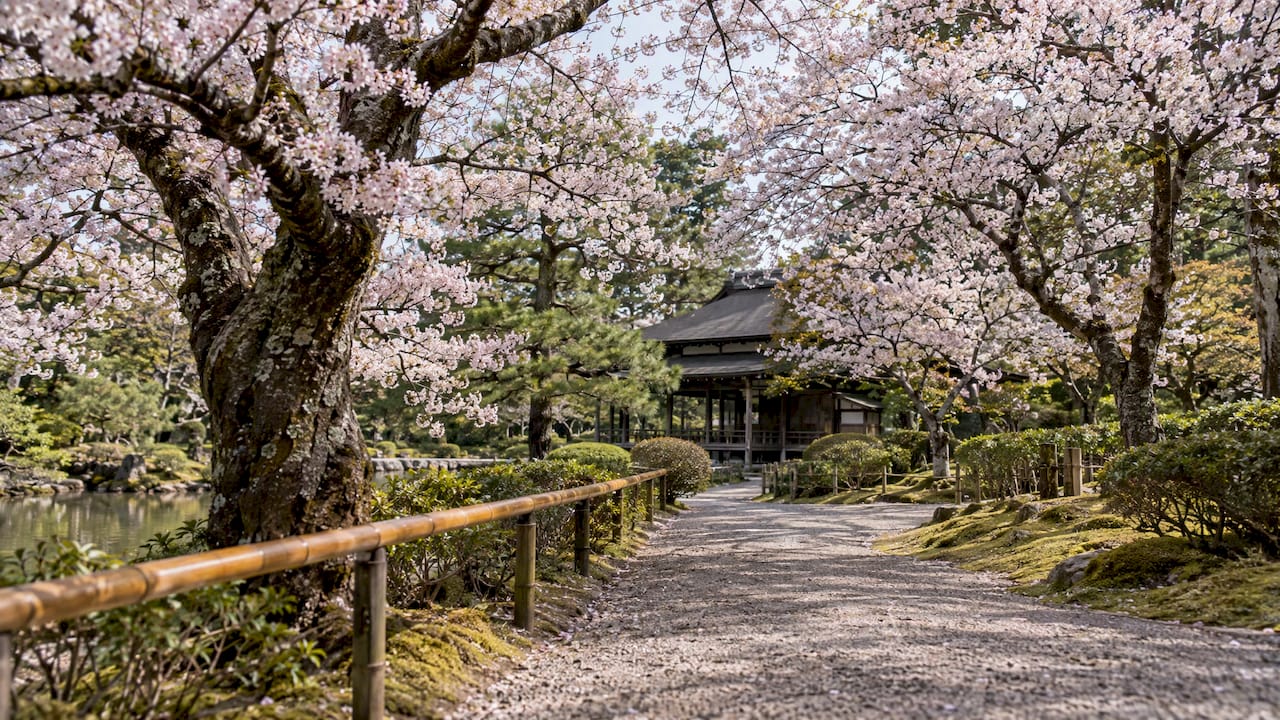
A luxury cherry blossom trip to Japan comes down to one problem: the trees bloom for only about a week, and no one can name the exact days a year ahead. The way to solve it is to build the trip around a moving window rather than a fixed date. That means choosing the right regions, staying flexible on a few days, and having someone on the ground who can reshuffle the plan when the forecast shifts. Below we cover when to go, where to see the blossoms away from the crowds, how spring cruises fit in, and what to expect from a private tea ceremony in Tokyo.
TL;DR
- Blossoms last only seven to ten days in any one place, and the season sweeps north from mid-March to early May.
- For major-city trips booked far ahead, Japan’s national tourism organization advises aiming for the end of March, then adjusting once the official forecast is updated.
- Spanning several regions, or adding a spring cruise, widens your chances of seeing peak bloom.
- Quiet settings such as a river cruise in Toyama or a castle festival in the north beat the famous parks at peak weekends.
- A bespoke plan with flexible days and pre-arranged experiences protects the trip if the bloom comes early or late.
Table of Contents
- When to go: bloom timing by region
- Why planning around blossoms is risky, and how to hedge it
- Less-crowded places to see the blossoms
- Spring cruises along the Japanese coast
- A private tea ceremony in Tokyo
- What else belongs in a luxury blossom week
- Our perspective
- Plan your Japan cherry blossom trip with us
- FAQ
- Sources
When to go: bloom timing by region
The sakura front does not arrive everywhere at once. It starts in the far south and climbs the country. According to ANA’s travel planner, the wave begins in Okinawa in mid-January, peaks in Tokyo and Kyoto between late March and early April, and ends in Hokkaido in late April to May.
The 2026 forecast from Japan’s national tourism organization (JNTO), which cites the Japan Weather Association, shows how wide the spread is. These are the published first-bloom dates for that year:
| City or region | 2026 forecast first bloom |
|---|---|
| Kochi (Shikoku) | March 16 |
| Tokyo | March 19 |
| Osaka | March 26 |
| Sendai | March 31 |
| Sapporo | April 19 |
| Kushiro (Hokkaido) | May 5 |
Source: JNTO cherry blossom forecast, 2026. Most of those 2026 dates trended early to very early compared with the long-term average, so treat them as an example of the pattern, not a calendar for next year. The forecast is issued at the start of each year and updated often as spring approaches, so the current year’s figures are on the same page.
First bloom is not the moment you want. Full bloom comes some days later, and the petals fall soon after. That is why the useful planning unit is the week, not the day.
The weather you will pack for
JNTO’s spring guide says that during the season most of Japan sits around 12 degrees Celsius, about 54 degrees Fahrenheit, so light outerwear and sweaters are enough. Evenings under illuminated trees feel cooler than the afternoon, so a cashmere wrap earns its place in the case.
Why planning around blossoms is risky, and how to hedge it
JNTO itself is candid about this. Its honeymoon guide calls planning around cherry blossoms a risky business, because bloom timing is not an exact science. Its advice for major cities booked far in advance is to aim for the end of March, when there is a high chance of seeing at least some blooms. It also notes that spring is a lovely time to visit even if you miss the peak, with mild, generally clear weather until the June rainy season.
For a luxury traveler, the stakes are higher than for a backpacker. You are committing to specific rooms, a private guide, a table at a restaurant and perhaps a cabin on a ship. A week’s error costs real money and a disappointing view. Four tactics reduce that risk.
- Stay long enough to move. A trip of ten to fourteen days gives you room to shift regions as the front advances. Our luxury Japan itinerary guide for 10 and 14 days shows how those days can be paced.
- Build in two bloom zones. Pair Tokyo and Kyoto with a northern stop, or a southern one, so that if the capital peaks early you still have trees ahead of you. ANA’s planner makes the same point: itineraries spanning multiple regions extend viewing time.
- Hold the bloom-sensitive pieces loosely. Private garden visits, boat outings and picnic setups depend on the trees. Book the hotels and flights firmly, and sequence the weather-dependent experiences in the middle of the trip, where they can swap days.
- Watch the forecast as a team. Once the official forecast starts updating, someone should be reading it for you and rebooking guides and transfers accordingly.
The fourth point is where a travel advisor earns the fee. Changing a guide, a car and a restaurant booking in three cities in a day is easy to describe and tiring to do from a hotel lobby.
Less-crowded places to see the blossoms
The famous parks in Tokyo and Kyoto are lovely, and they are also packed at peak. Luxury travelers usually want the opposite: space, quiet and a sense of occasion. Several settings deliver that.
On the water in Toyama
JNTO describes the Matsukawa River cherry blossom cruise in Toyama as a boat-based hanami, the Japanese custom of viewing blossoms, that runs throughout April and passes a corridor of some 500 blossoming trees along the former castle moat. Boats leave near the Matsukawa Tea House, a ten-minute walk from Toyama Station. It suits a trip that continues north after the main cities, when Tokyo is already past peak.

Castle festivals in the north
JNTO’s March 2026 press release highlights festivals timed to the northern bloom. They include Takada Castle Park in Niigata, with more than 3,000 paper lanterns, Kakunodate in Akita, and Hirosaki Castle Park in Aomori, which has more than 2,500 cherry trees and the oldest Somei-Yoshino tree. These run from mid-April into early May, which makes them a natural second act after a late-March start in Tokyo or Kyoto.

Kenrokuen and Hirosaki
ANA’s planner also points to Kenrokuen in Ishikawa and Hirosaki Castle in Aomori as places where blossoms and history sit together. They are good candidates for a private guide who can time the visit for early morning, before day-trippers arrive.
Sumida River in Tokyo
The Sumida River is the easy city option. Tokyo Cruise’s official page lists its 2026 cherry blossom cruise as running from March 20 to April 5 depending on bloom conditions, by advance reservation only. Prices that year were ¥1,000 for an adult one-way ride from Asakusa to Hinode Pier, or ¥2,500 for the 45-minute loop. It is a pleasant public ride. A private charter on the same river is a different experience, and it is the kind of exclusive access we arrange for clients.
Spring cruises along the Japanese coast
A cruise can solve the timing puzzle in a way a land itinerary cannot, because the ship itself moves with the season. Several small ships sail Japanese waters in spring, and the bloom is built into their calendars.
Mitsui Ocean Fuji is the clearest example. CruiseFever reports that its voyages run from 5 to 11 days with roundtrip departures from Tokyo, Yokohama, Nagoya and Kobe, and that the line designs its calendar to catch peak bloom along the coast between March and May.
Luxury Travel Advisor lists the 2026 spring program, which shows how a season can be sequenced:
| Voyage | Start | Length | Route highlights |
|---|---|---|---|
| Sakura Serenade | March 18 | 6 nights | Nagoya, Kochi, Uwajima, Nakatsu, Busan |
| Petals & Ports | March 30 | 7 nights | Tokyo, Ibusuki, Sasebo, Busan, Kobe |
| Echoes of the Sea | April 6 | 9 nights | Coastal Japan |
| Golden Week | April 29 | 11 nights | From Yokohama |
Source: Luxury Travel Advisor, 2026 Mitsui Ocean Fuji itineraries. Voyages include a range of beverages and Wi-Fi. Mitsui’s head of sales for North America describes the program as aimed at discerning travelers who want an authentic cultural experience on an all-suite ship. Dates differ each year, so confirm the current schedule before you plan around any of these.
Why a cruise suits the blossom chase
The southern departures in mid-March meet the front early in places like Kochi, and the later voyages meet it further north or on the Golden Week holiday. You unpack once, and the ports are chosen for the season. A cruise also pairs well with a land stay: a few nights in Tokyo or Kyoto before or after the ship gives you a second chance at the blossoms if the ship’s timing misses.
Two practical points. Flights are the part people forget; our guide to how cruise air programs work explains when a bundled air option makes sense. And drinks inclusions vary widely between lines, so read our breakdown of luxury cruise drink packages before comparing fares. For choosing between routes, selecting a luxury cruise itinerary that fits you walks through the questions that matter.
A private tea ceremony in Tokyo

A tea ceremony is the quietest of the great Japanese rituals, and it pairs naturally with sakura season, when the seasonal sweets and the tea-room setting echo what is blooming outside. JNTO’s luxury travel guide describes it as an essential cultural experience in which guests are served matcha and small sweets in a ritual dating to the 16th century. The same guide notes that Kyoto is the best location for exclusive traditional tea ceremonies, so a trip that includes both cities can place a private session wherever it fits the days best.
What to know before you go:
- Private means a host for your party alone. The pace is yours, and there is time for questions about the utensils and the etiquette.
- Dress simply and comfortably. You will sit for a while, often on a floor or low seat, so loose, modest clothing helps. Tell your planner about any mobility needs in advance so the setting can be matched.
- Schedule it on a flexible day. A tea ceremony does not depend on the blossoms, which makes it an ideal filler for a day when the weather or the bloom does not cooperate.
- Think of it as part of omotenashi. JNTO says that omotenashi, Japan’s tradition of wholehearted hospitality, is thought to have roots in the tea ceremony, and that its attention to detail can only be understood firsthand.
If you want a private ceremony in Tokyo as part of a blossom trip, we can include it in a custom itinerary and place it on the day that suits the forecast best.
What else belongs in a luxury blossom week
Beyond the trees themselves, Japan’s luxury offering is deep. JNTO notes that Tokyo consistently ranks as the city with the most Michelin-starred restaurants in the world, with Kyoto and Osaka not far behind. It also describes sleeper trains such as the Seven Stars in Kyushu and JR West’s Twilight Express Mizukaze as hotel-like journeys with fine dining and off-board excursions. Both are worth considering as a way to connect regions during a bloom chase, because the journey becomes part of the trip rather than a gap in it.
Spring is also high season for rooms with garden views, and the best of those go first. That favors early booking of hotels, with the bloom-dependent experiences kept flexible. For the cultural side of a trip like this, our luxury cultural immersion guide covers how to build depth into a destination. If you are tempted by a quieter shoulder period, see why off-peak luxury travel delivers more, because a week either side of the peak often brings softer crowds with blossoms still on the branches in some regions.
Our perspective
Cherry blossom trips fail in one predictable way: the traveler books everything tightly around a date, and the trees do not agree. We have spent more than 20 years planning complex journeys, and the lesson is that flexibility has to be designed in from the start.
For Japan, that means treating the trip as a sequence of options. Hotels and flights are fixed early. The garden visits, the river outings and the tea ceremony are placed where they can move. If the bloom runs early, the plan shifts south or compresses. If it runs late, it shifts north.
That is also why we plan these trips as bespoke itineraries and not packages. A standard tour cannot rearrange itself in a day. A planner with destination knowledge and relationships with partners on the ground can, and that is what you are paying for. Our guide to designing a bespoke itinerary explains how we think about it.
The best blossom trips we imagine are not the ones with the most famous parks. They are the ones where you stand under a quiet tree at the right hour, with nobody else there, because the plan made room for it.
Michael
Plan your Japan cherry blossom trip with us
We design custom itineraries, book hotels and cruises, arrange transportation and set up exclusive experiences for travelers who want a trip built around them. For a Japan blossom journey, that means a plan with bloom-aware sequencing, flexible days and the hotel, cruise and private experience bookings handled in one place. Start with our vacation planning and tour and cruise package services, or tell us your preferred dates and we will shape the route from there.

If you want to see how a longer route comes together first, read our luxury Japan itinerary guide.
FAQ
When is the best time to see cherry blossoms in Japan?
For Tokyo, Kyoto and Osaka, late March to early April is the usual window. JNTO advises aiming for the end of March when you book major-city trips far in advance. Further north, the bloom continues through April and into early May.
How long do the blossoms last?
In any one place they bloom for only seven to ten days. Wind or rain can shorten that. This is why a route across several regions gives you a better chance of catching full bloom.
Is a cherry blossom cruise worth it?
A cruise is a good fit if you want to meet the bloom at several ports without repacking. Some Japanese-flagged luxury ships schedule their spring sailings around peak bloom along the coast. Pairing a voyage with a few nights on land gives you a second chance if timing slips.
Can I book a private tea ceremony in Tokyo?
Yes, a private session can be part of a custom itinerary. JNTO describes the ceremony as a ritual of matcha and small sweets dating to the 16th century. Tell your planner your dates and any mobility needs, and it can be placed on a flexible day.
What if the blossoms come early or late?
That is the main risk, and the answer is flexibility. Keep the hotels and flights fixed, and place bloom-dependent experiences where they can move. The official forecast is updated frequently as spring nears, so your plan can follow it.
Sources
- JNTO: Spring in Japan, cherry blossom forecast
- JNTO: Japan’s cherry blossom season moves north as spring unfolds
- JNTO: Seasonal guide to honeymoons in Japan
- JNTO: Spring guide
- ANA: Journey through Japan’s cherry blossom season
- JNTO: Matsukawa River cherry blossoms
- Tokyo Cruise: Sumida River cherry blossom cruise
- Luxury Travel Advisor: Mitsui Ocean Fuji 2026 itineraries
- CruiseFever: Japanese cruise line that schedules sailings around cherry blossoms
- JNTO: Luxury travel in Japan