
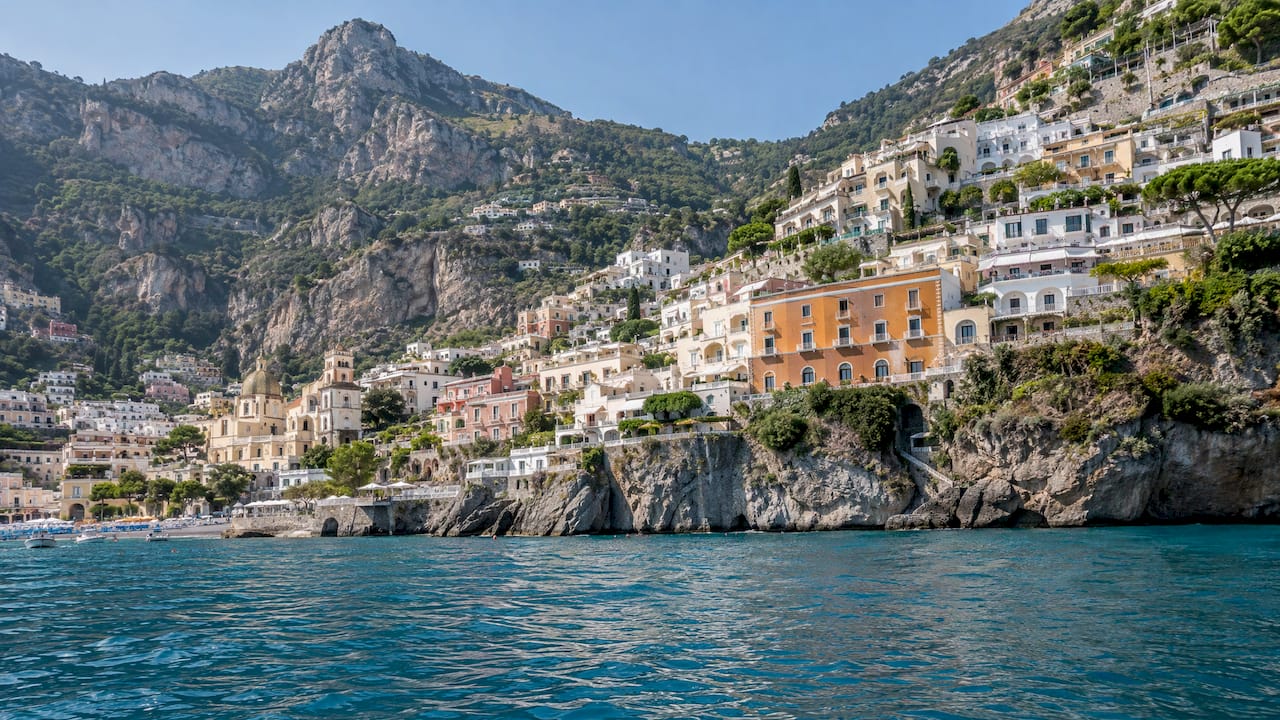
A luxury Amalfi Coast trip is won or lost on three decisions: which town you base yourself in, which month you travel, and how you move between the cliffs, the sea and the table. Get those right and the coast delivers the glamour it is known for. Get them wrong and you spend the trip on staircases, in traffic or in a crowd. At Hidden Door Travel we plan this coast as a bespoke trip, with hotels, transfers and the boat day arranged around you, and the sections below show why those choices matter so much.
TL;DR
- Choose the base by temperament: Positano for glamour and the best beach scene, Amalfi for ease and ferry access, Ravello for quiet, views and culture.
- In Positano, the room category matters more than the star rating, because the hotels are built down a cliff and the view and the walk both depend on which room you hold.
- May to June and September to early October are the usual sweet spots. July and August are the hottest, busiest and most expensive months.
- The best way to see the coast is from the water, and the best way to move along it is by ferry or private transfer rather than by driving the coast road.
- Plan at least five days, and have every transfer, drop-off point and boat day arranged before you land.
Table of Contents
- What makes the Amalfi Coast a luxury destination
- Positano, Amalfi or Ravello: choosing your base
- Luxury hotels in Positano: what to look for
- The best time to go
- Seeing the coast from the water
- Getting there and getting around
- How long to stay and what to include
- Our perspective
- Plan your Amalfi Coast trip with us
- FAQ
- Sources
What makes the Amalfi Coast a luxury destination
UNESCO describes the Amalfi Coast as an outstanding example of Mediterranean landscape: green mountains dropping into turquoise water, with historic centers of colorful stacked houses, whitewashed alleys and flower-filled balconies. That is the draw, and it is also the constraint. The coast is a narrow shelf of towns on cliffs, with one winding road, few flat surfaces and almost no room to build anything new.
For that reason, luxury here means something specific. It is rarely about size or novelty. It is about position: a terrace with an unobstructed view, a private path to the water, a driver who knows which drop-off point your hotel uses, a boat that leaves when you want it to. Those things are arranged ahead of time, not found on arrival.
Positano, Amalfi or Ravello: choosing your base
The three towns suit three different trips. Condé Nast Traveler’s hotel guide describes Positano as the most picturesque, with colorful cliffside houses and a see-and-be-seen atmosphere, but also the most tiring base because of its steps. Amalfi is historic and central, with public transport reaching along the coast. Ravello sits above the coast, with sweeping views, a peaceful and romantic mood and far fewer crowds, though it does not suit beach lovers.
| Positano | Amalfi | Ravello | |
|---|---|---|---|
| Character | Glamorous, vertical, social | Historic, central, practical | Quiet, romantic, cultural |
| Beach | Yes, in town | Yes, in town | None, it is up on the ridge |
| Getting around | Steps everywhere | Easiest hub for buses and ferries | Bus or taxi from Amalfi |
| Best for | First-time visitors, couples, scene | Mobility, day trips, a central base | Honeymoons, culture, escape |
A few details sharpen the choice. Ravello is a short bus or taxi ride up from Amalfi, so it is the right pick when stillness matters more than a beach on your doorstep. If you want the sea at your feet and an evening scene, Positano wins. If you are planning several day trips by ferry, Amalfi’s central position saves time.
One caution applies to every base: none of the Amalfi Coast areas is easy for anyone with limited mobility, because of the abundant steps and winding lanes. If that is a concern in your party, say so at the start of planning, so the property, the room level and the transfers are chosen around it.
Splitting the stay
Many of the best trips use two bases rather than one. A split such as several nights in Positano followed by a few in Ravello gives you the sea and then the stillness. The one thing to avoid is moving more often than that. Every change means luggage, steps and a transfer, which is the opposite of what a luxury holiday is for.
Luxury hotels in Positano: what to look for
Positano is where most luxury searches end up, so it deserves a closer look. Two properties come up repeatedly in Vogue’s Amalfi Coast guide:
- Le Sirenuse is the Sersale family’s boutique hotel, opened in 1951 and made famous when John Steinbeck wrote about it in 1954. It was named the 20th best hotel in the world by The World’s 50 Best in 2023. It has a spa, pool, hammam and a Michelin-starred restaurant with an oyster bar.
- Il San Pietro di Positano is a family-run property of more than 50 years, with 56 rooms cascading down the cliffside, a private beach, a spa, a pool, boat tours and kayaking, and two restaurants, one of them Michelin-starred.
Both are worth knowing, but the name on the door is only part of the decision. Four things shape how a Positano stay actually feels.
The room matters more than the hotel. One Positano hotel guide makes the point that position matters more than star ratings. The advice is to book a category that guarantees the full view rather than one labeled partial or side view, and to confirm the specific room’s outlook before paying. It also warns that the entry-level room at a top hotel is often a false economy.
The vertical layout is real. Condé Nast Traveler advises choosing a Positano hotel carefully, because the walk from the beach back up the cliff is no small feat. Hotels with a private lift, a beach reached by elevator or a central position in the village change the daily experience.

Book early for the best months. For May to September, the same Positano guide suggests booking six to nine months ahead. The best view categories at the best properties are the first to go.
Stay put. Moving around Positano with luggage is not charming. Pick one hotel for the Positano portion of the trip and make it the right one.
If Positano appeals but the steps do not, the answer is usually a better-placed room, not a different town. That is exactly the kind of detail we weigh when we book a stay for a client, matching the property and room category to how you want to spend your days.
The best time to go
The coast has a clear season, and luxury travelers tend to cluster at its edges. The Knot’s honeymoon guide calls May to June and September to early October often the best time, with July and August very hot and crowded, and the coast largely shutting down toward the end of October. Vogue agrees that July and August bring a sparkling sea and high-eighties temperatures, but are also the most crowded and expensive months, while September and October suit travelers who want culture once the crowds disperse.
At the other end of the year, Lonely Planet notes that from November to March many restaurants and hotels close and ferry and bus services are much more limited. A luxury trip needs the full range of options open, which points to late spring or early autumn.
A quick way to decide:
- Late May to June: warm, green, the coast fully open, and the sea warming up.
- July and August: the classic beach-and-boat summer, if you accept the heat and the crowds.
- September to early October: warm water, thinning crowds, and a calmer pace in the restaurants.
The Ravello Festival, which Lonely Planet-style guides and The Knot list among the highlights of the region, also runs through the summer, so music lovers can build a stay in Ravello around it. Check the festival’s official page for the current program before fixing dates.
If you are combining the coast with a cruise or other destinations, our guide to cruising seasons explains how timing affects what is available.
Seeing the coast from the water
The single best way to understand the Amalfi Coast is from a boat. Vogue’s guide says a day out on the water is the best way to see it, and names the Grotta dello Smeraldo as the most popular swimming spot and Marina di Praia in Praiano as a good public beach club with a strong lunch restaurant. The Knot, quoting a travel expert, suggests a route that circles the Li Galli islands and goes around Capri, with a lunch stop at a beach club and a pass by the Faraglioni rock formations.
A private boat day lets you set the pace: a late start, a swim where the water is calm, a long lunch, and no shared schedule. When you plan it, think through these points:
- The route. Positano to Capri and back is a different day from a slow run along the coast toward Amalfi and Praiano. Decide whether you want islands, grottos or towns.
- The pier. Know where you board. In Positano and Amalfi, access can involve steps and a short walk, which affects what you carry and wear.
- Lunch. Reserve the beach club or restaurant ahead in the high months. A boat day without a table is a wasted afternoon.
- The weather window. The sea changes. Build the boat day into a trip with some flexibility, not onto the last day.
This is a place where bespoke planning does real work. We arrange transportation and concierge details as part of a custom itinerary, so the boat, the lunch and the transfers back to your hotel are one plan rather than separate bookings.
Getting there and getting around
There is no railway along the coast itself, so the arrival is by road or sea. Most international visitors fly into Naples, and from there the coast is a drive away. Lonely Planet reports that Salerno Costa d’Amalfi Airport began welcoming flights from Spain, France and other parts of Italy in July 2024, with shuttle buses to nearby towns. That helps on a European routing, but for most travelers from the US, Naples remains the practical gateway.
Once you are there, the choice is between the road and the sea.
The road. The SS163 is the coast’s only main road, and it is slow and congested in summer. Lonely Planet notes that since 2023 even-numbered plates are banned on even-numbered days during Easter week, in August and on weekends between June 15 and September 30, with the equivalent restriction for odd plates. That is one reason a private driver is the usual luxury answer, rather than a rental car.
The sea. Lonely Planet calls the ferry the best way to travel between towns. Ferries skip the traffic and give you the view from the water. They only reach the coastal towns, so Ravello always involves a road leg.
A few practical points shape a luxury itinerary:
- Many hotels in Positano and Amalfi are reached from a set drop-off point rather than a street address, so a driver who knows the hotel matters.
- Luggage and steps are the real enemy. Ask where the nearest drop-off is, how many steps follow, and whether porters are available.
- Ferry and bus service is much thinner outside the main season, so a trip in the shoulder months leans more on private transfers.
We handle air, hotel and car bookings together with the rest of the plan, so arrival, transfers and the first night at the hotel line up. If you are connecting the coast with Rome, Capri or another stop, our article on designing a multi-destination luxury trip covers the sequencing.
How long to stay and what to include
Lonely Planet suggests at least five days to see Positano, Ravello, Maiori and Furore without rushing. For a luxury trip that is a reasonable floor, not a target. Six to eight nights allows a split stay, a boat day, a long lunch in the hills, an evening in Ravello and at least one day with nothing planned.
A well-built itinerary usually includes:
- Two bases at most, chosen for contrast (sea, then ridge).
- One full private boat day, placed mid-stay.
- One cultural evening, such as a concert in Ravello in summer.
- One or two long, reserved lunches rather than a string of dinners.
- Private transfers at each change of base and on arrival and departure.
The point of a plan like this is not to fill every hour. It is to remove friction, so the hours you do spend are the ones you came for. The role of itinerary design in luxury travel explains how we think about pacing.
Our perspective
The Amalfi Coast is a place where small details carry the whole trip. A room one category lower can mean a blocked view. A hotel one street over can mean forty more steps with luggage. A boat booked the day before in August can mean a lunch spot with no table.
We build trips for travelers who want those details settled before they leave home. With more than 20 years of industry experience, direct destination knowledge and relationships with elite partners, our approach is to plan the whole coast as one design: where you sleep, how you arrive, when you are on the water, and what is reserved for you.
That is also why we plan complex trips that others find too difficult. A multi-stop itinerary, a family spanning generations, a destination wedding on the cliffs, a cruise that ends in Naples: each one is easier when one team holds the whole plan and the relationships behind it.
If you are weighing Positano against Ravello, or a July sailing against a September stay, we would rather talk it through with you than leave you to guess.
Michael
Plan your Amalfi Coast trip with us
We plan bespoke luxury trips, including custom itineraries, hotel and cruise bookings, transportation arrangements and concierge service. For the Amalfi Coast, that means a single plan covering your base or bases, your transfers, your boat day and the access that suits your dates.
To start, tell us when you want to travel, who is coming and what a perfect day looks like. You can see how we work on our luxury travel agency page, read what planning fees cover, or go straight to our vacation planning and tour and cruise services. If the coast is part of a larger beach holiday, our luxury beach getaway roadmap is a good companion.
FAQ
Which is better, Positano or Amalfi?
It depends on what you want from the stay. Positano is the more glamorous and photogenic base, with the stronger social scene, but it is steep and tiring. Amalfi is more central and practical, with easier access to buses and ferries. Travelers who put atmosphere first usually choose Positano, and those who plan many day trips often prefer Amalfi.
What are the best 5-star hotels on the Amalfi Coast?
In Positano, Le Sirenuse and Il San Pietro di Positano are the two most often cited, and both have Michelin-starred restaurants. Which suits you depends on the room category, the view and how much walking you want. We match the property and the room to your trip, then book it as part of your itinerary.
What is the best month to go to Amalfi?
May to June and September to early October are generally the best, with warm weather and fewer crowds than July and August. Late October and winter bring closures and reduced ferry and bus service. If you want a swimming-focused summer trip, plan around the heat and book early.
How should I plan a private boat tour?
Decide the route first, whether Capri and the Li Galli islands or a slower run along the coast. Then confirm your boarding pier, reserve a lunch stop and keep some flexibility for weather. We arrange these pieces together with your hotel stay and transfers.
How many days do I need?
At least five days is a sensible minimum, and six to eight nights suits a luxury pace, especially if you split your stay between two towns. Allow for arrival and departure transfers in addition to the days on the coast.
Sources
- At These Amalfi Coast Hotels, the Only Thing Better Than… (Condé Nast Traveler)
- Amalfi Coast Guide: Where to Stay, What to Do (Vogue)
- Amalfi Coast Honeymoon Guide (The Knot)
- Top tips for travel to Italy’s Amalfi Coast (Lonely Planet)
- Travel the Amalfi Coast on public transit (Lonely Planet)
- Where to Stay on the Amalfi Coast (The Hotel Guru)
- Best Luxury Hotels in Positano: Where to Stay in Style