
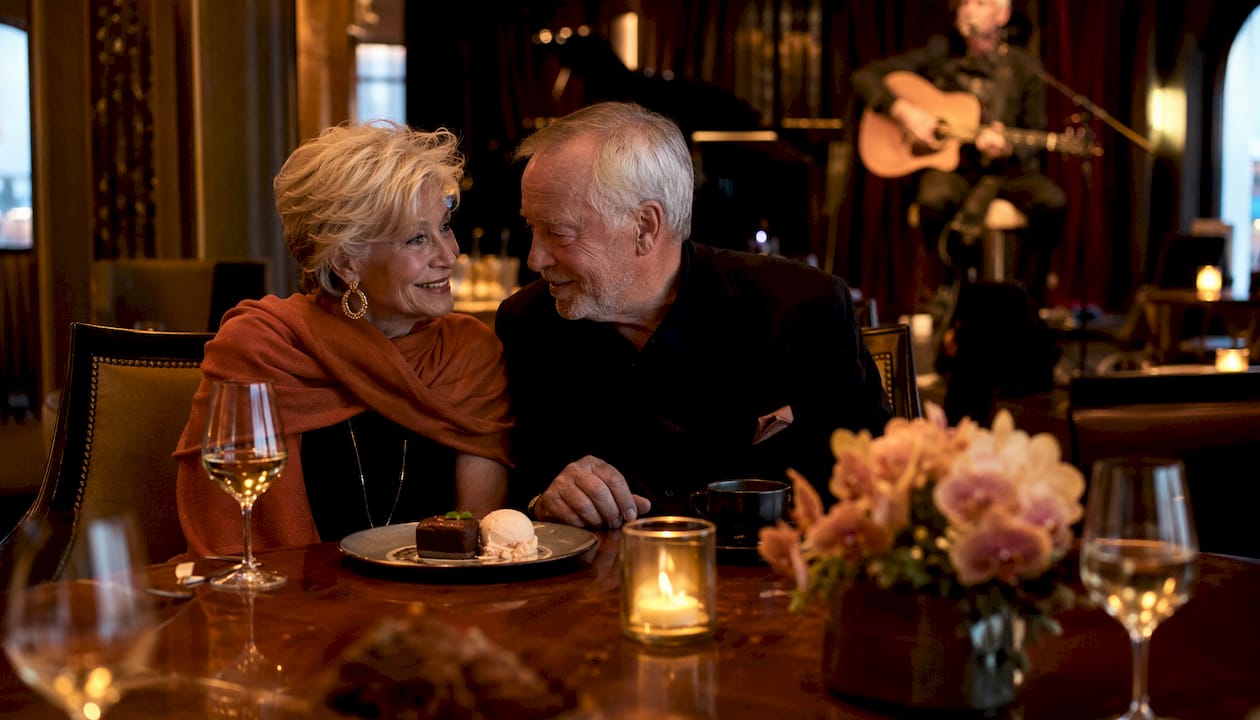
Luxury cruise entertainment is not a show schedule. It is an atmosphere, a curated world that wraps around you from the morning wellness ritual on deck to the late-night theatrical event in a converted dining salon. The short version: on a true luxury voyage, entertainment and enrichment are woven into every hour of the day, not cordoned off into a two-hour evening production.
Here is what that looks like in practice:
- Theatre and main-stage productions — original works, Broadway-style revues, and bilingual cast performances with high-production staging
- Intimate live music — jazz duos, classical recitals, piano bars, and cabaret in small-venue settings
- Enrichment lectures and discovery programs — guest experts, curated speaker series, and destination-focused panels
- Wellness and culinary programming — chef’s table events, sommelier tastings, guided meditation, and movement rituals treated as core experiences
- Bespoke and themed events — immersive theatrical dining, gala deck parties, and invitation-only salon evenings
- Late-night social experiences — silent discos, hosted DJ nights, and interactive music formats
Table of Contents
- How luxury cruise entertainment differs from mainstream ships
- The main kinds of entertainment and enrichment you’ll find on luxury cruises
- Where luxury cruise entertainment happens on board
- How a typical day of programming flows on a luxury cruise
- What “enrichment” actually means on a luxury cruise
- How wellness and culinary programs function as entertainment
- High-tech and immersive formats to expect on luxury ships
- Who curates onboard programs and where the talent comes from
- What’s included in the fare and what costs extra
- How to choose a luxury cruise based on entertainment priorities
- The shift from scheduled shows to an immersive atmosphere
- Practical tips to get the most from onboard programming
- Key Takeaways
- Why the “atmosphere” model changes everything about choosing a luxury cruise
- Hiddendoortravel can help you find the right entertainment-forward voyage
- Useful sources and further reading
How luxury cruise entertainment differs from mainstream ships
The fundamental difference is not budget. It is philosophy.
Mass-market cruise lines build entertainment around volume: the more guests, the bigger the theater, the more shows per night. Luxury ships invert that logic. Smaller guest counts mean smaller venues, and smaller venues mean the programming can be genuinely intimate rather than stadium-scale. A small-ship luxury experience that carries 200 guests can stage a theatrical dinner for 40 people in a converted salon. A ship carrying 5,000 cannot.
The second structural difference is inclusion. Specialty dining and entertainment on several luxury lines — Regent, Seabourn, Oceania, and Windstar among them — are folded into the fare, while other operators like Silversea and Azamara charge separately for certain premium events. On mainstream lines, specialty restaurant cover charges typically run $20–$50 per person. The practical effect on entertainment is significant: when guests are not constantly deciding whether an experience is worth the upcharge, they engage more freely.
| Feature | Luxury ships | Mainstream ships |
|---|---|---|
| Venue scale | Small, intimate (40–150 seats) | Large to mega (—) |
| Programming style | Curated, enrichment-first, atmosphere-driven | Volume-driven, scheduled show blocks |
| Specialty dining inclusion | Often included in fare | Usually charged separately ($20–$85/person) |
| Enrichment lectures | Discovery teams, expert speakers | Occasional, not a core offering |
| Bespoke/original productions | Common on ultra-luxury ships | Rare; licensed productions dominate |
| Guest demographics | Smaller, more homogeneous groups | Broad, family-heavy, high volume |
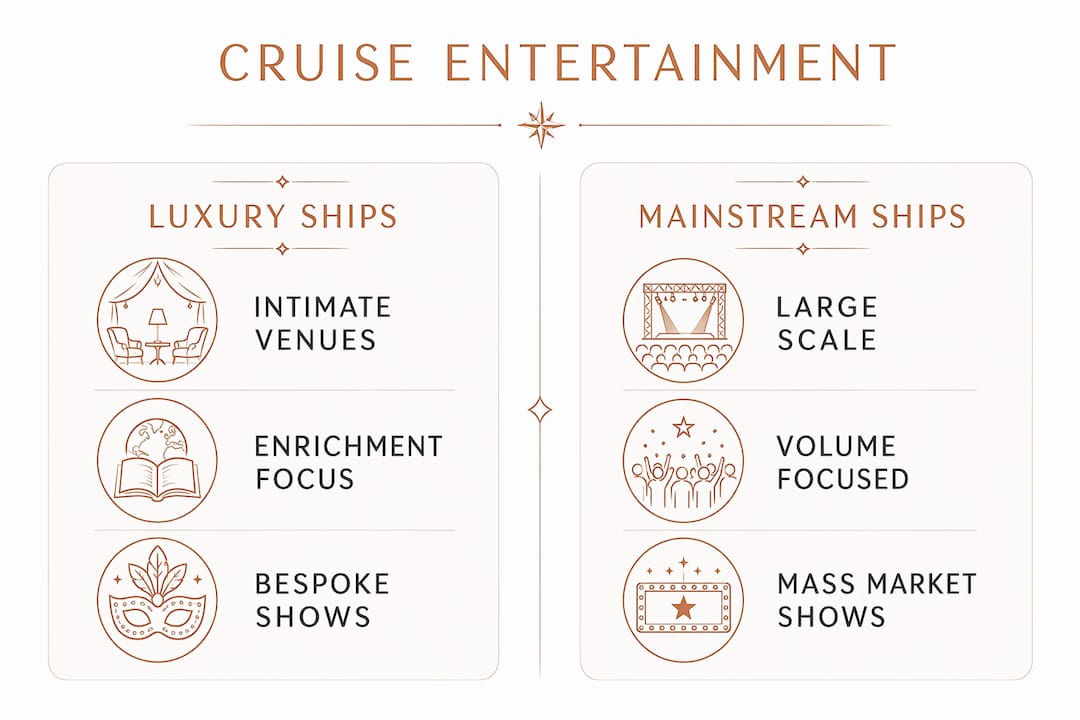
The pacing difference matters as much as the content difference. Luxury programming tends to breathe. Events are not back-to-back fillers; they are spaced to let guests absorb a port, a meal, or a conversation before the next experience begins.
The main kinds of entertainment and enrichment you’ll find on luxury cruises
The range is wider than most travelers expect. Here is a practical taxonomy:
Performance and theatre
- Broadway-style and main-stage productions — original works staged with LED visual design, live accompaniment, and professional casts; best for couples and culture-seekers who want a full theatrical evening
- Intimate cabaret and jazz — small-venue performances in piano bars or salons, often running late into the night; ideal for solo travelers and couples who prefer conversation-scale settings
- Classical and orchestral recitals — chamber music, string quartets, and crossover classical programs; popular with older demographics and music enthusiasts
- Comedy and interactive game shows — lighter evening formats like music trivia and crowd-participation games; accessible for mixed-age groups and families
Immersive and themed experiences
- Theatrical dining events — the most talked-about format on ultra-luxury ships; VidantaWorld Voyages ELEGANT’s immersive Jazz Age dinner called The Gilded Cage, priced at $169 per guest, transforms a dining venue into a Prohibition-era speakeasy where the story unfolds around the table
- Guest-artist residencies — a visual artist, author, or musician traveling with the ship for a full voyage, offering workshops, talks, and informal interactions
Enrichment programming
- Lecture series and discovery panels — subject-matter experts covering history, marine biology, art, geopolitics, or the specific cultures along the itinerary; the backbone of enrichment-first voyages
- Destination-led shore-event pairings — curated small-group experiences in port that extend the onboard programming into the destination itself
Culinary and wellness
- Culinary demonstrations and tastings — chef’s table dinners, sommelier flights, regional cooking classes tied to the itinerary
- Wellness classes and rituals — guided meditation, movement sessions, and spa rituals scheduled as programming rather than optional add-ons
The range of onboard entertainment formats — from orchestras and comedy nights to enrichment lectures and interactive game shows — is broad even on luxury ships, but the curation and production quality are what separate the category.
Where luxury cruise entertainment happens on board
Venue design shapes experience more than most travelers realize before they sail.
Main theatre — the largest performance space, typically tiered seating for 150–400 guests on a luxury ship. Sightlines are engineered for productions, and acoustics are purpose-built. This is where original stage works, headline acts, and full-cast productions live.
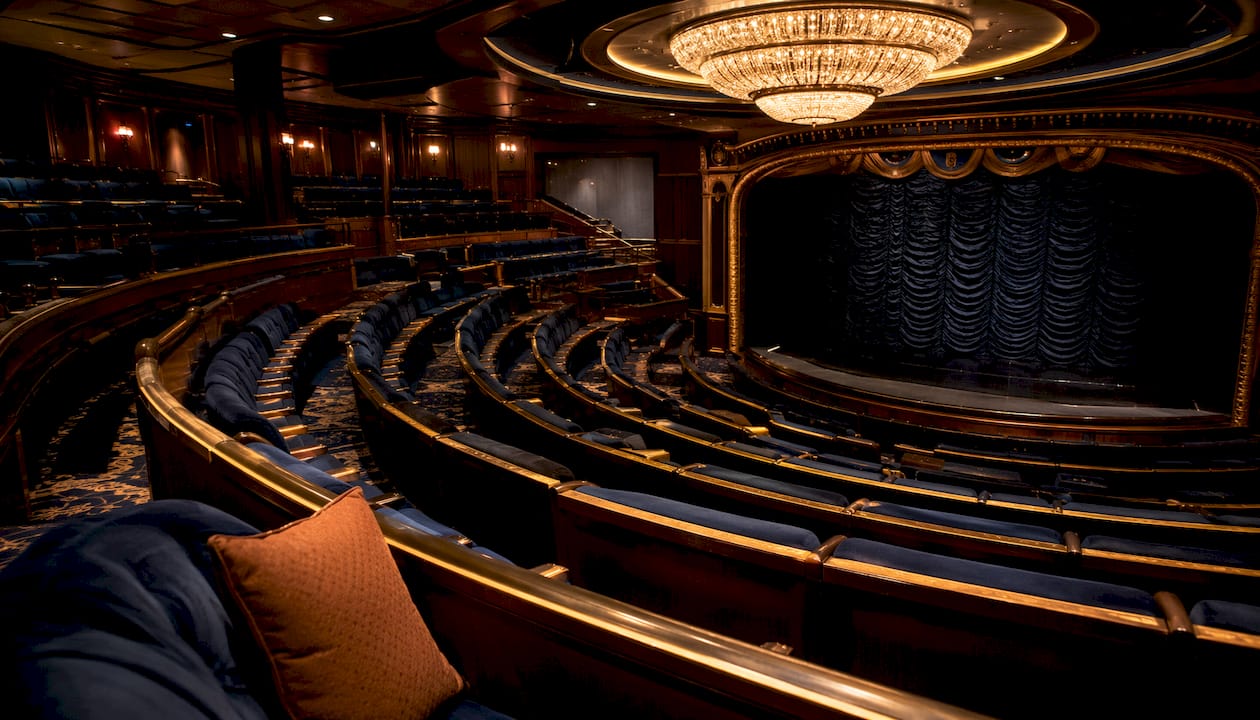
Black-box studio or studio theatre — a flexible, smaller space (often 60–100 seats) that enables immersive staging, in-the-round formats, and experimental works. The intimacy changes the relationship between performer and audience entirely.
Lounges and piano bars — the social heart of the ship after dinner. A skilled jazz duo in a 40-seat lounge creates an atmosphere no main-stage production can replicate. These venues also host late-night informal sessions that run well past midnight.
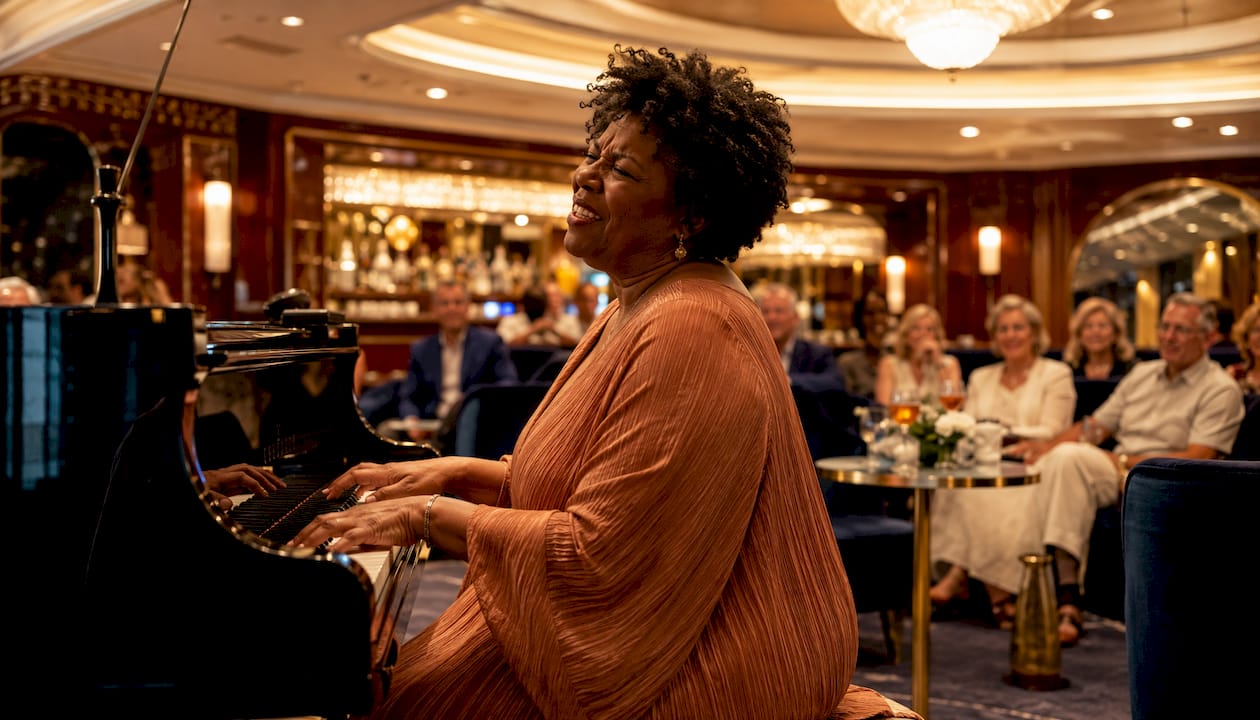
Observation lounges — glass-fronted spaces at the bow or upper decks, used for morning lectures, afternoon talks, and stargazing events. The view is part of the programming.
Outdoor decks and pool areas — the setting for sail-away parties, themed deck celebrations, and outdoor cinema. On ELEGANT, the pool deck hosts The White Party, a late-voyage celebration with the production cast, a jazz duo, and a DJ.
Private salons and suite spaces — invitation-only events, small-group tastings, and exclusive artist encounters happen here. This is where bespoke programming becomes genuinely personal.
Specialty restaurants — converted for immersive dining events on select evenings. The physical transformation of a dining room into a theatrical environment is a signature luxury format.
Pro Tip: For small-venue shows and invitation-only salon events, arrive five to ten minutes early. Many intimate spaces have no reserved seating, and the best sightlines fill fast.
Ship size directly affects how many of these venue types coexist. Luxury ships typically opt for fewer, higher-quality venues with more inclusion in the fare, while larger vessels spread guests across more spaces but dilute the intimacy of each.
How a typical day of programming flows on a luxury cruise
The shift from “what’s showing tonight” to “what’s the atmosphere today” is the clearest sign you are on a luxury ship.
Sample sea day timeline
- 6:30–8:00 AM — Morning wellness ritual on deck: guided breathing, movement session, or meditation. On some ships, this is a choreographed ceremony tied to the voyage’s cultural theme.
- 9:00–10:30 AM — Enrichment lecture in the observation lounge: a historian, marine biologist, or destination expert presenting on the next port of call.
- 11:00 AM–12:30 PM — Culinary demonstration or wine tasting in a specialty venue; hands-on workshop option for smaller groups.
- 1:00–3:00 PM — Unstructured time; informal live music in the lounge or piano bar.
- 4:00–5:30 PM — Afternoon Tea at Sea with live classical crossover performance; pre-dinner cocktail hour with a jazz duo.
- 7:00–9:00 PM — Main dining; specialty restaurant evening or immersive dining event.
- 9:30–11:00 PM — Main-stage production or intimate cabaret in the studio theatre.
- 11:00 PM onward — Late-night social: silent disco, hosted DJ night, or informal piano bar session.
Sample port day timeline
- Morning — Shore excursion, often a curated small-group cultural experience tied to the enrichment theme.
- Afternoon — Return to ship; relaxed programming, spa, or optional afternoon talk.
- Evening — If the ship has an overnight stay in port, the evening may extend ashore for a local cultural event or dinner, then return for late-night onboard programming.
The itinerary design matters enormously here. Overnight port stays enable evening programming that a standard one-day call cannot. Ships that build itineraries around late-night port access are specifically designed for guests who want the destination woven into the entertainment experience.
Programming cadence varies by ship class and voyage length:
- Shorter voyages (7 nights or fewer) tend to pack the schedule more tightly.
- Longer voyages (14+ nights) space events to avoid fatigue and allow for deeper enrichment arcs.
- Expedition-style ships prioritize destination-led programming over theatrical productions.
- Resort-forward luxury ships balance both, with original productions alongside immersive shore experiences.
What “enrichment” actually means on a luxury cruise
Entertainment and enrichment are not the same thing, and the distinction matters when you are choosing a voyage.
Entertainment is amusement-focused and largely passive. You watch, you listen, you enjoy. A Broadway-style production is entertainment. A jazz set is entertainment. Both are valuable, but neither changes what you know or how you see a place.
Enrichment is participatory and context-rich. It gives you something to take home beyond a memory.
Formats that qualify as enrichment include:
- Lecture series — subject-matter experts presenting on history, science, art, or geopolitics relevant to the itinerary
- Hands-on workshops — cooking classes tied to regional cuisine, photography workshops, language introductions
- Destination expert panels — local cultural liaisons or academics brought aboard for a single port or voyage segment
- Curated small-group shore experiences — not a standard excursion, but a guided encounter designed to connect with the onboard programming theme
Luxury operators often present enrichment programming with high-profile guest speakers, curated lecture series, and destination-focused discovery teams that bring subject-matter experts onboard. The expected outcome for guests is not just knowledge; it is a richer relationship with the places the ship visits. That depth is what cultural immersion travel does at its best, whether on land or at sea.
How wellness and culinary programs function as entertainment
On the best luxury voyages, a sommelier session is not a perk. It is programming.
Culinary and wellness experiences have moved from optional add-ons to core components of the entertainment matrix on many luxury ships, much like the high-end dining and land-based culinary partnerships that influence luxury cruise culinary programming, such as those highlighted in the Michelin Star tour on Waiheke Island. The logic is straightforward: food and physical wellbeing are the two things guests engage with every single day of a voyage. Treating them as entertainment rather than utility changes the entire guest experience.
Culinary formats you can expect:
- Chef’s table dinners — multi-course tasting menus with the executive chef present, often limited to 8–12 guests
- Regional cooking demonstrations — hands-on classes tied to the current itinerary; a pasta-making session in the Mediterranean, a ceviche workshop in South America
- Sommelier-led tasting flights — structured wine, sake, or spirits tastings with educational commentary
- Immersive theatrical dining — the most produced format; a full narrative experience built around a meal, such as The Gilded Cage aboard ELEGANT
- Destination-sourced menus — dishes built from ingredients picked up in port, connecting the table to the place
The S.A.L.T. program at Silversea is one of the most ambitious culinary concepts in the category, with a dedicated kitchen, hands-on lab, and bar all focused on the ship’s current destination. It is a useful benchmark for what destination-driven culinary programming can look like at its most developed.
Wellness formats you can expect:
- Morning movement rituals on deck (yoga, tai chi, guided stretching)
- Guided meditation and breathwork sessions
- Spa rituals scheduled as group programming, not just individual appointments
- Wellbeing lectures on sleep, nutrition, or mindfulness tied to the voyage theme
Many of these programs are included in the fare on luxury ships, though premium formats like the chef’s table or a private spa ritual typically carry an additional charge. Specialty dining inclusion varies by line: Regent, Oceania, and Windstar include specialty restaurants in the fare; Silversea and Azamara charge for certain premium experiences.
Pro Tip: Reserve chef’s table dinners and immersive dining events as early as possible — ideally at booking or on embarkation day. These formats are limited by design, and the most popular evenings fill within hours of boarding.
High-tech and immersive formats to expect on luxury ships
Production technology on ultra-luxury ships has caught up with what audiences expect from live entertainment on land.
The formats you are most likely to encounter on higher-end vessels and signature events:
- LED video walls and projection-mapped sets — dynamic backdrops that transform the stage environment in real time; used in original productions like ELEGANT’s Rock Pop Royalty, where a video-mapped costume moment has become one of the ship’s signature theatrical images
- LED wristband audience interaction — synchronized light effects that turn the audience into part of the visual spectacle during high-energy productions
- Spatial audio systems — directional sound design that places the listener inside the performance rather than in front of it
- 4D cinema and motion seats — immersive film experiences with physical sensation elements; more common on larger luxury vessels
- Augmented reality overlays — emerging format for interactive shore-side experiences and onboard educational programming
- Projection-mapped dining environments — used in theatrical dining events to transform a restaurant into a fully realized narrative world
The original stage productions aboard ELEGANT illustrate how technology serves storytelling rather than replacing it. A bilingual cast, live piano and violin accompaniment, and LED visual design work together to create something that feels authored, rather than assembled.
For guests with accessibility needs, technology cuts both ways. LED wristbands and spatial audio can enhance participation for guests with limited mobility, but fast-moving projection environments and strobe-adjacent lighting effects may be challenging for guests with photosensitive conditions. Always confirm technical details with the ship’s accessibility coordinator before booking a specific event.
Who curates onboard programs and where the talent comes from
The quality of luxury cruise programming depends almost entirely on the people behind it.
Key roles in the programming structure:
- Entertainment director — oversees all performance and social programming; manages the production cast and coordinates with venue managers
- Enrichment or discovery director — sources and manages guest lecturers, academic partners, and destination experts; designs the intellectual arc of the voyage
- Guest lecturers and subject-matter experts — academics, journalists, scientists, chefs, and artists contracted for a single voyage or a series; credentials vary widely, so the operator’s vetting process matters
- Resident artists and performers — musicians, visual artists, or writers traveling the full voyage and engaging informally with guests beyond their scheduled appearances
- Production managers — responsible for technical execution of main-stage shows, including lighting, sound, and set management
- Local cultural liaisons — brought aboard in specific ports to provide context, facilitate shore experiences, and connect onboard enrichment themes to the destination
High-production shows exist alongside smaller-scale, curated performances and lecture series on luxury ships, and the balance between them reflects the operator’s programming philosophy. Some lines lean heavily toward theatrical production; others build their identity around the enrichment director and speaker roster.
Bespoke programming — original works commissioned specifically for a ship or voyage — is the clearest differentiator at the ultra-luxury level. When an operator writes and stages an original production rather than licensing a known title, the result is something guests cannot see anywhere else. That exclusivity is part of what the fare is paying for.
What’s included in the fare and what costs extra
Knowing the inclusion model before you board prevents the kind of bill-shock that ruins the last morning of a voyage.
| Experience type | Typically included | Typically extra |
|---|---|---|
| Daily enrichment lectures | Yes, on most luxury lines | Rarely charged |
| Main-stage productions | Yes | No |
| Intimate lounge performances | Yes | No |
| Wellness classes (group) | Yes, on most luxury lines | Private sessions extra |
| Specialty restaurant dining | Varies by line (Regent, Oceania, Windstar: yes; Silversea, Azamara: some charges) | Premium menus or wine pairings |
| Chef’s table / tasting menu | Usually extra | $50–$200+ per person |
| Immersive theatrical dining | Usually extra | $169 per person (The Gilded Cage aboard ELEGANT is a reference point for pricing) |
| Headline guest performer events | Varies | Sometimes ticketed separately |
| Spa rituals (group programming) | Sometimes included | Individual appointments extra |
| Shore excursions | Rarely fully included | Varies widely |
On mainstream lines, specialty restaurant cover charges typically run $20–$50 per person, while luxury immersive events are priced higher per guest. The price point for The Gilded Cage is a useful reference for what a fully produced theatrical dining experience commands at the ultra-luxury level.
A few practical notes on budgeting:
- Gratuities for event staff are generally included in the fare on all-inclusive luxury lines, but confirm this at booking.
- Families booking specialty events for multiple guests should budget per-person costs carefully; a chef’s table for four at $150 per person is a $600 evening.
- Advance reservations made before embarkation often carry better availability and occasionally lower pricing than onboard booking.
- The all-inclusive cruise model varies more than the marketing suggests; always read the fine print on what “included” actually covers.
Pro Tip: Ask your travel advisor to request a full programming calendar before you sail. Many luxury lines release the voyage entertainment schedule 30–60 days in advance, giving you time to reserve high-demand events before you board.
How to choose a luxury cruise based on entertainment priorities
The right ship for a food-and-wine traveler is not the right ship for a lecture-and-culture traveler. Getting this match right is the single most important planning decision.
Questions to ask before booking:
- What percentage of the programming is enrichment versus pure entertainment?
- Are specialty dining and signature events included in the fare, or ticketed separately?
- What is the typical guest demographic, and does it match your travel style?
- How many sea days does the itinerary include, and how is programming structured on those days?
- Does the ship carry a dedicated enrichment or discovery director?
- What is the ship’s capacity, and how does that affect venue intimacy?
- Does the itinerary include overnight port stays that enable evening destination programming?
Matching your primary interest to ship attributes:
- Food and wine — prioritize lines with included specialty dining, a dedicated culinary program, and itineraries that source ingredients in port. Selecting a luxury cruise itinerary that aligns with your culinary interests makes the difference between a good voyage and a defining one.
- Culture and lectures — look for ships with a named enrichment director, a published speaker roster, and itineraries built around historically or culturally significant ports.
- Music and theatre — prioritize ships with original productions, a resident cast, and a dedicated studio theatre alongside the main stage.
- Wellness and relaxation — look for ships where wellness programming is integrated into the daily schedule, not just available as a spa menu.
Itinerary design affects programming more than most travelers anticipate. A Mediterranean itinerary with overnight stays in Dubrovnik and Athens enables evening cultural events ashore that a standard port-call itinerary cannot offer. Expedition-style luxury cruises prioritize destination-led programming and naturalist-led enrichment over theatrical production. Neither is better; they serve different travelers.
The ultra-luxury cruise category specifically is where original productions, bespoke events, and the most developed enrichment programs tend to live. If programming quality is your primary criterion, that is where to focus the search.
The shift from scheduled shows to an immersive atmosphere
The most significant trend in luxury cruise entertainment is not a new technology or a new format. It is a design philosophy.
Entertainment design experts in the ultra-luxury sector describe a shift from a “managed schedule” to an “atmosphere to be lived in” — programming that integrates wellness, rituals, and cultural elements across the entire guest day rather than concentrating them in discrete evening blocks.
The VidantaWorld Voyages ELEGANT case illustrates the trend in concrete terms. Carrying just 216 guests through the Mediterranean, ELEGANT offers original movement-and-music ceremonies at arrival and departure, afternoon tea with live classical crossover performance, guided breathwork sessions at sea, and late-night deck celebrations — all alongside its main-stage productions and theatrical dining. The programming is not a schedule. It is a texture that runs through the entire voyage.
What this means for travelers planning a luxury cruise:
- Expect programming to find you, not the other way around. The best luxury ships design experiences that happen in the spaces you already occupy — the deck, the dining room, the lounge.
- Sea days are not downtime. On atmosphere-driven ships, sea days carry some of the most memorable programming of the voyage.
- The daily program is a guide, not a contract. Informal performances, spontaneous artist encounters, and impromptu tastings are part of the design.
- Itinerary and programming are inseparable. Ships built around the atmosphere model choose ports specifically to extend that atmosphere ashore.
The practical implication for planning: ask not just what shows are scheduled, but how the ship fills the hours between them.
Practical tips to get the most from onboard programming
A few habits separate guests who catch everything they wanted from those who miss the events they most looked forward to.
Before you board:
- Request the voyage entertainment calendar from your travel advisor as soon as it is released, typically 30–60 days before sailing.
- Reserve chef’s table dinners, immersive theatrical dining, and any ticketed headline events at booking or immediately after embarkation.
- Confirm accessibility accommodations in writing before you sail: seating requirements, hearing loop availability, mobility access to specific venues, and any dietary needs for culinary events.
On board:
- Check the daily program each morning; luxury ships often add informal events, pop-up performances, and last-minute speaker sessions that do not appear in the advance schedule.
- Arrive early for small-venue shows and salon events. Many intimate spaces seat 40–80 guests with no reserved seating, and the best positions fill quickly.
- For enrichment lectures, sit near the front if you want to engage the speaker directly. Most discovery-team presenters welcome questions and often continue conversations informally afterward.
- Photography policies vary by event. Immersive theatrical dining and some productions prohibit phones during the performance; confirm before you sit down.
Dress and etiquette:
- Luxury ships typically have a range of dress codes across venues: casual on deck, smart casual in lounges, formal or black-tie optional for gala evenings and theatrical dining.
- For immersive events, lean into the theme. Ships that stage a Jazz Age theatrical dinner are not being precious about it; guests who dress the part genuinely enhance the experience for everyone in the room.
Pro Tip: If a high-demand event is fully booked when you check, ask the entertainment director or your butler about a waitlist. Cancellations are common, and ships with attentive service teams will often hold a spot for guests who ask directly.
Key Takeaways
Luxury cruise entertainment is an enrichment-first, atmosphere-driven experience that rewards travelers who plan ahead and choose their ship to match their specific interests.
| Point | Details |
|---|---|
| Enrichment-first design | The best luxury ships weave lectures, wellness, and cultural programming into every part of the day, not just the evening. |
| Venue scale matters | Intimate spaces (40–150 seats) define the luxury difference; smaller ships enable formats that large vessels cannot replicate. |
| Inclusion varies by line | Specialty dining and signature events are included on some lines (Regent, Oceania, Windstar) and ticketed separately on others; always confirm before booking. |
| Book high-demand events early | Chef’s table dinners and immersive theatrical events fill fast; reserve at booking or on embarkation day to avoid missing them. |
| Hiddendoortravel matches clients to the right ship | Hiddendoortravel evaluates programming calendars, enrichment rosters, and itinerary design to match each client to a voyage that fits their specific interests. |
Why the “atmosphere” model changes everything about choosing a luxury cruise
Most travelers evaluate a luxury cruise by its itinerary and its cabin. The travelers who come back most satisfied evaluate it by its programming philosophy.
The shift toward atmosphere-driven entertainment is real, and it has a practical consequence: two ships sailing the same Mediterranean itinerary can deliver entirely different experiences depending on how they fill the hours between ports. One might offer a polished but conventional show schedule. The other might stage a morning movement ceremony on deck, a destination lecture before lunch, an afternoon sommelier session, and a theatrical dinner that turns a Tuesday night into something guests describe for years.
The conventional wisdom says to choose a luxury cruise by destination. That is not wrong, but it is incomplete. The destination is the backdrop. The programming is the experience. A guest who cares deeply about food and wine will be frustrated on a ship that treats dining as a utility, no matter how beautiful the ports are. A guest who wants intellectual engagement will be bored on a ship that substitutes production value for substance.
What I find most underestimated in this category is the role of the enrichment director. On ships that take this role seriously, the discovery team is the intellectual spine of the voyage. The quality of that team, the credentials of the guest speakers, and the coherence of the lecture arc across the voyage are better predictors of guest satisfaction than the size of the theater or the number of specialty restaurants. Ask about it before you book. If the line cannot tell you who the enrichment director is or what the speaker roster looks like for your specific voyage, that tells you something.
The other thing worth saying plainly: personalized travel planning matters more in this category than almost any other. The difference between a luxury cruise that matches your interests and one that merely costs a lot is almost always a planning decision made before you board.
Hiddendoortravel can help you find the right entertainment-forward voyage
Choosing a luxury cruise for its programming is a different kind of decision than choosing one for its itinerary or its cabin category. It requires knowing which ships carry a serious enrichment director, which lines include theatrical dining in the fare versus ticket it separately, and which itineraries are built around overnight port stays that extend the entertainment experience ashore.
Hiddendoortravel works with clients who want exactly that level of specificity. The agency evaluates programming calendars, enrichment rosters, and itinerary design to match each traveler to a voyage that fits their actual interests, whether that is a food-and-wine-focused Mediterranean sailing, a culture-and-lecture expedition, or an ultra-luxury voyage with original theatrical productions. Early reservations for high-demand events, dietary and wellness accommodation planning, and access to voyage details that do not appear in the public brochure are part of what the agency handles before you board.
If you are ready to find a luxury cruise built around the experiences that matter most to you, speak with a Hiddendoortravel expert to start the conversation. For a broader look at what working with a bespoke travel agency involves, the agency’s planning guide is a practical starting point.
Useful sources and further reading
The sources below were used in researching this guide and offer authoritative further reading on specific topics:
-
VidantaWorld Voyages ELEGANT: Unprecedented Live Entertainment at Ultra-Luxury Sailing — Primary press release detailing original productions, The Gilded Cage theatrical dining event, and the atmosphere-driven programming philosophy; the most detailed public account of what ultra-luxury original production looks like in practice.
-
What to Expect on a Luxury Cruise: Dining — Cruise Critic — Authoritative explainer on inclusion models across luxury lines, reservation norms, and specialty dining policies; essential reading before booking any luxury voyage.
-
The Ultimate Guide to Cruise Ship Entertainment — World of Cruising — Broad industry overview of entertainment formats, enrichment programming structures, and how luxury ships adapt mainstream formats; useful for understanding the full range of onboard options.
-
Crystal: A World of Exceptional Entertainment — Cruising Journal — Detailed look at how high-production shows coexist with intimate performances and lecture series on luxury ships; useful for understanding the programming mix.
-
Cruise Dining Options Beyond the Main Restaurant — Cruises World — Practical breakdown of venue economics, inclusion models, and how ship size affects dining and entertainment options.
-
Luxury Cruise Dining Experiences — Silversea — Silversea’s own description of its S.A.L.T. culinary program; the clearest public example of destination-driven culinary programming at scale.
-
How Cruise Lines Are Redefining Entertainment at Sea — Cruising.org — Industry-level analysis of how cruise lines are investing in entertainment as a differentiator; useful context for the atmosphere-driven programming trend.
For a curated reading list tailored to a specific voyage or interest, contact Hiddendoortravel directly.