

Yes, bespoke luxury travel advisors almost always charge a planning or concierge fee, and it typically runs from a few hundred dollars for a single custom trip to $5,000 or more for an annual retainer. The exact number depends on trip complexity, the level of access you need, and how the advisor structures pricing. The models and real numbers below show what you should expect to pay and why.
TL;DR:
- Planning fees vary by advisor but typically range from a few hundred dollars for domestic trips to over $1,500 for complex, multi-region itineraries.
- Fees are structured as flat rates, percentage commissions, hourly charges, or retainers, with high-frequency travelers paying up to $25,000 annually.
- A planning fee covers personalized itinerary design, reservations, supplier negotiation, and access to exclusive hotel perks like upgrades and credits.
- Additional costs may apply for bespoke elements such as private jets, yachts, or difficult-to-secure reservations, often billed separately.
- Honest advisors will clearly specify what the fee includes, whether it is credited toward the trip, and what perks or upgrades are guaranteed before agreeing to pay.
Table of Contents
- How Travel Planning Fees Are Structured
- What a Planning Fee Actually Buys You
- What Determines How Much You’ll Pay
- Questions to Ask Before You Approve a Quote
- What Fees Actually Look Like by Trip Type
- Why Fees Exist and What They’re Really Paying For
- Considering a Bespoke Planning Partner?
- Sources
- FAQ
How Travel Planning Fees Are Structured
Advisors price their work in one of five common ways, and knowing which model you’re being quoted changes how you read the number.
- Flat per-trip fees cover a single itinerary from start to finish, usually quoted before any work begins.
- Tiered package pricing scales the fee to service level, often labeled basic, premium, or full luxury concierge.
- Hourly consulting bills for time spent researching, negotiating, and coordinating, which suits complex multi-destination trips with a lot of moving parts.
- Percentage-based fees run roughly 5 to 10% of total trip cost, which scales naturally with a $50,000 honeymoon versus a $500,000 family expedition.
- Retainers are annual or ongoing arrangements for clients who travel frequently and want a standing concierge relationship rather than a one-off transaction.
Domestic trip planning generally lands between $100 and $500, while international itineraries run $250 to $1,500. Advisors working exclusively in the luxury tier often charge $750 to $2,500 per trip, and concierge retainers for high-frequency travelers can range from $5,000 to $25,000 annually. Some agencies credit the fee toward your final booking cost if you move forward; others treat it as a standalone charge for the planning work itself, regardless of whether you book. Standard packaged vacations sometimes carry no advisor fee at all, since the supplier commission covers the advisor’s time. Fees show up specifically when the itinerary is custom.
What a Planning Fee Actually Buys You
A planning fee isn’t a service charge for filling out forms. It pays for a set of deliverables that are hard to replicate on your own: full itinerary design, hotel and cruise reservations, ground transportation coordination, supplier negotiation, and someone reachable if a flight cancels at 11 p.m. in Lisbon.
The measurable part is what makes the fee worth scrutinizing rather than dismissing. Advisors booking through networks like Virtuoso or Signature routinely secure confirmed perks such as daily breakfast, a property credit around $100, and priority upgrade consideration at partner hotels, benefits that simply aren’t available when you book direct.
- Guaranteed room category or view upgrades subject to availability
- Early check-in and late checkout arranged in advance
- Resort credits applicable to spa treatments or dining
- Welcome amenities and personalized in-room touches
- Direct access to a general manager or concierge desk for on-property issues
Pro Tip: Ask an advisor to itemize the specific hotel perks they can confirm before you book. If they can’t name amenities beyond “we’ll try,” that’s a sign their supplier relationships aren’t as deep as the fee suggests.
What Determines How Much You’ll Pay
Fees scale with the complexity of what you’re asking an advisor to solve, not simply the length of the trip.
- Number of destinations and travelers. A single-resort week for two costs far less to plan than a five-country itinerary for a family of eight with different mobility needs.
- Bespoke experiences. Private chef dinners, closed museum tours, or a helicopter transfer require research and direct negotiation that a standard booking never touches.
- Destination difficulty. Remote or logistically complex regions, think Antarctica or certain parts of sub-Saharan Africa, demand specialized supplier knowledge that commands a premium.
- Timing. Last-minute requests and peak-season bookings compress the planning window and often carry a rush surcharge.
- Advisor network membership and niche expertise. Advisors with deep relationships in a specific region or category can secure access others simply cannot, and that access is priced accordingly.
Hard-to-get reservations, special permits, and similarly truly bespoke elements typically carry their own surcharge on top of the base planning fee, billed separately because they’re priced case by case rather than on a standard schedule. Private aircraft and yacht charters fall into this category too.
Questions to Ask Before You Approve a Quote
A fair quote should survive direct questioning. Ask these before you sign anything:
- What exactly does the fee cover, and what falls outside it?
- Is the fee credited toward my final booking, or is it separate regardless of outcome?
- What happens to the fee if I cancel or change plans?
- Who do I call at 2 a.m. if something goes wrong on-property?
- What confirmed perks or upgrades will you secure, and can you name them?
- Does travel protection cost extra, and what does it cover?
Red flags worth walking away from: a verbal-only quote with nothing in writing, a scope so vague it could mean anything, promises of “guaranteed” upgrades no hotel actually guarantees, and fees that seem to appear only after you’ve committed to work with them.
Pro Tip: If an advisor won’t put the fee structure and cancellation terms in writing before you pay anything, that alone tells you how the rest of the relationship will go.
On negotiation, staged payments tied to deliverables (deposit at booking, balance at departure) protect you better than one lump sum upfront. Some advisors will credit part of the fee against your final trip cost if you book within a set window, so it’s worth asking directly rather than assuming it’s off the table.
What Fees Actually Look Like by Trip Type
Numbers help more than ranges alone, so here’s what real bookings tend to cost across common trip categories:
- Long weekend getaway: $100 to $150, usually for hotel booking and a light itinerary
- 7-day Caribbean resort trip: $200 to $300, covering room category negotiation and transfers
- 10 to 14-day Europe multi-city itinerary: $400 to $600, reflecting multiple hotel bookings and rail or car logistics
- Multi-country bespoke trip (15+ days): $750 to $1,500, factoring in specialized itinerary design across regions
- Destination wedding coordination: $1,000 to $5,000, depending on guest count and venue complexity
- Ongoing concierge retainer: $5,000 to $25,000 annually for frequent travelers who want standing access
These bands come from industry pricing disclosures and shift with how much bespoke work sits inside each trip. A 10-day Europe trip built entirely around private tours and Michelin reservations will land above the $600 ceiling, while a straightforward resort stay might come in under $200. Fees for standard packaged bookings are often waived entirely, since the advisor earns a commission from the supplier instead. Bespoke, high-touch itineraries are where the fee becomes standard practice, and where exceptional requests, think a same-week private jet charter, can push costs well past these benchmarks.
Why Fees Exist and What They’re Really Paying For
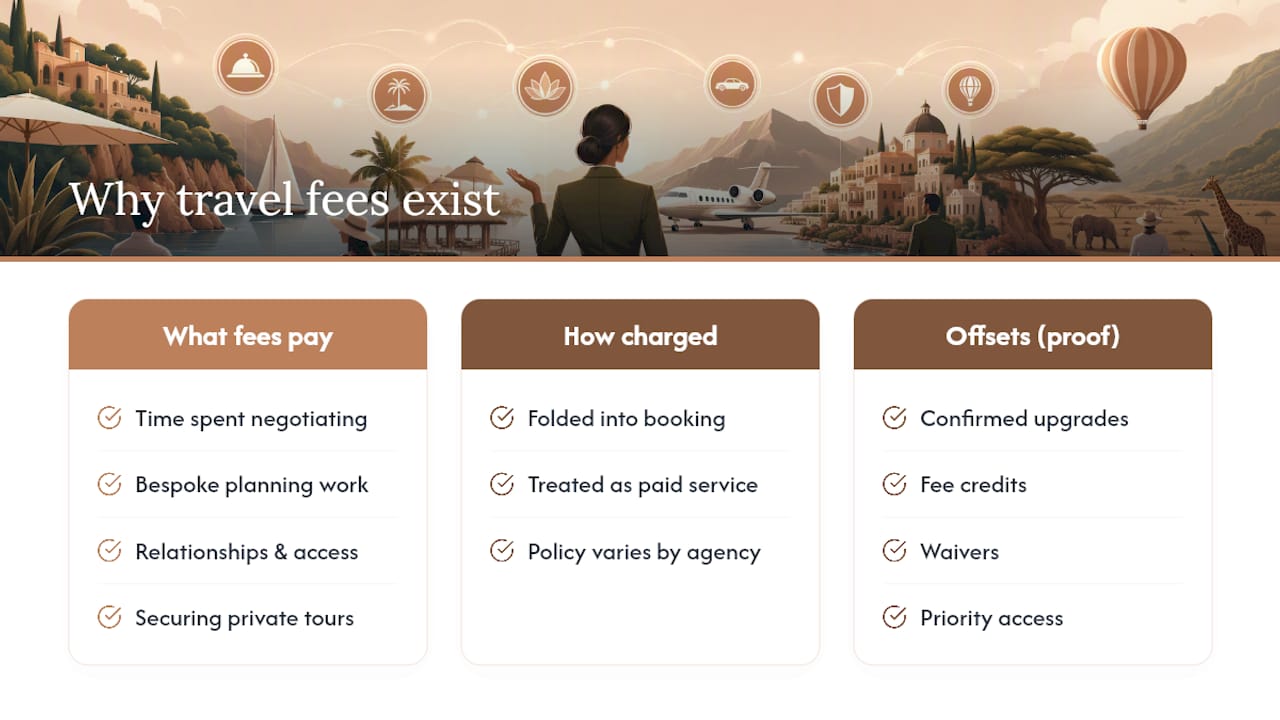
The fee model exists because bespoke planning takes real time and real relationships, not because agencies are padding a markup. Every hour spent negotiating a suite upgrade or securing a private tour of a closed exhibit is time a client doesn’t spend on hold with a hotel switchboard.
Fee-credit and waiver policies vary agency by agency, and the honest answer is that no single standard governs the industry. Some firms fold the fee into the booking once you commit; others treat planning as its own paid service regardless of outcome. What matters more than the exact structure is whether the advisor can point to specific, confirmed benefits, upgrades, credits, priority access, that offset what you’re paying for their time.
— Michael
Considering a Bespoke Planning Partner?
If you’re weighing whether a planning fee is worth it, the real question is what you get back for it. Some luxury travel advisors build fully custom itineraries with direct supplier relationships, meaning the perks and access points discussed above aren’t theoretical, they’re part of how a bespoke trip gets designed from the first conversation.

A first conversation with our team typically starts with a scope call: where you want to go, what matters most to you on the ground, and a transparent estimate before any work begins. From there, you get a proposal built around your actual priorities, not a template. If you’re ready to see what a custom itinerary looks like for your next trip, visit our luxury travel agency page to request a consultation and get a scoped proposal started.
Sources
- Travel Agency Service Fees: When & How to Charge
- The Detail-Oriented Traveler’s Guide to Luxury Travel Planning (And Where an Advisor Fits In) – PTN Travel
- How Much Does a Travel Agent Cost? (2026)
- Luxury Travel Advisor: Cost & When It’s Worth It
FAQ
Do all luxury travel advisors charge planning fees?
Most do for custom itineraries, though some waive fees on standard packaged bookings since they earn a commission from suppliers instead.
Are travel planning fees credited toward my trip cost?
It depends on the advisor. Some credit the fee against your final booking, while others charge it as a standalone fee regardless of whether you book.
What’s a reasonable fee for a two-week Europe trip?
Expect roughly $400 to $600 for a multi-city itinerary, more if it includes private tours or hard-to-get reservations.
Why would I pay a fee instead of booking directly?
A fee often buys confirmed perks, like breakfast, property credits, and upgrade priority, that direct bookings don’t get, along with support if something goes wrong mid-trip.
How does Hidden Door Travel structure its planning fees?
Many bespoke luxury travel advisors scope each trip individually during an initial consultation, providing a transparent estimate before any planning work begins.