

If you cancel a bespoke trip yourself, you generally lose your deposit, absorb supplier penalties, and forfeit non-refundable curation fees. If your supplier or agency cancels or significantly changes the trip, you’re normally entitled to a comparable alternative or a full refund, following ABTA’s code of conduct guidance. Who pays depends entirely on who initiated the change.
Before you sign anything, know the buckets your money can land in:
- Deposit forfeiture — usually 10 to 25% of trip cost, often non-refundable once paid.
- Supplier penalties — hotels, private tour operators, and event access providers each set their own cancellation windows.
- Agency service and curation fees — typically non-refundable regardless of who cancels, since they cover time already spent.
- Compensation for late supplier changes — owed to you, not the other way around, when the change comes too close to departure.
Hidden Door Travel structures every bespoke agreement around this distinction, and the rest of this guide breaks down exactly how it plays out in dollars and deadlines.
Key Takeaways
Who pays for a canceled or changed bespoke trip comes down to one factor: whether the client or the supplier initiated the change.
| Point | Details |
|---|---|
| Client cancellations cost the client | Expect to lose deposits, face supplier penalties, and forfeit non-refundable curation fees. |
| Supplier changes trigger client rights | Significant changes entitle clients to a comparable alternative or a full refund under ABTA guidance. |
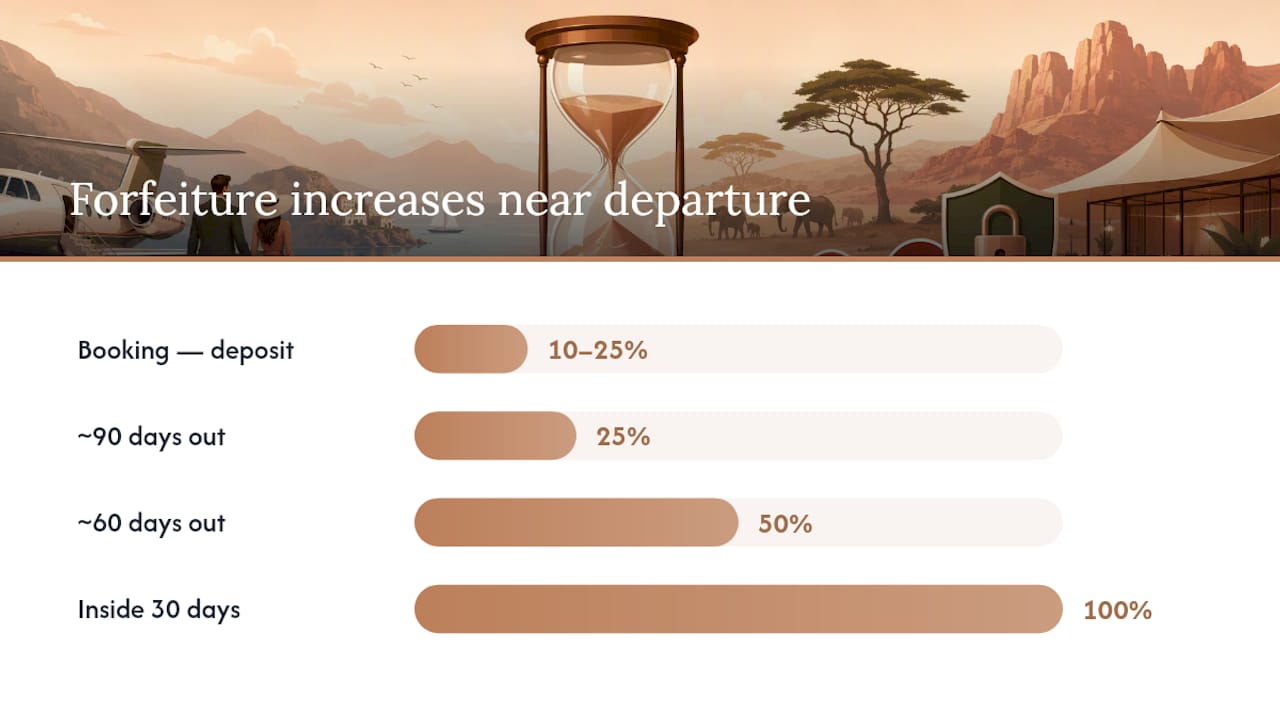
| Deposits run 10 to 25% | Penalty scales tighten sharply as departure approaches, often reaching full forfeiture inside 30 days. |
| Get terms in writing | Written amendment windows and refund triggers prevent disputes when a supplier changes course. |
| Hidden Door Travel negotiates in advance | The agency secures amendment windows, staged payments, and documented alternative-or-refund terms before clients sign. |
Table of Contents
- What Bespoke Trip Cancellation Policies Typically Cover
- How Do You Tell a Cancellation From a Significant Change?
- How Fees, Refunds, and Timing Actually Work
- What to Do If You Want to Cancel or You’re Told of a Change
- Contract Clauses to Negotiate and Sample Wording to Request
- How Hidden Door Travel Handles Cancellations and Supplier Changes
- Why Bespoke Terms Look Different, and Why That’s the Point
- How Hidden Door Travel Reduces Your Cancellation Exposure
- Sources
What Bespoke Trip Cancellation Policies Typically Cover
A bespoke travel contract isn’t one document. It’s a stack of terms: your agency agreement plus every individual supplier’s own rules, layered on top of each other. Reading only the agency summary and assuming it covers everything is the single most common mistake affluent travelers make.
Expect your contract to spell out the deposit amount and due date, the payment schedule leading to final balance, the exact date your booking becomes non-refundable, and how agency service fees are billed separately from supplier costs. No-show rules and documentation requirements (what proof you need to request a refund or dispute a charge) round out the fine print.
Coverage varies sharply by product type. A private villa’s cancellation terms look nothing like a chartered yacht’s, and event access tickets for something like courtside seats at a major final often carry zero refund flexibility once purchased, as industry contract guidance makes clear. Airlines follow their own DOT-regulated rules independent of what your agency promises.
A typical bespoke timeline runs like this: deposit due at booking, balance due 60 to 90 days before departure, and individual supplier cutoffs (often 30 to 45 days out for villas and private tours) sitting in between, each with its own forfeiture trigger.
How Do You Tell a Cancellation From a Significant Change?
A cancellation swaps in an entirely different trip. A significant change alters a key characteristic of your original booking but leaves the core trip intact and potentially still amendable. That distinction decides whether you’re owed a refund or just an adjusted itinerary.
ABTA’s guidance treats certain changes as functionally equivalent to cancellations, entitling you to the same choice: a comparable alternative or your money back. These include:
- A change of destination country.
- Removal of a main advertised component (the private audience, the reserved box at a match, the flagship excursion you booked the trip around).
- A flight change by a substantial number of hours on longer itineraries.
Changes that usually count as “significant” but not full cancellations include a resort or property swap, a downgrade to a lower accommodation category, or an inconvenient airport substitution that adds hours to your transfer, something worth weighing against how your transportation and experience design was originally planned.
When your advisor tells you about a change, run this checklist:
- Ask whether an equivalent or better alternative is being offered at no extra cost.
- Confirm whether the change affects price, and in which direction.
- Get a firm deadline for your decision.
- Ask explicitly whether a refund is on the table instead of the alternative.
- If the notice comes late, ask about compensation.
ABTA guidance states that members must offer clients “a genuine choice of a comparable alternative or a full refund” when a significant change or supplier cancellation occurs, and that each case is judged on its own facts rather than a fixed formula.
How Fees, Refunds, and Timing Actually Work
Your refund equals whatever the supplier actually returns, minus whatever your agency retains for work already performed. Deposit forfeiture and supplier penalties are common, and they’re almost always tiered: the closer to departure you cancel, the more you lose.
Deposits generally run 10 to 25% of trip value, and many suppliers apply sliding penalty scales, something like 25% forfeited at 90 days out, 50% at 60 days, and 100% inside 30 days. Air components carry their own logic: a 24-hour hold window often applies to fares booked at quoted rates, and airlines operate under Department of Transportation rules requiring refunds within 7 business days to a credit card or 20 calendar days by other methods when a flight is canceled or significantly changed.
| Milestone | What typically happens |
|---|---|
| Booking/deposit | 10 to 25% due, often immediately non-refundable |
| 60 to 90 days out | Balance due; supplier cutoffs for private tours and villas often begin here |
| 30 to 45 days out | Penalty scales tighten sharply toward full forfeiture |
| Post-cancellation | Supplier refunds process on their own timeline; airline refunds follow DOT windows |
Pro Tip: Ask your advisor to structure payments in stages with partially refundable components rather than one large non-refundable deposit. It won’t eliminate risk, but it narrows your exposure window considerably.
What to Do If You Want to Cancel or You’re Told of a Change
Move fast, but move on paper. The moment you’re considering cancellation, or the moment you’re notified of a change, pause any discretionary payments and pull together your documentation before you respond.
- Gather your original booking confirmation and every supplier’s terms and conditions.
- Request written confirmation of any proposed change, not a verbal summary.
- Ask your advisor for the supplier’s exact cancellation and refund terms in writing.
- Formally request either an alternative or a refund, and copy your advisor on all correspondence.
- Set a specific deadline for a response and put it in writing.
Your documents checklist should include the booking confirmation, all supplier terms, payment receipts, and any prior written assurances about specific trip components.
A workable email line: “Please confirm in writing whether this constitutes a significant change under the booking terms, and provide our options for a comparable alternative or full refund by [date].”
Pro Tip: Never accept a verbal reassurance about a supplier issue. Ask your advisor to confirm it by email the same day, before you make any further payment.

Contract Clauses to Negotiate and Sample Wording to Request
Ask for four things in writing before you sign: a defined amendment window, an explicit alternative-or-refund trigger, a firm refund timing commitment, and a complete list of non-refundable fees. Vague language here is where disputes start, according to contract risk guidance for travel agencies.
Sample clause language worth requesting:
- Amendment window: “Client may request itinerary amendments up to [X] days before departure without penalty.”
- Alternative-or-refund trigger: “In the event of a significant change, Client will be offered a comparable alternative at no additional cost or a full refund within [X] business days.”
- Refund timing: “Supplier refunds will be forwarded to Client within [X] business days of receipt by the Agency.”
- Fee transparency: “Non-refundable fees are limited to the following itemized list: [list].”
- Force majeure with options: “In the event of force majeure, Client may elect to postpone, receive credit, or request a refund where the supplier permits.”
For high-value bookings, prioritize penalty caps and longer response windows over marginal fee discounts. If a supplier offers you a lower-category alternative, you should be refunded the difference, not asked to accept it at par, per ABTA’s guidance on alternative offers.
Reconciling supplier terms with the client-facing agreement, rather than assuming they match, is what prevents an agency from absorbing penalties it never agreed to.
Pro Tip: Ask specifically who on the supplier side has authority to waive a penalty, then request that concession before you request a fee reduction elsewhere.
How Hidden Door Travel Handles Cancellations and Supplier Changes
Hidden Door Travel gives clients a documented decision process whenever a supplier proposes a significant change, and negotiates amendment windows and alternatives directly with suppliers before the client ever sees the notice.
What that looks like in practice:
- Proactive supplier liaison the moment a potential change surfaces.
- A defined decision window so clients aren’t rushed into an answer.
- Staged or escrowed payments where suppliers allow it, limiting upfront exposure.
- Referral to specialized cancel-for-any-reason coverage for clients who want broader protection than standard supplier terms provide.
Every bespoke agreement should tell you exactly what happens next if a supplier changes course, not leave you guessing at the worst possible moment.
That documented process, paired with round-the-clock concierge support, is what separates a negotiated bespoke booking from a fixed-package purchase with no room to maneuver.
Why Bespoke Terms Look Different, and Why That’s the Point
Bespoke bookings aren’t standard package deals with a fancier label, and their cancellation terms shouldn’t be read as if they were. I’ve watched clients assume a private villa contract works like a hotel loyalty booking, then get blindsided by a 45-day cutoff buried in a supplier addendum nobody flagged.
The terms are negotiable far more often than clients realize. If your advisor hasn’t pushed for a longer amendment window or a capped penalty on your behalf, ask why. Bring your specific itinerary to your advisor and ask them to walk through every cutoff date before you pay a deposit.
How Hidden Door Travel Reduces Your Cancellation Exposure
Most travelers discover their real exposure only after a supplier changes terms mid-trip planning. Hidden Door Travel negotiates flexibility into your contract before that happens, drafting client-facing wording that names your alternative-or-refund rights up front instead of leaving them implied.

What that gets you:
- Contract language negotiated in advance, not disputed after the fact.
- Staged payment plans that limit how much sits at risk at any one time.
- Supplier guarantees secured directly by your advisor, not left to chance.
- Curated travel-protection referrals matched to your specific itinerary.
If you’re planning a bespoke trip and want cancellation terms that actually protect you, start with a consultation through Hidden Door Travel’s luxury travel experts and have your advisor walk the contract line by line before you commit a deposit.
Sources
- GUIDANCE ON THE APPLICATION OF THE CODE OF CONDUCT July 2024
- Travel Agency Contract: Key Terms and Requirements – LegalClarity
- Key Contract Risks for UK Travel Agencies | Sprintlaw UK
This article is general information, not a substitute for advice from a qualified lawyer. Consult a qualified legal professional about your own circumstances before acting on anything here.