
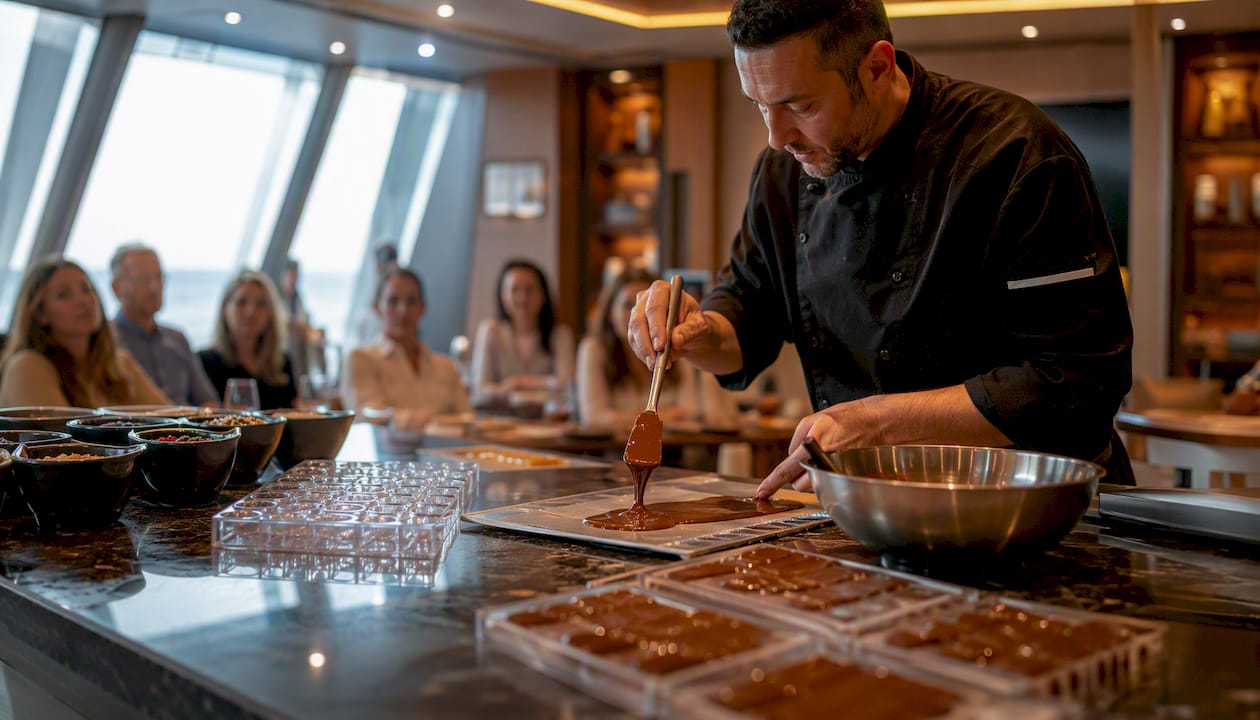
The most impactful onboard enrichment falls into five formats, and which one suits you depends almost entirely on what you want to walk away with. Certification courses, multi-session lecture series, hands-on workshops, expedition-led fieldwork, and wellness or arts immersion each serve a different kind of traveler. Luxury and expedition lines tend to deliver the deepest versions of all five, while mainstream ships offer lighter, broader programming.
- WSET wine certification (e.g., Azamara’s Level 1 program) — best for food and wine travelers who want formal credentials to take home
- Resident historian lecture series — best for culture-first travelers who want context before every port call
- Hands-on culinary workshops — best for food lovers who prefer doing over watching
- Expedition naturalist fieldwork — best for active explorers on small-ship or polar itineraries
- Wellness and arts immersion (yoga intensives, glassblowing, photography clinics) — best for travelers seeking creative or restorative depth
A Hiddendoortravel adviser can match you to the right sailing based on program type, instructor credentials, and whether the enrichment is genuinely woven into the itinerary or just bolted on as filler.
Key Takeaways
The most reliable signal of a genuinely enriching cruise is a multi-day program with credentialed instructors, formal partnerships, and shore integration — not the number of activities listed in a brochure.
| Point | Details |
|---|---|
| Match program type to traveler | Certifications suit credential-seekers; lecture series suit culture travelers; hands-on workshops suit active learners. |
| Verify instructor credentials | Named specialists and formal partners (WSET, Smithsonian, culinary schools) signal real program depth. |
| Expect paid supplements for top programs | Azamara’s WSET Level 1 runs $275; most certifications and multi-day masterclasses carry a similar supplement. |
| Request the enrichment calendar | A sample calendar before booking is the fastest way to confirm program coherence across the voyage. |
| Hiddendoortravel adviser advantage | Advisers confirm credentials, secure limited-capacity spots early, and negotiate private sessions unavailable to direct bookers. |
Table of Contents
- What do onboard enrichment programs actually include?
- How do the major cruise lines compare on enrichment?
- What do the best enrichment programs look like by theme?
- How does enrichment change by ship size and itinerary?
- What does enrichment cost, and how do you reserve a spot?
- How do you choose the right enrichment-focused cruise?
- How Hiddendoortravel evaluates enrichment programs for clients
- The enrichment promise vs. what actually delivers
- Hiddendoortravel can secure the enrichment experiences worth having
- Sources
What do onboard enrichment programs actually include?
Enrichment is a mix of scheduled lectures, interactive workshops, certifications, resident specialists, and ship-to-shore programs that connect what you learn at sea to what you experience on land. The format varies more than most travelers expect.
Typical delivery looks like this: a 45-minute lecture in a dedicated theater, a small-group cooking class in an onboard culinary center, a pop-up gemology demonstration in a lounge, an on-deck naturalist briefing before a zodiac landing, or a photography clinic that continues ashore. Some programs run as standalone sessions; the best ones build across multiple days into a coherent arc, so a lecture on Venetian history on day one feeds directly into a guided glassblowing workshop in Murano on day three.
Session topics span a wide range. Astronomy and stargazing talks, regional history briefings, culinary demonstrations, language lessons, wellness classes, watercolor painting, and even gemology are all common. Luxury and expedition cruise segments have expanded these offerings significantly, with lines competing to sign credentialed speakers and formal institutional partners rather than relying on generalist presenters.
Accessibility varies by line. Most major cruise operators offer hearing loops in lecture theaters and can arrange seating accommodations for guests with mobility limitations, though it’s worth confirming specifics before you book. Programs held on deck or during shore excursions may have physical requirements that limit participation.
On cost: the majority of lectures and demonstrations are included in your fare. Certifications, multi-day masterclasses, and specialty workshops with limited capacity often carry a paid supplement, sometimes requiring advance registration before you board.
How do the major cruise lines compare on enrichment?
The five dimensions that matter most when comparing lines are what the enrichment is best for, what activities it typically includes, whether it’s covered in the fare, the ship’s size and segment, and which itinerary types bring out the strongest programming. Editorial roundups of the best enrichment cruises consistently place luxury and expedition lines at the top, though a few premium and small-ship operators punch well above their weight.
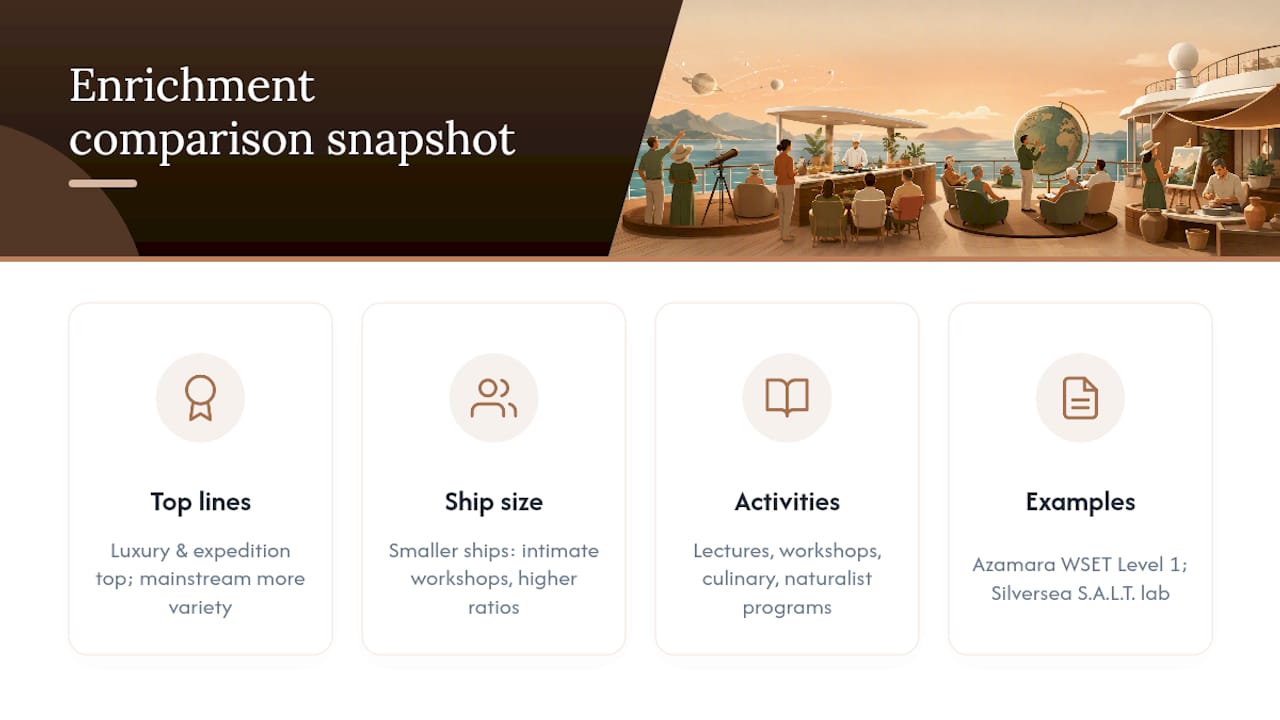
A note on ship segment: smaller ships generally allow more intimate workshop formats, higher instructor-to-guest ratios, and tighter thematic coherence across a voyage. A 200-guest expedition ship can run a naturalist program where every landing, every lecture, and every meal conversation reinforces the same theme. A 3,000-guest mainstream ship cannot, though it can offer more variety.
Two standout program examples worth knowing: Azamara’s WSET Level 1 certification partnership is one of the few programs that delivers a formal, internationally recognized credential at sea. Silversea’s S.A.L.T. (Sea and Land Taste) program is a rare example of culinary enrichment built into the ship’s physical infrastructure, with a dedicated kitchen, a culinary lab, and shore excursions designed around local food producers.
What do the best enrichment programs look like by theme?
The five enrichment themes each have a distinct delivery model, and the gap between a strong program and a weak one is usually the instructor’s credentials and whether the sessions connect to each other.
Culinary programs
Oceania’s The Culinary Center is the benchmark for hands-on cooking at sea: small classes, professional-grade equipment, and menus tied to the ports ahead. Silversea’s S.A.L.T. program goes further, pairing onboard cooking sessions with visits to local producers and markets ashore. Holland America’s America’s Test Kitchen partnership brings a recognizable brand into the demo kitchen, though it skews toward demonstration rather than participation. Most culinary programs are included in the fare; specialty classes with limited seats sometimes carry a small supplement.
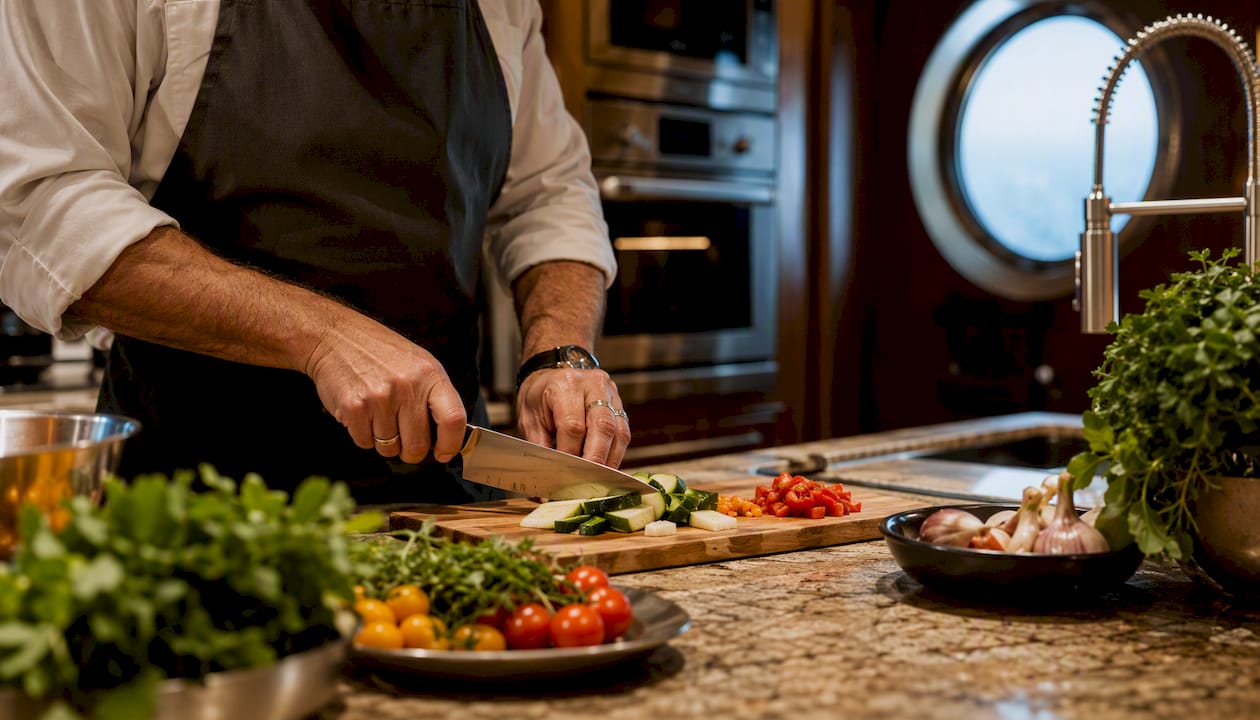
Audience fit: food lovers, home cooks, and travelers who want to bring a recipe home alongside a memory.
Academic and lecture series
Viking’s structured lecture model sets the standard here: resident historians, destination-specific multimedia briefings, and TED Talk screenings that prime guests before each port. Cunard’s speaker program draws from British academia, the arts, and public life, with the transatlantic crossing serving as a natural setting for multi-day intellectual programming. Princess Cruises’ ScholarShip@Sea offers a lighter version, with rotating guest lecturers across topics from marine biology to photography.
Audience fit: curious generalists, history enthusiasts, and travelers who want to understand a destination before they walk off the ship.
Expedition and nature programs
Small-ship and expedition lines run the most immersive versions of this theme. American Cruise Lines deploys onboard naturalists and historians on its domestic river and coastal itineraries, with talks that feed directly into guided shore time. Seabourn’s partnership with Smithsonian Journeys places credentialed expedition experts onboard for polar and remote-destination sailings. Windstar Cruises pairs guest lecturers with cultural workshops on select voyages, matching the speaker’s expertise to the region being sailed.
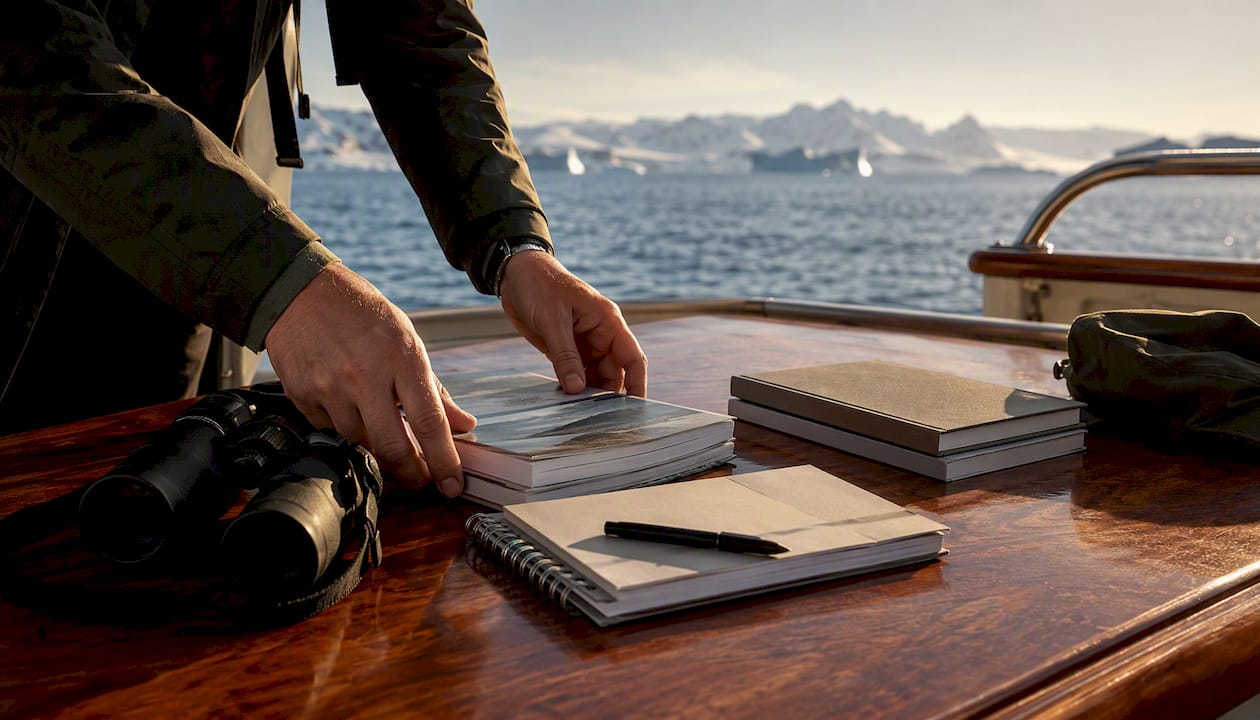
Audience fit: active explorers, wildlife enthusiasts, and travelers drawn to remote or ecologically significant destinations. For travelers considering luxury expedition cruise destinations, expedition enrichment is often the primary reason to book a particular sailing.
Arts and wellness immersion
Crystal’s Crystal Visions lecture series covers visual arts, music, and design with guest speakers who are practitioners, not just commentators. Regent Seven Seas integrates art programs into longer voyages, with workshops in watercolor, photography, and ceramics. Wellness intensives, from multi-day yoga programs to mindfulness retreats, appear across luxury lines and are increasingly structured as progressive series rather than standalone classes.
Audience fit: creative travelers, wellness seekers, and anyone who wants a skill or practice to continue after disembarking.
Certification courses
This is the category with the clearest measurable outcome. Azamara’s WSET Level 1 Award in Wines, priced at $275 per participant, runs on select sailings beginning in December 2026 and expanding through 2027. It’s the most prominent example of a cruise line delivering a formal, externally validated credential at sea. A few culinary-focused lines offer certificates of completion for their cooking programs, though these carry less external recognition than a WSET qualification.
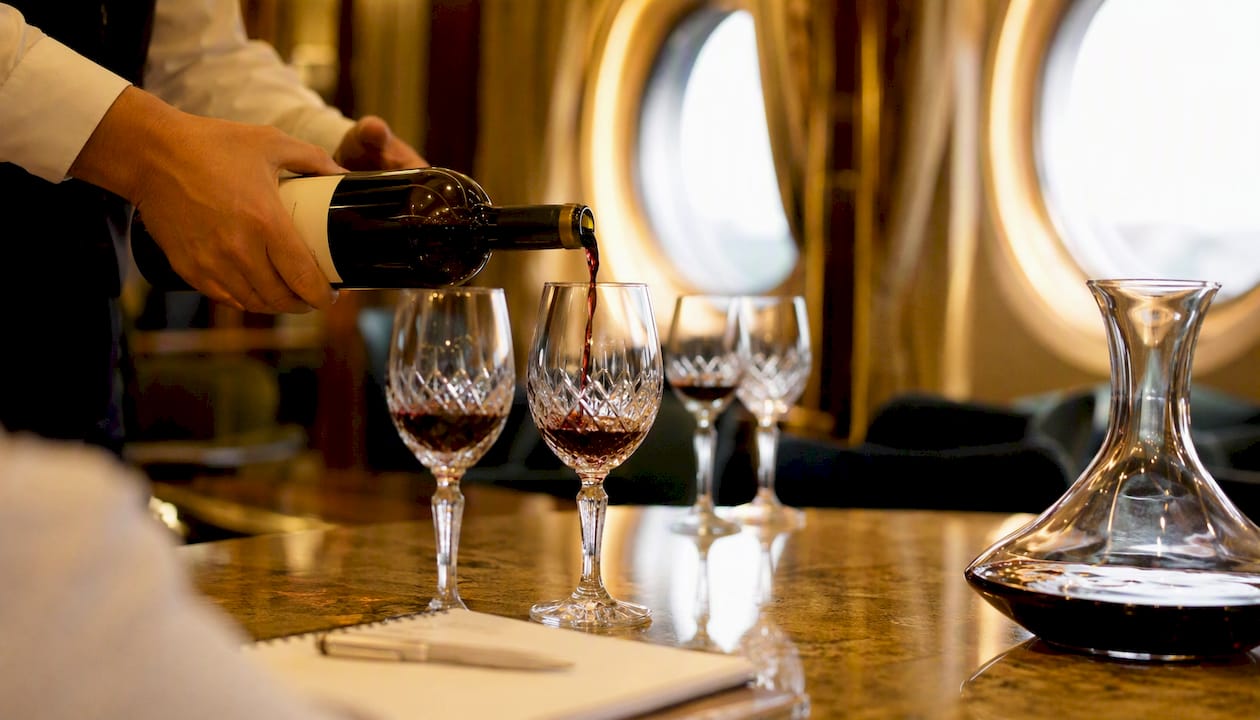
Audience fit: food and wine travelers who want something tangible beyond the experience itself.
How does enrichment change by ship size and itinerary?
Smaller luxury and expedition ships generally provide more intensive, coherent enrichment than mainstream vessels, and the reasons are structural, not just a matter of budget. Industry reporting confirms that speaker credentials and program coherence are the primary differentiators between lines that genuinely deliver and those that use enrichment as a marketing label.
- Small expedition ships (under 300 guests): daily naturalist or historian briefings, high instructor-to-guest ratios, shore programs designed around the lecture content, thematic coherence across the full voyage
- Luxury ocean ships (300–700 guests): resident specialists, formal institutional partnerships, multi-session programs with progressive structure, included in fare
- Premium ships (700–2,000 guests): strong lecture series, some hands-on workshops, broader topic variety but less thematic coherence, mostly included
- Mainstream ships (2,000+ guests): lighter programming, rotating guest lecturers, demonstration-style classes, enrichment competes with entertainment for scheduling priority
Itinerary matters as much as ship size. Long voyages, world cruises, and sailings to remote or culturally rich destinations tend to host richer programs because there’s more time and more subject matter to work with. A 14-night Mediterranean sailing with five port days gives a resident historian enough runway to build a multi-lecture arc on ancient trade routes. A 7-night Caribbean loop rarely does.
Enrichment sessions typically run during sea days, in the morning before port arrivals, or in the early evening. They slot alongside shore excursions rather than competing with them, though on expedition ships the two are often the same activity. For a deeper look at how luxury and mainstream cruises differ structurally, the gap in enrichment depth is one of the clearest illustrations.
What does enrichment cost, and how do you reserve a spot?
Many enrichment events are complimentary, but the highest-value options — certifications, multi-day masterclasses, and specialty workshops with limited capacity — typically carry a paid supplement and require advance booking.
Common pricing models across cruise lines:
- Fully included: standard lectures, destination briefings, demonstrations, and most wellness classes
- Pay-per-session: individual specialty workshops, photography clinics, some wine tastings
- Flat program fee: multi-day culinary courses or arts intensives, usually booked as a package
- Pre-cruise enrollment: certification courses like Azamara’s WSET Level 1 ($275), which require sign-up before boarding
- Excursion-linked pricing: shore programs that extend an onboard lecture, priced as a shore excursion
The $275 price point for Azamara’s WSET Level 1 certification is a useful benchmark for what a formal credential program costs at sea. Most paid workshops run lower than that; multi-day culinary intensives on premium lines can run higher.
Practical booking advice: reserve enrichment activities as early as possible, ideally at the time of cruise booking. Capacity for hands-on workshops is almost always limited, and popular sessions on sold-out sailings fill weeks before departure. Ask your cruise line or travel adviser for the enrichment calendar at the time of booking, not after you’ve paid the deposit. Program quality, particularly speaker credentials and thematic coherence, is worth verifying before you commit to a sailing rather than after.
Pro Tip: If a certification course is your primary reason for booking a particular sailing, confirm the course dates and availability with the cruise line directly before finalizing your reservation. Announced programs sometimes run on select ships only.
How do you choose the right enrichment-focused cruise?
Prioritize program type alignment first — whether you want a certification, a lecture series, or hands-on workshops — and then check whether the program is coherent across the voyage rather than a collection of unrelated one-off sessions.
- Identify your enrichment type. Decide whether you want a formal credential, a multi-day thematic series, hands-on skill building, expedition fieldwork, or wellness immersion. Each type maps to a different set of cruise lines and ship sizes.
- Check instructor and partner credentials. Look for named speakers with verifiable expertise, formal institutional partnerships (WSET, Smithsonian, culinary schools), and resident specialists rather than rotating generalists.
- Review the itinerary for shore integration. The strongest programs connect onboard sessions to what you do ashore. A lecture on Alaskan ecology should precede a naturalist-led kayaking excursion, not stand alone.
- Confirm inclusion vs. supplement pricing. Ask specifically which sessions are included and which require additional payment. Get the enrichment calendar, not just a general description.
- Verify accessibility accommodations. If you have mobility, hearing, or visual needs, confirm that the specific sessions you want to attend are accessible before booking.
- Ask for sample enrichment calendars. A line that can’t produce a sample calendar for a sailing is a line that hasn’t committed to a real program. This is the single fastest way to separate genuine enrichment from marketing copy.
For selecting a luxury cruise itinerary that genuinely delivers on enrichment, the calendar check is non-negotiable.
Red flags to avoid:
- A “speaker series” with no speaker bios or credentials listed
- One or two standalone lectures described as an “enrichment program”
- No shore tie-ins for a destination-focused topic (a history lecture with no corresponding guided visit)
- Enrichment described only in marketing language with no specific session titles or topics
Questions to ask before you book:
- Who are the resident specialists or guest lecturers on this sailing?
- How many enrichment sessions are scheduled, and on which days?
- Which sessions require advance registration or a paid supplement?
- Is there a thematic thread connecting the sessions across the voyage?
- What accessibility accommodations are available for workshops and lectures?
How Hiddendoortravel evaluates enrichment programs for clients
Hiddendoortravel evaluates enrichment programs on four criteria: instructor credentials, program coherence across the voyage, shore integration, and measurable guest outcomes such as certificates, hands-on skills, or exclusive access that couldn’t be arranged independently. A program that checks all four is genuinely rare, which is why the evaluation matters before booking rather than after.
The adviser checklist looks like this:
- Instructor credentials: named speakers with verifiable expertise or formal institutional affiliations, not generic “guest lecturers”
- Multi-day narrative: sessions that build on each other rather than covering unrelated topics on consecutive days
- Formal partnerships: WSET, Smithsonian, culinary schools, or regional cultural institutions that lend external credibility
- Shore integration: onboard content that connects directly to guided shore time, not parallel programming that ignores the destination
- Capacity and booking logistics: confirmation of available spots in limited-enrollment workshops before the sailing is finalized
On the booking side, advisers at Hiddendoortravel reserve enrichment spots at the time of cruise booking, not as an afterthought. For high-demand programs, that means contacting the cruise line directly to hold capacity in advance. For private or semi-private sessions, it sometimes means negotiating directly with the ship’s program coordinator. Enrichment programs are increasingly designed to drive guest satisfaction and revenue when thematically integrated, which means lines are more willing to accommodate bespoke arrangements when approached through an experienced adviser.
Pro Tip: Ask your adviser to request the full enrichment calendar for your sailing, not just the highlights. The calendar reveals whether the program has genuine thematic depth or whether it’s three unrelated lectures spread across a two-week voyage.
The advantages of working with an elite travel agency are clearest in exactly this kind of situation: knowing which questions to ask, which lines actually deliver on their enrichment promises, and how to secure limited-capacity experiences before they fill.
The enrichment promise vs. what actually delivers
Most cruise lines claim enrichment. Far fewer deliver it in a form that stays with you after disembarkation. The conventional advice — “look for a line with a speaker series” — misses the point almost entirely, because a speaker series is the minimum viable version of enrichment, not the gold standard.
What actually distinguishes a memorable program from a forgettable one is thematic coherence: the sense that every lecture, workshop, and shore excursion is part of the same conversation. Viking does this well with its destination-first multimedia approach. Silversea does it with S.A.L.T. Azamara does it with WSET certification sailings where the wine education continues in every port. The common thread is that someone designed the voyage as a learning arc, not as a schedule of available speakers.
The other thing most travelers underestimate is the value of a formal credential or hands-on outcome. A WSET Level 1 certificate is something you use after the trip. A cooking technique learned in Oceania’s culinary center is something you repeat at home. A naturalist’s explanation of Antarctic ice formation changes how you look at every glacier you’ll ever see. Passive lectures, however well-delivered, rarely produce that kind of lasting return.
The practical implication: when you’re evaluating a sailing, ask what you’ll have at the end of the enrichment program that you didn’t have at the start. If the answer is “a nice memory,” keep looking.
Hiddendoortravel can secure the enrichment experiences worth having
Booking an enrichment-focused cruise without an adviser is like buying a concert ticket without knowing the setlist. You might get exactly what you wanted, or you might discover on day three that the “culinary program” is two demonstrations and a wine tasting.
Hiddendoortravel’s advisers do the verification work before you commit: pulling enrichment calendars, confirming instructor credentials, checking which workshops have open capacity, and securing spots in limited-enrollment sessions that fill months before sailing. For travelers interested in private or semi-private arrangements — a dedicated cooking session with the ship’s executive chef, a private naturalist briefing before a zodiac landing, or a shore excursion designed around a specific cultural interest — advisers negotiate those arrangements directly with the ship’s program team.
The lines that offer the deepest enrichment (Silversea, Seabourn, Viking, Azamara, Regent) also tend to have the most complex booking logistics. Getting the right cabin, the right sailing date, and the right enrichment calendar aligned takes the kind of supplier relationships that come from booking these lines regularly. For travelers planning a sailing where enrichment is the point rather than a bonus, working with Hiddendoortravel’s luxury travel experts is the most direct route to getting it right. Reach out to start planning the sailing that actually delivers.
Sources
When verifying program details beyond what a cruise line’s brochure states, these sources give you independent context and official program information.
- Forging fulfillment: Cruise lines bolster enrichment programs
- Best Enrichment Cruises
- Viking Ocean Cruises® – Onboard Enrichment
- Cruise Enrichment Programs: How They Drive Guest Satisfaction, Revenue, and Loyalty
- Windstar Cruises | Services & Enrichment
Recommended
- Luxury Cruise Entertainment Explained for Discerning Travelers – Hidden Door Travel
- Types of Behind-the-Scenes Tours: Your Insider Guide – Hidden Door Travel
- Why Luxury Cruises Differ From Mainstream: What to Know – Hidden Door Travel
- Luxury Expedition Cruise Destinations Worth Booking Now – Hidden Door Travel