

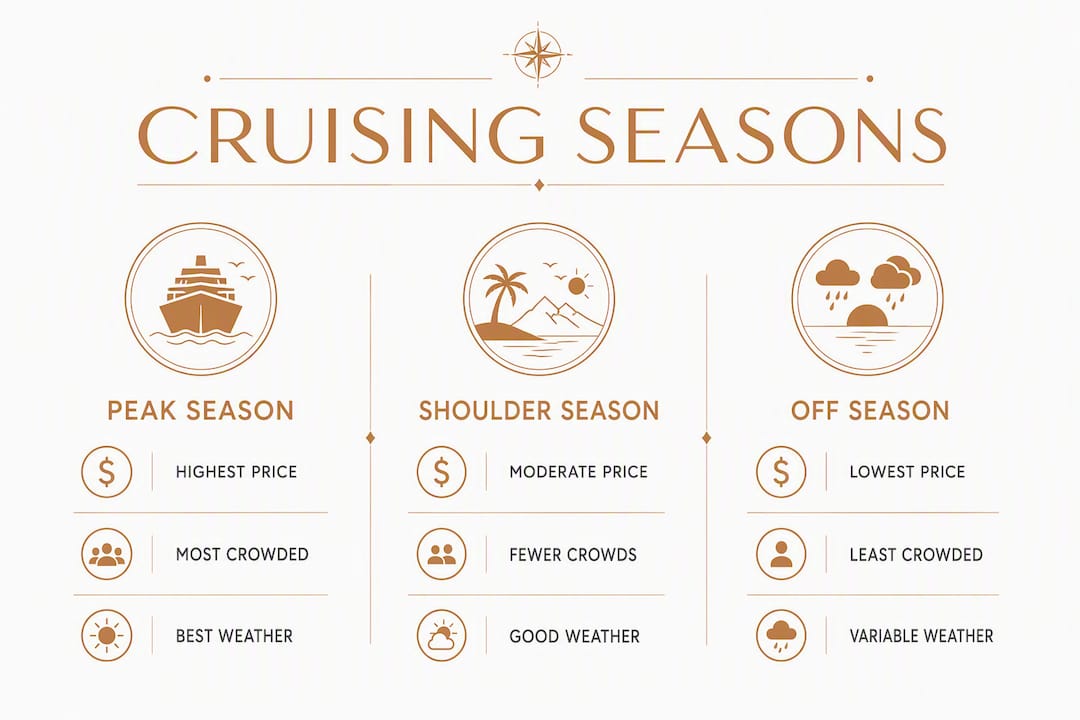
A cruising season is the operational window when weather, port access, and traveler demand align for a specific destination. Every major cruise region runs on one of three tiers: peak (best conditions, highest prices), shoulder (good weather, lower fares, thinner crowds), or off-season (cheapest fares, higher itinerary risk). If your priority is weather, book peak. If you want the best value without sacrificing experience, shoulder season is almost always the smarter call. If price is everything and you can handle a rerouted port or two, off-season delivers.
The planning takeaway is simple: most travelers get the best cruise experience by targeting the shoulder edges of a destination’s peak window. You get the weather without the crowds or the peak-season price tag.
Quick planning reference:
- Weather first: Book peak season for your destination.
- Budget first: Target shoulder season, typically meaningfully lower fares than peak according to consumer travel advisories.
- Fewest crowds: Early shoulder, just before peak kicks in.
- Avoid: Caribbean August–October (Atlantic hurricane season), Alaska November–March (closed), Antarctica April–October (closed).
Table of Contents
- What actually drives a cruising season?
- Peak, shoulder, and off-season: what each one actually means for you
- Destination-by-destination cruise season calendar
- How cruise lines redeploy ships between seasons
- How to pick the best time to cruise for your priorities
- Months and conditions worth approaching with caution
- When to book and how to save without giving up the experience
- Weather risks and the protections that actually matter
- Key Takeaways
- The season choice most travelers get wrong
- Hiddendoortravel makes season-based planning work for you
- Useful sources
What actually drives a cruising season?
A cruising season is not just a marketing label. It reflects real operational constraints that determine whether a ship can safely reach a port, whether that port is open, and whether enough travelers want to go.
Weather and climate windows are the primary driver. Cruise itineraries depend on predictable sea states, manageable wind patterns, and dry-enough conditions for shore excursions to run. The Caribbean’s prime window runs December through April because that is the dry season, with steady trade winds and minimal storm risk. Alaska’s season is compressed into late April through mid-October because outside those months, ice, weather, and reduced daylight make operations impractical.

Demand cycles layer on top of weather. School calendars, US federal holidays, and major events push pricing up during predictable windows. The week between Christmas and New Year’s is among the most expensive times to cruise the Caribbean regardless of weather. Spring break, summer break, and Thanksgiving week all follow the same pattern.
Port and infrastructure access adds another constraint. Some ports close seasonally due to ice, tidal conditions, or local regulations. Alaska’s ports operate under specific capacity rules that can shorten the effective season even when weather cooperates. Antarctica’s ports are only accessible when sea ice retreats, which limits the season to roughly November through March.
Pro Tip: Ship deployment cycles matter more than most travelers realize. When a cruise line repositions vessels between hemispheres, the ships available on a given route change. A newer, larger ship may only serve Alaska in summer and move to the Caribbean in winter, meaning the onboard experience you expect may not be available on your preferred dates.
Finally, cruise lines reposition ships seasonally to follow favorable climate windows, which directly affects which vessels and itinerary types are available in each market at any given time.
Peak, shoulder, and off-season: what each one actually means for you
Understanding the three-tier framework is the fastest way to match your priorities to a booking window.
Peak season delivers the best weather, the most reliable itineraries, and the widest selection of shore excursions. It also brings the highest fares, the most crowded ports, and the tightest cabin availability. Popular excursions sell out weeks before departure. Onboard, ships run at or near capacity, which affects everything from pool deck space to specialty restaurant reservations. For wildlife-focused sailings like Alaska bear viewing or Norwegian fjord whale watching, peak months often offer the best sightings, but you share those moments with more people.
Shoulder season is where experienced travelers tend to land. Weather is usually still good, crowds are noticeably thinner, and fares run meaningfully lower than peak. Shore excursion operators are still fully staffed, and ports have not yet reduced services. For luxury travelers especially, shoulder season often delivers a higher-quality experience than peak because the service-to-guest ratio improves across the ship.

Off-season is the high-risk, high-reward tier. Fares are at their lowest, but itinerary reliability drops. Cruise lines reserve the right to reroute or skip ports when weather deteriorates, and in some destinations, shore services thin out considerably. Shops, local tour operators, and restaurants in smaller ports may operate reduced hours or close entirely.
| Factor | Peak | Shoulder | Off-Season |
|---|---|---|---|
| Price | Highest | 15–30% below peak | Lowest |
| Crowds | Heavy | Moderate | Light |
| Weather reliability | Best | Good | Variable |
| Itinerary risk | Low | Low–moderate | Higher |
| Shore excursion access | Full | Full | Reduced |
| Best for | First-timers, families, wildlife | Value seekers, repeat cruisers | Budget travelers, flexible itineraries |
For a deeper look at how luxury cruises differ from mainstream sailings across these season types, the gap in service quality during off-season is worth understanding before you book.
Destination-by-destination cruise season calendar
Seasons vary dramatically by region. Here is a practical breakdown of when to go, what to expect, and who each window suits best.
Caribbean and Mexico
The Caribbean’s prime window runs December through April, when the dry season brings calm seas, low humidity, and reliable sunshine. February through April is the sweet spot: past the holiday premium, before the heat builds. May and November are shoulder months with good weather and lower fares. August through October is the core of the Atlantic hurricane season, bringing the cheapest fares but real itinerary risk. Cruise lines do sail through hurricane season, but port substitutions and rerouting are common.
- Peak: December–April
- Shoulder: May, November
- Avoid with caution: August–October
Alaska
Alaska’s season runs from late April through mid-October, with mid-June through mid-July as the peak for weather and wildlife. Bears are most visible at salmon streams in late July and August. May and September are the shoulder months: fewer crowds, lower fares, and still-excellent scenery, though wildlife sightings can be less predictable. Alaska’s operational season is also subject to port capacity regulations that can limit itinerary options at the edges of the window.
- Peak: Mid-June–July
- Shoulder: May, September
- Closed: November–March
For expedition-style Alaska sailings, luxury expedition cruise options extend into the shoulder months with smaller ships that access ports larger vessels cannot reach.
Mediterranean and Greece
The Mediterranean runs April through October, with July and August as peak. The heat in peak summer is intense, particularly in Greek islands and southern Spain, and popular ports like Santorini and Dubrovnik are extremely crowded. May, June, and September are the standout shoulder months: warm water, manageable temperatures, and far fewer day-trippers competing for the same sites. October is viable but some smaller island services begin winding down.
- Peak: July–August
- Shoulder: May–June, September
- Shoulder advantage: Significantly lower fares, cooler temperatures, better shore access
Northern Europe, Baltic, and Norwegian fjords
This region operates on a compressed summer window. June through August is peak, capturing the midnight sun in Norway and Iceland and the best weather for Baltic capitals like Tallinn and Stockholm. May and September offer shoulder pricing with still-pleasant conditions, though Iceland and Norway can be unpredictable in shoulder months.
- Peak: June–August
- Shoulder: May, September
- Best for: Cultural itineraries (Baltic), dramatic scenery (fjords), northern lights (late September)
Panama Canal, South Pacific, Australia, and Asia
These regions follow their own seasonal logic:
- Panama Canal transits: Year-round, but repositioning sailings in April–May and October–November offer the best value as ships move between Atlantic and Pacific deployments.
- Antarctica: Strictly November through March. Outside this window, the continent is inaccessible. January is peak for wildlife; November and March offer shoulder pricing with fewer ships.
- Australia and New Zealand: Southern Hemisphere summer, November through March, mirrors the Caribbean’s northern winter window.
- Asia and Dubai: October through April avoids monsoon season. Dubai peaks in winter (November–February) when temperatures are comfortable rather than extreme.
How cruise lines redeploy ships between seasons
The cruise industry is not seasonal in the traditional sense. A hotel sits in one place; a ship moves. Academic research on cruise deployment confirms that vessels cluster in Alaska and Northern Europe during summer months and migrate toward the Caribbean and Southern Hemisphere as northern winters arrive. This migration is what makes the industry function year-round.
Why repositioning happens:
- Seasonal demand shifts: Alaska and Norway fill ships in summer; the Caribbean fills them in winter.
- Asset utilization: an idle ship earns nothing. Lines move vessels to wherever demand is strongest.
- Fleet rotation: newer ships often serve the most popular seasonal routes; older vessels may cover shoulder or off-season deployments.
What a repositioning voyage is:
A repositioning cruise is the transit sailing between a ship’s summer and winter home ports. A vessel finishing its Alaska season in October might sail from Vancouver to Fort Lauderdale, stopping in San Francisco, Los Angeles, and a few Mexican ports along the way. These sailings tend to be longer (10–18 days), include more sea days than typical itineraries, and are priced well below comparable port-intensive cruises.
For travelers who enjoy sea days, interesting one-way routing, and lower fares, repositioning voyages are one of the best-kept values in cruising. The tradeoff is fewer port calls and sometimes limited excursion infrastructure at the transit stops. World cruise itineraries often incorporate repositioning legs as part of longer circumnavigation routes.
Practical implications for travelers:
- The ship assigned to a route in shoulder season may differ from the peak-season vessel.
- Onboard amenities vary by ship class. A repositioning voyage may put you on an older vessel.
- Shore excursion availability at transit ports is often limited compared to established seasonal homeports.
- Repositioning fares can be significantly lower than standard sailings on the same ship.
How to pick the best time to cruise for your priorities
The right season is not universal. It depends on what you are optimizing for. Run through this checklist before you book.
- Check wildlife and nature priorities — Bear viewing in Alaska peaks in late July and August. Antarctic penguin colonies are most active in January. Mediterranean wildflowers peak in May. Timing for nature experiences is non-negotiable.
For help selecting a luxury cruise itinerary that matches your season priorities, the decision gets more nuanced when you factor in ship class, excursion exclusivity, and port access.
Pro Tip: Shoulder weeks at the start of a season often outperform those at the end. Early May in the Mediterranean, for example, gives you the weather ramp-up with almost none of the summer crowds. Late September in Alaska gives you fall colors and calmer seas, but some operators have already reduced services.
Months and conditions worth approaching with caution
Not every month on the calendar is equal, and some windows carry real risks that go beyond inconvenience.
Caribbean hurricane season (June 1–November 30) is the most widely cited risk window. The Atlantic hurricane season, as defined by NOAA, runs June through November, with peak activity from August through October. Cruise lines do operate during this period, but itinerary changes are common. Ships may skip scheduled ports, substitute alternatives, or alter routing with little advance notice. The fares are lower for a reason.
Alaska’s closed season (November–March) is not a risk window so much as a non-window. Ports are effectively closed, and no major cruise lines operate standard Alaska itineraries during these months.
Antarctica outside November–March is similarly inaccessible. The sea ice makes expedition landings impossible, and no reputable operator runs Antarctic sailings outside the southern summer window.
Mediterranean late October through March is not dangerous, but the experience degrades. Many smaller island ports in Greece and Croatia reduce services significantly after October. Shops close, local tour operators stop running, and the atmosphere that makes these ports worth visiting largely disappears.
North Atlantic and transatlantic crossings in winter carry elevated sea-state risk. Swells can be significant, and while modern ships handle them safely, the onboard experience suffers. Motion sickness is more common, outdoor deck activities are limited, and port calls in the Azores or Canary Islands may be affected by weather.
Quick mitigation steps:
- Purchase cruise travel insurance before final payment to cover itinerary changes and cancellations.
- Choose flexible booking terms that allow date changes without heavy penalties.
- If you must sail in a risk window, pick itineraries with multiple port options so a single closure does not ruin the trip.
- For Caribbean sailings in September or October, check shore excursion weather guidance for specific ports before committing to excursions.
When to book and how to save without giving up the experience
Booking timing is as strategic as season selection. Get it wrong and you either overpay or lose access to the cabin and excursions you want.
Booking timeline by season type:
- Peak season sailings: — Book 12–18 months out. Popular Caribbean holiday sailings and Alaska summer departures fill quickly. Waiting until 6 months out means settling for whatever cabin categories remain.
Practical savings tactics:
| Booking window | Best for | Cabin choice | Excursion access |
|---|---|---|---|
| 12–18 months out | Peak season, Alaska, Antarctica | Best selection | First access |
| 6–9 months out | Shoulder season, Mediterranean | Good selection | Good access |
| 3–6 months out | Off-season, repositioning | Limited | Moderate |
| Under 60 days | Last-minute off-season deals | Very limited | Limited |
Weather risks and the protections that actually matter
Cruise lines are not passive when weather threatens. They have operational tools, and travelers have their own.
How cruise lines respond to weather:
- Routing changes: Ships alter course to avoid storm systems. A Caribbean itinerary may swap a windward island for a leeward one if a tropical system develops.
- Speed adjustments: Vessels increase speed to outrun deteriorating conditions or slow down to let a system pass.
- Port substitutions: A closed or unsafe port gets replaced with an alternative. This is the most common disruption travelers experience.
- Full cancellations: Rare, but possible when a named storm threatens a homeport or the entire planned route.
Where to check before you travel:
The NOAA National Hurricane Center publishes real-time storm tracking and seasonal outlooks. Check it before any Caribbean or Gulf sailing between June and November. Local port authority advisories are also worth reviewing for destinations with known seasonal access issues.
Trip insurance: what it covers and when to buy it:
Standard cruise travel insurance typically covers trip cancellation due to named storms, medical emergencies, and itinerary changes that result in missed ports. The critical detail is timing: most policies exclude coverage for storms that are already named when you purchase the policy. Buy insurance at or shortly after booking, not when a storm appears on the forecast.
Pro Tip: “Cancel for any reason” (CFAR) upgrades cost more but give you the flexibility to cancel a sailing in a risk window without needing a covered reason. For Caribbean sailings in September or October, CFAR is often worth the premium.
Traveler action steps for higher-risk seasons:
- Book refundable or flexible-rate fares when sailing in storm-prone windows.
- Keep emergency contact information for the cruise line, your travel agent, and your insurer in one accessible place.
- Register your travel with the US State Department’s STEP program before international sailings.
- Build a contingency day into your travel schedule around embarkation and disembarkation to absorb weather delays.
Key Takeaways
Shoulder season delivers the best balance of weather, price, and experience for most cruise destinations, making it the default recommendation for travelers with any flexibility.
| Point | Details |
|---|---|
| Season tiers | Every destination runs on peak, shoulder, or off-season, each with distinct tradeoffs in price, crowds, and itinerary reliability. |
| High-risk months | Caribbean August–October (hurricane season), Alaska November–March, and Antarctica April–October are windows to avoid or approach carefully. |
| Booking windows | Peak sailings need 12–18 months lead time; shoulder sailings work well at 6–9 months; off-season last-minute deals appear within 60–90 days. |
| Shoulder value | Shoulder season fares are meaningfully lower than peak while retaining good weather and full shore excursion access. |
| Hiddendoortravel | Hiddendoortravel’s bespoke planning service helps luxury travelers identify the optimal season window, secure preferred cabins early, and arrange exclusive shore access. |
The season choice most travelers get wrong
The conventional advice is to book peak season for the best experience. That is wrong for most travelers, and the math makes it obvious. Peak season is designed for the traveler who has no flexibility, no repeat experience with a destination, and no interest in tradeoffs. For everyone else, it is the most expensive way to get a more crowded version of the same trip.
The real mistake is treating season selection as a weather question when it is actually a priorities question. Travelers who book Alaska in July because “that’s when Alaska is best” often spend their port days in Juneau shoulder-to-shoulder with thousands of other passengers from multiple ships. The traveler who books May or September gets the same glaciers, often better bear sightings at less-trafficked streams, and a ship that is not running at capacity.
The same logic applies to the Mediterranean. August in Santorini is genuinely beautiful. It is also genuinely overwhelming. June or September gives you the same light, the same wine, and the same caldera views, with a fraction of the foot traffic.
Where bespoke planning changes the equation is in the details that generic booking cannot handle. Knowing which specific shoulder weeks still have full excursion operator schedules, which ships are deployed on a given route in May versus July, and which ports are worth prioritizing before local services wind down, that is agency-grade knowledge that changes the actual quality of the trip. The season is the frame. What goes inside it is where the real decisions are made.
Hiddendoortravel makes season-based planning work for you
Picking the right season is one decision. Executing it well across cabin selection, shore excursions, insurance timing, and contingency planning is another. Hiddendoortravel’s luxury travel experts handle the full picture, from identifying the shoulder weeks that still deliver peak-quality experiences to securing exclusive excursion access that sells out months before departure.
For luxury cruise clients, the agency’s value is most visible in the details: knowing which repositioning voyages offer genuine value versus which ones sacrifice too many port calls, coordinating travel insurance purchase timing to maximize coverage, and building contingency options into Caribbean itineraries that fall near the hurricane window. Hiddendoortravel also works directly with premium cruise lines to access cabin categories and shore programs that are not available through standard booking channels. If you are planning a cruise and want the season, the ship, and the experience to align, contact the team for a planning conversation.
Useful sources
- The Best Time to Go on a Cruise, Cruise Critic
- Seasonality of the Global Cruise Industry, ScienceDirect
- Cruise Ship Repositioning and Seasonality, ScienceDirect
- Best Time to Cruise Alaska, Alaska.org
- Caribbean Cruising Seasonality Overview, Ocean Posse
This article provides general travel planning information. Season windows, port access rules, and insurance terms change regularly. Confirm current conditions with official port authorities, NOAA advisories, and a qualified travel professional before booking.