
Cruise gratuities differ because lines choose fundamentally different service models. Some bundle tips into the fare; others add a separate per-person, per-day charge plus percentage surcharges on optional purchases. On mainstream and premium lines, daily auto-gratuities run roughly $17–$25 per person, and most lines add a percentage surcharge on bar tabs, specialty dining, and spa bills. Royal Caribbean, for example, charges 18% on beverages and specialty dining and 20% on spa and salon services. Knowing this before you book is the difference between an accurate budget and a folio shock at disembarkation.
Table of Contents
- How are cruise gratuities structured on most ships?
- Why do gratuity rates change from one line to the next?
- What do major cruise lines actually charge in 2026?
- How to budget for gratuities on a 7-night cruise
- Which crew members actually receive the pooled gratuities?
- What should you verify on a cruise line’s policy page before booking?
- Key Takeaways
- The part most travelers get wrong about gratuities
- How Hiddendoortravel handles gratuities for bespoke cruise clients
- Useful sources for verifying current gratuity policies
How are cruise gratuities structured on most ships?
Three components make up the full picture: a daily service charge per person, a percentage added to optional purchases, and a tip pooling system distributing funds among crew.
The daily charge appears on your onboard folio as a line item, labeled accordingly, accumulating each night, and is prepaid or charged at the end. Percentage charges on optional services, usually 18%–20%, are added at the point of sale and cannot normally be removed because they are set by the merchant contract for those outlets. A typical folio might show: “Daily gratuity $18.00,” “Bar service 18% $4.32,” “Spa 20% $28.00.”
Pooling means the collected daily charges are distributed across multiple departments, rather than given directly to any one individual. That is why removing the charge affects crew you never see, not just your waiter.
Pro Tip: Prepay gratuities when possible to lock in a rate and simplify final billing. It also removes one line item from your final folio, which simplifies disembarkation.
Why do gratuity rates change from one line to the next?
The short answer: business model, staffing ratios, and market positioning. Gratuity levels have been rising across the industry, and the gap between a luxury all-inclusive fare and a mainstream a la carte fare is now a meaningful budget variable.
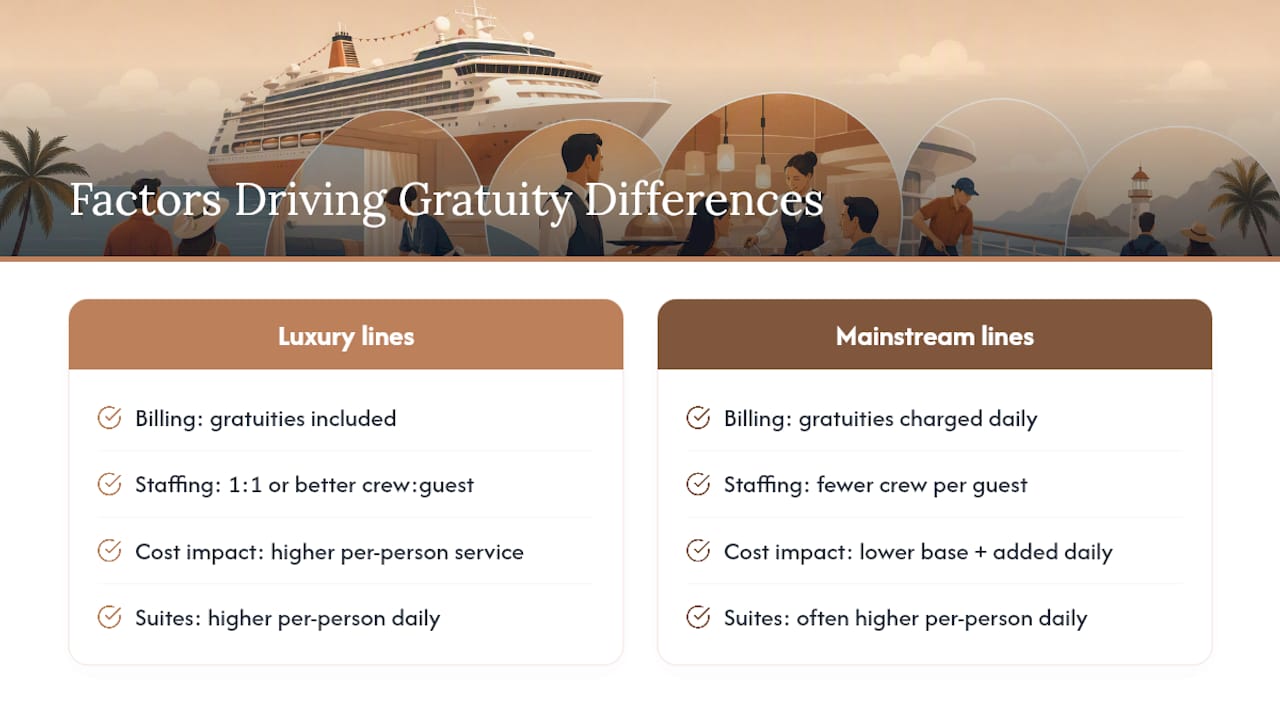
Included vs. separate. Some luxury lines include gratuities within the cruise fare. You pay more upfront, but nothing extra accumulates daily. Many mainstream lines charge gratuities separately, adding daily charges on top of the base fare. Understanding why luxury cruises differ from mainstream helps clarify why the sticker price gap is often smaller than it looks once you add gratuities.
Staffing ratios. A luxury line with a 1:1 or better crew-to-guest ratio employs more people per passenger, which drives higher per-person service costs. Those costs are either absorbed into the fare or reflected in higher daily charges.
Suite differentials. Many lines charge suite guests a higher gratuity per person per day than standard cabin guests, reflecting additional services.
Child and toddler rules. Policies vary widely. Some lines exempt children under 2 entirely; others charge a reduced rate for children under 12. Disney Cruise Line charges gratuities for all guests regardless of age.
Currency and region. European sailings on some lines are priced in euros, so U.S. travelers booking those itineraries may see a different base rate than they expect from a dollar-denominated policy page.
What do major cruise lines actually charge in 2026?
The table below reflects approximate rate ranges commonly reported on official policy pages. Line-by-line 2026 effective dates and suite differentials confirm which lines bundle and which charge separately.
| Cruise Line | Gratuity Model | Per Person/Day (Standard) | Suite Differential | Bar/Spa % |
|---|---|---|---|---|
| Royal Caribbean | Separate daily charge | ~$18.00 | Yes (+$2–$3) | 18% / 20% |
| Carnival Cruise Line | Separate daily charge | ~$18.00 | Yes | 18% |
| Norwegian Cruise Line | Separate daily charge | ~$18.00–$20.00 | Yes (+$5) | 20% |
| Princess Cruises | Separate daily charge | ~$18.00 | Yes | 18% |
| MSC Cruises | Separate daily charge | ~$13.50–$16.00 | Yes | 18%–20% |
| Celebrity Cruises | Separate daily charge | ~$18.00–$20.00 | Yes (+$4) | 18%–20% |
| Holland America | Separate daily charge | ~$18.00 | Yes | 18% |
| Disney Cruise Line | Separate daily charge | ~$13.50 | No differential | 18% |
| Cunard | Separate daily charge | ~$13.50–$16.00 | Yes | 18%–20% |
| Oceania Cruises | Separate daily charge | ~$18.00 | Yes | 18%–20% |
| MSC Yacht Club / MSC Suites | Separate (suite tier) | ~$18.00 | Included above | 18%–20% |
| Princess (Suites) | Separate daily charge | ~$18.00 | Included above | 18% |
| Regent Seven Seas | Included in fare | N/A | N/A | N/A |
| Silversea | Included in fare | N/A | N/A | N/A |
| Seabourn | Included in fare | N/A | N/A | N/A |
| Virgin Voyages | Included in fare | N/A | N/A | N/A |
Rates are approximate and subject to change. Verify on each line’s official policy page before final payment.
Note: Industry benchmarks confirm many major lines now charge $17–$25 per person per day, with the upper end driven by suite differentials and premium positioning.
How to budget for gratuities on a 7-night cruise
Two adults on a mainstream line paying a typical daily gratuity per person can expect a substantial total for a 7-night sailing. Adding gratuities on bar tabs and specialty dining increases the total costs noticeably.
| Scenario | Rate | 2 Adults, 7 Nights |
|---|---|---|
| Mainstream standard cabin | $18.00/person/day | — |
| Luxury all-inclusive line | Included in fare | $0 additional |
Bar and dining gratuity surcharges are charged separately. Two people spending $40/day on drinks at 18% adds another $100.80 over seven nights. Specialty dining at $60/person with 18% adds $21.60 per meal. A single spa visit at $150 with 20% adds $30.00. The smart approach to managing luxury travel expenses is to estimate these totals before boarding, not after.
Pre-departure and onboard checklist:
- Confirm whether gratuities are included or separate when you book
- Prepay the daily charge to lock the current rate
- Check your folio on day 3 or 4 to catch any unexpected charges early
- Visit Guest Services before the last full day if you need to adjust for documented service failures
- Confirm child exemptions and suite differentials in writing before final payment
Pro Tip: Check each receipt carefully at bars and specialty restaurants. If a percentage gratuity is already printed on the receipt, the line has auto-charged it. Writing an additional amount on the tip line doubles the charge. Leave the tip line blank or write $0 if the auto-charge is already applied.
Which crew members actually receive the pooled gratuities?
Most auto-gratuities go into a shared pool distributed across food and beverage teams, stateroom attendants, buffet crew, and behind-the-scenes support staff like laundry and galley workers. Tip pooling exists specifically to give non-visible crew a share of gratuities rather than concentrating all tips with front-of-house staff.
Excluded from the pool: the captain, senior officers, entertainment staff, and third-party concession employees (think the boutique shop or the casino staff). Those roles are salaried positions.
Removing the auto-charge does not just reduce your waiter’s income. It reduces the payout for the person who cleaned your cabin at midnight, the crew member who pressed your shirts, and the galley worker who prepped your breakfast. Adjust the daily charge only for a genuine, documented service failure, and do it at Guest Services rather than simply removing it at checkout.
What should you verify on a cruise line’s policy page before booking?
Confirm these specifics before you pay the deposit:
Whether gratuities are included in the fare or charged separately is the first question. If separate, note the exact per-person, per-day rate for your cabin category. Then check whether a suite differential applies and by how much. Verify the percentage surcharge on beverages, specialty dining, and spa services, since those vary by line and sometimes by ship class.
Age cutoffs matter if you are traveling with children. Some lines charge full gratuities for children over 2; others set the cutoff at 12. Get the exact rule for your sailing date, not a general policy, because lines update these. Detailed line-specific guidance on children’s gratuity rules is the most reliable place to verify current cutoffs.
Ask whether prepaid gratuities are refundable if you cancel. Some lines refund them in full; others treat them as non-refundable after a certain window. Screenshot or save a PDF of the policy page at booking, and confirm the details in writing with your travel agent or the cruise line before final payment.
Key Takeaways
Cruise gratuities vary because lines use different service models, staffing ratios, and pricing structures, so the only reliable budget is one built from each line’s current official policy.
| Point | Details |
|---|---|
| Included vs. separate | Luxury lines (Regent, Silversea, Seabourn, Virgin) include gratuities; mainstream lines charge $17–$25 per person per day. |
| 7-night math | Two adults at $18/day owe $252 in daily charges before bar, dining, or spa surcharges. |
| Percentage surcharges | Most lines add 18%–20%–20% to bar, specialty dining, and spa bills; these cannot usually be removed. |
| Bring cash for extras | Porters, guides, butlers, and kids’ club staff fall outside the auto-gratuity pool and expect cash. |
| Hiddendoortravel advantage | Hiddendoortravel builds gratuity lines into bespoke budgets, prepays when useful, and verifies policy details before final payment. |
The part most travelers get wrong about gratuities
The conventional wisdom is that luxury lines are overpriced and mainstream lines are the better deal once you add up the extras. That framing misses something. When you add daily gratuities, bar surcharges, specialty dining fees, and spa charges to a mainstream fare, the gap between a bundled luxury fare and an itemized mainstream one shrinks considerably, sometimes to nothing.
What matters more than the model is whether you actually know what you owe before you board. The travelers who feel blindsided by gratuities are almost always the ones who checked the base fare and stopped there. The daily charge is not a hidden fee. It is published on every line’s policy page. The problem is that most people do not read it until they see the folio.
For high-end sailings, the all-inclusive model does more than simplify the bill. It removes a category of friction entirely. No mental math at the bar, no receipt scrutiny at the spa, no envelope-stuffing on the last night. That is worth something, especially on a sailing where the point is to stop thinking about logistics.
How Hiddendoortravel handles gratuities for bespoke cruise clients
Gratuity surprises are one of the most common complaints from first-time luxury cruise travelers, and they are entirely preventable. Hiddendoortravel builds every gratuity line into your trip budget from day one: daily charges, percentage surcharges on optional services, and cash allowances for porters, guides, and butlers. When prepaying makes sense, the agency handles it. When a line’s policy has changed since booking, you hear about it before you board, not at Guest Services.

The agency’s luxury travel planning service covers the full cost picture for every sailing, including the line-specific details that most travelers only discover onboard. If you are comparing a bundled luxury fare against a mainstream option, Hiddendoortravel runs the real numbers so the comparison is honest. To get a bespoke cruise budget with gratuities already factored in, start a conversation with the team.
Gratuity policies change. Always verify current rates directly with the cruise line before final payment.
Useful sources for verifying current gratuity policies
Rates and policies change, sometimes mid-season. Check these sources before final payment:
- Royal Caribbean FAQ — Onboard service gratuity/expense
- Tipping on a cruise: What to know about ship gratuities – The Points Guy
- Cruise Tipping for 2026: What You’ll Actually Owe, by line — In the Wake
- Gratuities – What’s the Point? – Cruise Critic
- Cruise Gratuities Explained: 2026 Rates & How to Adjust
- How cruise gratuities really work – Forbes
- Cruise gratuities guide – Cruise Maven
- Tipping on a cruise: Your complete big-ship tip guide – Cruise Critic