
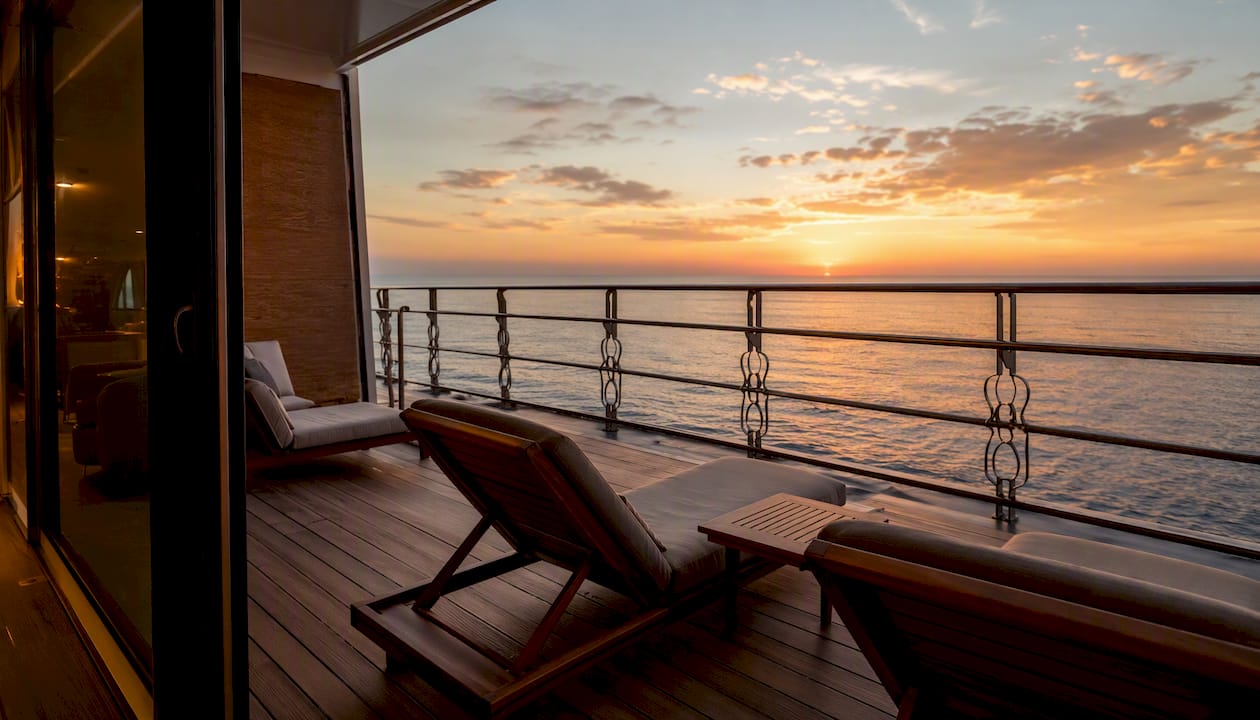
A verandah suite is a cruise stateroom or suite with a private outdoor verandah, accessed through floor-to-ceiling sliding glass doors, that gives you unobstructed sea or port views and fresh air without sharing space with anyone else. As NG Cruise explains, the verandah functions as a direct extension of the cabin, typically furnished with seating and enclosed by a glass balustrade. On luxury lines, the suite tier adds a separate lounge, upgraded bath, and considerably more interior square footage on top of that private outdoor space.
Who benefits most from booking one:
- View-focused travelers on scenic itineraries (Alaska, Norway, Antarctica) where the outdoor space earns its cost every single day
- Couples and honeymooners who want a private retreat rather than a shared pool deck
- Travelers sensitive to fresh air and ventilation, for whom an interior or oceanview cabin feels genuinely confining after day two
- Anyone on a longer voyage where the verandah becomes a daily-use living space, not just a novelty
Table of Contents
- What features and amenities do verandah suites typically include?
- How big are verandah suites, and what do the layouts look like?
- How do major cruise lines name and configure verandah suites?
- Is a verandah the same thing as a balcony?
- Is a verandah suite worth the upgrade?
- How do you choose and book the right verandah suite?
- How Hiddendoortravel advises clients on verandah suite bookings
- Key Takeaways
- The verandah upgrade most travelers get wrong
- Hiddendoortravel makes verandah suite selection straightforward
- Useful sources
What features and amenities do verandah suites typically include?
The private outdoor space is the headline, but the interior package is what separates a standard veranda stateroom from a true verandah suite, as detailed in this overview of yacht sundeck design and features. CruiseDeckPlans’ detailed listing for the Seabourn Sojourn shows exactly what a luxury verandah suite delivers: two lower beds convertible to a queen, a walk-in closet, a granite-topped bathroom, full-length glass door access to the verandah, and an in-suite refrigerator.
Verandah (outdoor) features:
- Private furnished space with at least two chairs and a small table
- Glass or solid balustrade (glass gives unobstructed sightlines)
- Size varies from roughly 65–75 sq ft on mass-market ships to 100+ sq ft on luxury vessels
- Corner and extended verandahs wrap around the ship’s hull for wider views
Interior features commonly paired with verandah suites:
- Seating or living area (sofa, armchairs) separate from the sleeping zone
- Sleeping configuration: two lower beds, queen, or king depending on category
- Bathroom options: shower-only at entry level; soaking tub plus double vanity at suite tier
- Mini-fridge or stocked bar, coffee machine, hairdryer, in-room safe
| Feature | Veranda Stateroom | Verandah Suite |
|---|---|---|
| Private outdoor space | Yes | Yes (often larger) |
| Separate living area | Rarely | Usually |
| Bathroom | Shower only | Tub + double vanity |
| Walk-in closet | No | Often |
| Butler/concierge service | No | On many luxury lines |
| Stocked bar/fridge | Mini-fridge | Full bar setup |
When reviewing listings, always look for published floorplans, exact square footage, deck location, and photo galleries. A listing without those details is asking you to guess.
How big are verandah suites, and what do the layouts look like?
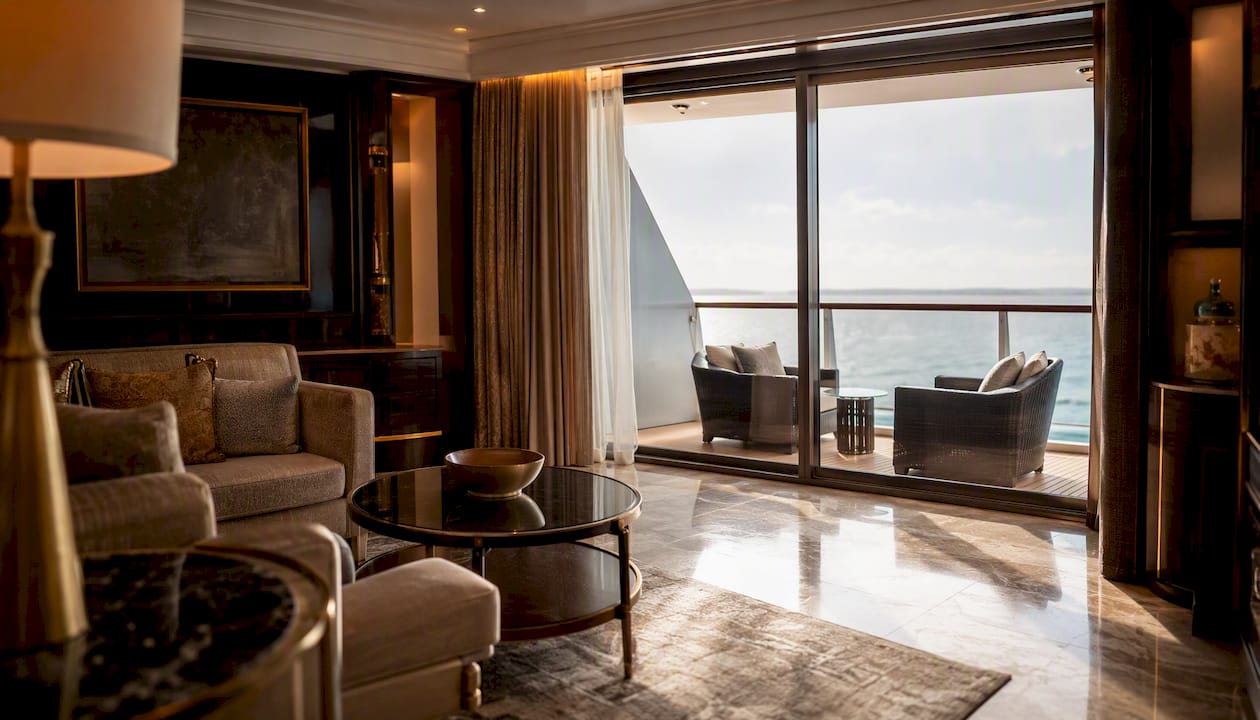
Size ranges vary more than most booking sites suggest. Seabourn publishes interior and verandah dimensions separately, with veranda suites running roughly 23–28 m² (approximately 248–301 sq ft) inside plus a 6–7 m² (65–75 sq ft) verandah. That level of published precision is what you should demand from any line you’re considering.
| Category | Interior (approx.) | Verandah (approx.) | Layout |
|---|---|---|---|
| Standard veranda stateroom | — | 65–75 sq ft | Open plan, beds + small sitting area |
| Veranda suite | — | 65–100 sq ft | Lounge area + sleeping zone |
| Deluxe/Grand verandah suite | — | 100 sq ft | Separate bedroom, dining area |
| Corner/wrap verandah | — | — | Angled or L-shaped outdoor space |
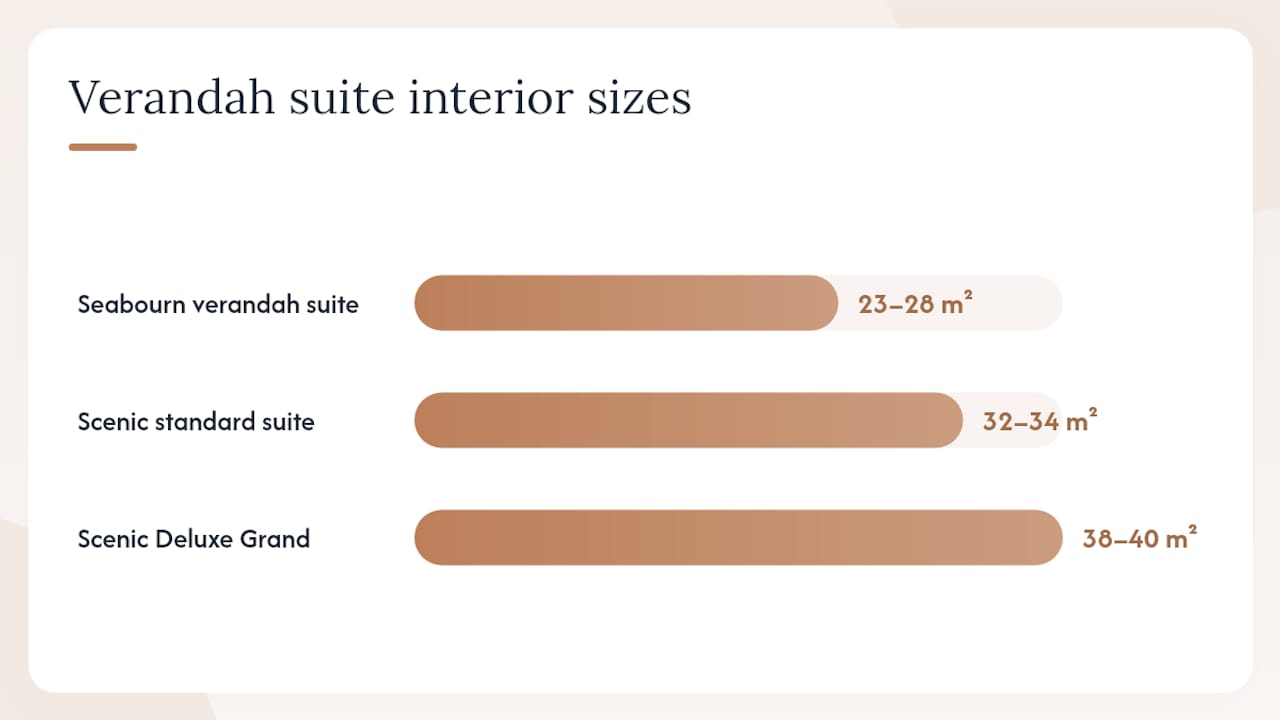
Scenic Eclipse’s Verandah Suites sit at roughly 32–34 m² for standard verandah suites and 38–40 m² for Deluxe Grand Verandah Suites, with floor-to-ceiling sliding glass doors and separate lounge areas. Those published dimensions are a reliable benchmark for what a small-ship luxury verandah suite actually delivers.
How to use deck plans effectively:
- Pull the ship’s deck plan and locate your cabin number before booking
- Check whether the cabin sits below a pool deck, a lifeboat station, or a high-traffic corridor
- Verify whether the verandah is fully open or partially obstructed by a lifeboat or overhang
- Corner cabins (often labeled “C” or “wrap”) appear at the ship’s bow or stern and offer wider sightlines
For luxury expedition itineraries where scenery is the entire point, the verandah’s orientation relative to the ship’s route matters as much as its square footage.
How do major cruise lines name and configure verandah suites?
The terminology shifts by brand, but the underlying product is consistent: a private outdoor platform attached to your cabin. What changes is the size, the finish level, and occasionally the access mechanism.
- Scenic (Scenic Eclipse): Offers Verandah Suites and Deluxe Grand Verandah Suites with floor-to-ceiling sliding glass doors, butler service, and published square-meter specs. The “Deluxe” label signals a larger interior and a more generous outdoor space, not just a cosmetic upgrade.
- Silversea: Uses “Veranda Suite” across several ship classes. Suite tiers step up through Vista, Veranda, and Medallion categories, with the Veranda Suite typically offering a sitting area, marble bathroom, and a private verandah with ocean views.
- Celebrity Cruises: Brands its offering as the Infinite Veranda® on Edge-class ships. The design converts the traditional balcony into an extension of the interior living space at the touch of a button, with the floor-to-ceiling glass wall opening fully. Celebrity describes their Edge Staterooms with Infinite Veranda® as larger than their prior Solstice Series veranda staterooms.
- Disney Cruise Line: Uses the term “verandah” for its private balconies across most of its fleet. The product is functionally equivalent to a balcony stateroom on other lines; DCL’s choice of “verandah” is a branding tradition, not a signal of a different product.
- “Deluxe” or “Grand” in the suite name usually means more interior square footage and a larger outdoor space, not just better furnishings.
- “Penthouse” or “Owner’s” signals suite-level verandahs with premium finishes, butler service, and sometimes a private hot tub.
- Brand-specific innovations like Celebrity’s Infinite Veranda® change the physical experience enough that you should read the product description carefully rather than assuming equivalence with a traditional balcony.
Is a verandah the same thing as a balcony?
Functionally, yes. The Oxford Learner’s Dictionaries define “veranda” as a roofed platform attached to a building, and Longman’s definition reinforces the same architectural concept. In maritime use, cruise lines apply “verandah,” “veranda,” and “balcony” to the same product: a private outdoor platform attached to a stateroom. The choice of term is almost always a branding or regional tradition decision, not a structural one.
Disney uses “verandah.” Most American mass-market lines say “balcony.” European and luxury lines often prefer “veranda” or “verandah.” The spelling difference between “veranda” and “verandah” carries no functional meaning whatsoever.
What actually matters when you’re comparing listings:
- Exact square footage of the outdoor space (not just the cabin)
- Railing type: glass gives unobstructed views; solid panels block sightlines when seated
- Furniture included: two chairs and a table is standard; a sun lounger is a genuine upgrade
- Whether the space is covered, partially covered, or fully open to the sky
- Access: sliding glass door vs. a hinged door affects how the space feels from inside
Pro Tip: Never compare two cabins by name alone. A “Verandah Suite” on one line and a “Balcony Stateroom” on another may deliver nearly identical outdoor space. Pull the floorplan and the published square footage for both before drawing any conclusions.
Is a verandah suite worth the upgrade?
The honest answer depends on your itinerary and how you actually spend time on a ship. On a Caribbean beach-stop cruise where you’re off the ship by 8 AM and back for dinner, the verandah gets used for morning coffee and not much else. On a scenic coastal voyage through the Norwegian fjords or the Chilean channels, that private outdoor space becomes the reason you booked the trip.
Genuine advantages:
- Private retreat with no competition for deck chairs or sightlines
- Direct ventilation and natural light, which matters on longer voyages
- Better resale value if you need to transfer a booking
- On scenic itineraries, the verandah is where the experience actually happens
Real drawbacks to weigh:
- Higher cost than an interior or oceanview cabin, sometimes significantly so
- Cabins below pool decks or near the ship’s anchor can be noisy
- On smaller ships, wake turbulence and spray can make the verandah unusable in rough weather
- Lifeboats obstruct the view on certain mid-ship and lower-deck cabins
| Traveler type | Verandah worth it? | Why |
|---|---|---|
| Scenic itinerary (fjords, Alaska, Antarctica) | Strongly yes | Outdoor space is the primary experience |
| Beach-stop Caribbean cruise | Situational | Depends on time spent aboard |
| Honeymooner / couple | Yes | Privacy and atmosphere justify the cost |
| Budget-focused traveler | Probably not | Interior cabin frees budget for excursions |
| Traveler prone to seasickness | Yes | Fresh air and horizon views help significantly |
Pricing varies too much by line and season to quote a universal figure, but the upgrade delta on premium small-ship lines tends to be proportionally smaller relative to the base fare than on mass-market ships. Watch for early-booking promotions and cabin upgrade offers, which agents can often access before they reach the public.
Pro Tip: On scenic itineraries, book the verandah on the side of the ship facing the primary attraction. On Alaska’s Inside Passage, that’s typically the port side northbound. Ask your agent to confirm orientation before finalizing the cabin number.
How do you choose and book the right verandah suite?
Matching your cabin to your itinerary is the single most important step most travelers skip. Here’s the checklist that actually matters:
- Confirm exact square footage for both the interior and the verandah separately. A listing that gives only a combined figure is hiding something.
- Request the floorplan and verify whether the layout is open-plan or has a separate sleeping area.
- Check the deck plan for your cabin’s position: below a pool deck, near the anchor windlass, or adjacent to a crew corridor are all red flags.
- Verify verandah obstruction by lifeboat or lifeboat davit. Mid-ship cabins on lower decks are the most common offenders.
- Ask about furniture included on the verandah: chairs, table, sun lounger, or just a railing.
- Request photos or a cabin walkthrough video for the specific cabin number, not just the category.
Questions to ask your agent or the cruise line directly:
- What deck is this cabin on, and what is directly above it?
- Is the verandah fully open or partially covered?
- Which direction does the verandah face relative to the ship’s typical route?
- Are there any HVAC vents or mechanical equipment near the verandah?
- What is the earliest this cabin category has historically been available for upgrade?
Timing matters. Booking early secures the best cabin selection within a category. Waiting for last-minute deals often means taking whatever cabin remains, which is frequently the one nobody else wanted.
How Hiddendoortravel advises clients on verandah suite bookings
The agency’s recommendation to upgrade to a verandah suite turns on three factors: itinerary type, ship size, and how the client actually uses their time at sea. On a small-ship expedition to Patagonia or a scenic river route, the verandah is non-negotiable. On a large resort ship with a beach-stop itinerary, the calculus shifts.
When a client is considering a verandah upgrade, the first thing we verify is the deck plan, not the brochure. We cross-reference the cabin number against the ship’s layout to confirm there’s no lifeboat blocking the sightline and no pool deck directly overhead. Then we pull actual photos of that specific cabin, not the category render. That 10-minute check has saved clients from booking a “verandah suite” that looks out at a steel davit arm.
Pro Tip: Ask your agent to pull the CruiseDeckPlans or equivalent resource for your specific ship and cabin number. Category photos are marketing material. Cabin-specific photos show you what you’re actually buying.
Hiddendoortravel’s team also tracks upgrade availability windows by line. Several luxury lines release unsold premium verandah inventory to travel agents before it goes public, and knowing when to call makes a real difference in what cabin you end up with.
Key Takeaways
A verandah suite is the most practical upgrade on any scenic cruise itinerary, delivering private outdoor space, direct sea views, and more interior living area than any other standard cabin category.
| Point | Details |
|---|---|
| Core definition | A verandah suite is a stateroom with a private outdoor platform accessed through floor-to-ceiling sliding glass doors. |
| Size ranges | Luxury veranda suites typically run 23–28 m² inside plus 6–7 m² of outdoor space; deluxe tiers reach 38–40 m². |
| Terminology is branding | “Verandah,” “veranda,” and “balcony” describe the same product; verify size and furniture, not the label. |
| Book by deck position | Confirm no lifeboat obstruction, no pool deck overhead, and correct ship-side orientation before finalizing. |
| Hiddendoortravel advantage | The agency cross-references deck plans and cabin-specific photos to secure the right verandah suite for each itinerary. |
The verandah upgrade most travelers get wrong
Most travelers treat the verandah decision as a budget question. It isn’t. It’s an itinerary question. A verandah suite on a Norwegian fjords sailing or an Antarctic expedition is one of the best value decisions in luxury travel, because the outdoor space is where the entire experience unfolds. On a ship that docks at a beach resort every morning, the same cabin is a pleasant extra you’ll use for breakfast.
The other thing people consistently underestimate is how much the specific cabin number matters within a verandah category. Two cabins with identical names and identical prices can deliver completely different experiences depending on deck position, orientation, and what sits directly above or beside them. The brochure won’t tell you that. A floorplan will, if you know how to read it.
Hiddendoortravel makes verandah suite selection straightforward
Choosing between a standard veranda stateroom and a luxury verandah suite on lines like Scenic, Silversea, or Celebrity involves more variables than most booking platforms surface. Hiddendoortravel’s luxury travel experts handle the full process: verifying floorplans and deck positions, pulling cabin-specific photos, confirming verandah orientation relative to your itinerary’s key scenery, and negotiating upgrade access before inventory goes public.
The agency’s bespoke cruise planning covers every detail that generic booking sites skip:
- Deck plan cross-referencing to eliminate obstructed or poorly positioned cabins
- Direct access to upgrade inventory on premium lines before public release
- Pre-cruise planning that matches your cabin choice to your itinerary’s specific scenic highlights
If you’re weighing a verandah upgrade for an upcoming sailing, contact Hiddendoortravel directly to have an expert audit your cabin options and secure the right suite for your trip.
Useful sources
- What Exactly Is a Verandah on a Cruise Ship? — NG Cruise
- Oxford Learner’s Dictionaries — veranda definition
- Discover our Veranda Staterooms | Celebrity Cruises
- Scenic Eclipse Verandah Suites – Scenic
- Suites | Seabourn
- Longman Dictionary of Contemporary English — veranda
- Disney Cruise Line in a Jiffy: What is a Verandah — TouringPlans
- Seabourn Sojourn Verandah Suite Details and Pictures — CruiseDeckPlans
Recommended
- Luxury Cruise Entertainment Explained for Discerning Travelers – Hidden Door Travel
- What Is an All Inclusive Cruise? Your 2026 Guide – Hidden Door Travel
- Why Luxury Cruises Differ From Mainstream: What to Know – Hidden Door Travel
- Luxury Hotel Suite Categories: The 2026 Expert Guide – Hidden Door Travel