
The Maldives, Bora Bora, Fiji, and select spots in Belize and the Caribbean cover the real range of what “best” means for overwater bungalows, from marine-life immersion to iconic mountain views to destinations that are relatively closer for travelers. Expect bed-and-breakfast or half-board pricing at most top properties rather than true all-inclusive. The smartest move is working with a luxury travel advisor who can secure the right villa placement, transfers, and value before you book.
TL;DR:
- The most important factors for an exceptional overwater bungalow experience are water reef access, villa privacy, and the transfer and service logistics.
- The Maldives offers the largest inventory of overwater villas suitable for any budget, with marine life and reef access being prime attractions.
- Bora Bora provides iconic mountain views but requires longer travel time due to connection flights through Tahiti, making it less suitable for short stays.
- Fiji combines cultural immersion with diving experiences and generally lower prices, while Caribbean and Belize options offer shorter flights but less dramatic scenery.
- Pre-booking specific villa numbers, understanding what’s included, and working with a luxury travel advisor significantly improve the overall experience and protect your investment.
Table of Contents
- What Makes an Overwater Bungalow One of the Best?
- Which Destination Is Best for Your Overwater Bungalow Trip?
- What Does an Overwater Bungalow Actually Cost?
- How Should You Choose the Right Resort?
- How Hidden Door Travel Elevates an Overwater Bungalow Trip
- From Booking to Check-In: What the Timeline Actually Looks Like
- What Else Should You Expect from the Resort Beyond the Bungalow?
- Are Overwater Bungalow Resorts Environmentally Sustainable?
- What I’d Prioritize First and a Trip That Almost Went Wrong
- Book the Overwater Bungalow Trip You Actually Want
- Sources
What Makes an Overwater Bungalow One of the Best?
Every glossy brochure photo looks the same: turquoise water, a thatched roof, a private deck. What separates a genuinely exceptional stay from an overpriced photo op comes down to five factors, and most travelers only discover them after they’ve already paid the deposit.
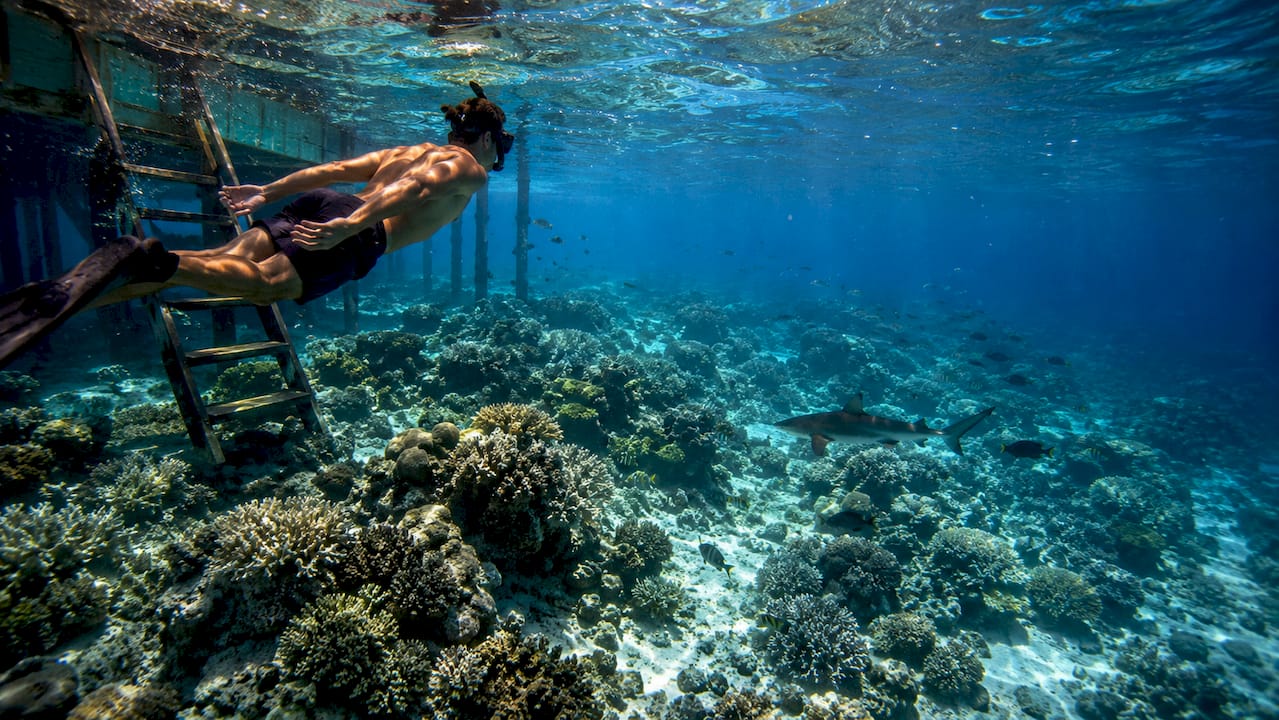
Water clarity and house reef access matters more than almost anything else if snorkeling or marine life is the point of the trip. Not every lagoon performs the same. Some Maldivian atolls deliver reef fish and reef sharks within a few strokes of your ladder; some Bora Bora lagoons, while stunning to look at, are quieter underwater. Ask specifically whether the resort has a living house reef directly beneath or adjacent to the water villas, not just a “lagoon view.”
Villa placement and privacy is the single most negotiable, most overlooked variable in this category. Outer-ring villas at the end of the jetty typically get unobstructed horizon views and far less foot traffic than inner-ring units closer to shore. A travel advisor who has actually mapped a resort’s jetty layout can request a specific villa number, not just a room category, which is the difference between total privacy and a parade of resort staff walking past your deck.
Architectural and in-room features vary wildly despite similar marketing language. A “plunge pool” can mean a four-foot dip pool or a twelve-foot infinity edge. Glass floor panels are often smaller and more decorative than promotional photography suggests. Some properties push design further than most, like Conrad Maldives’ Muraka, a two-level villa with an underwater master bedroom that represents the technical ceiling of what overwater architecture can do right now.
Service level and transfer logistics define the experience as much as the room does. Private seaplane or speedboat transfers, dedicated butler service, and a genuine one-island-one-resort model (where the entire island belongs to a single property) all separate the ultra-luxury tier from the merely nice.
Cost structure and inclusions need scrutiny before booking, not after arrival. Most rates quoted are room-only or bed-and-breakfast; airport transfers, excursions, and sometimes even Wi-Fi carry separate charges.
- Water clarity and reef access for snorkeling quality
- Jetty placement (outer ring versus inner ring) for privacy and views
- In-room architecture: plunge pools, glass panels, retractable roofs
- Transfer method and service model (private seaplane, butler, one-island-one-resort)
- What’s actually included in the nightly rate versus billed separately
Pro Tip: Before booking, ask for the exact villa number and a satellite map of the property. Marketing photos rarely show you which villas sit closest to the restaurant, the staff dock, or the boat channel, all of which quietly erode the privacy you’re paying for.
Which Destination Is Best for Your Overwater Bungalow Trip?
Picking the region comes before picking the resort. Each destination rewards a different kind of traveler, and the trade-offs between them are bigger than most rankings admit.
Maldives: the deepest bench of overwater inventory
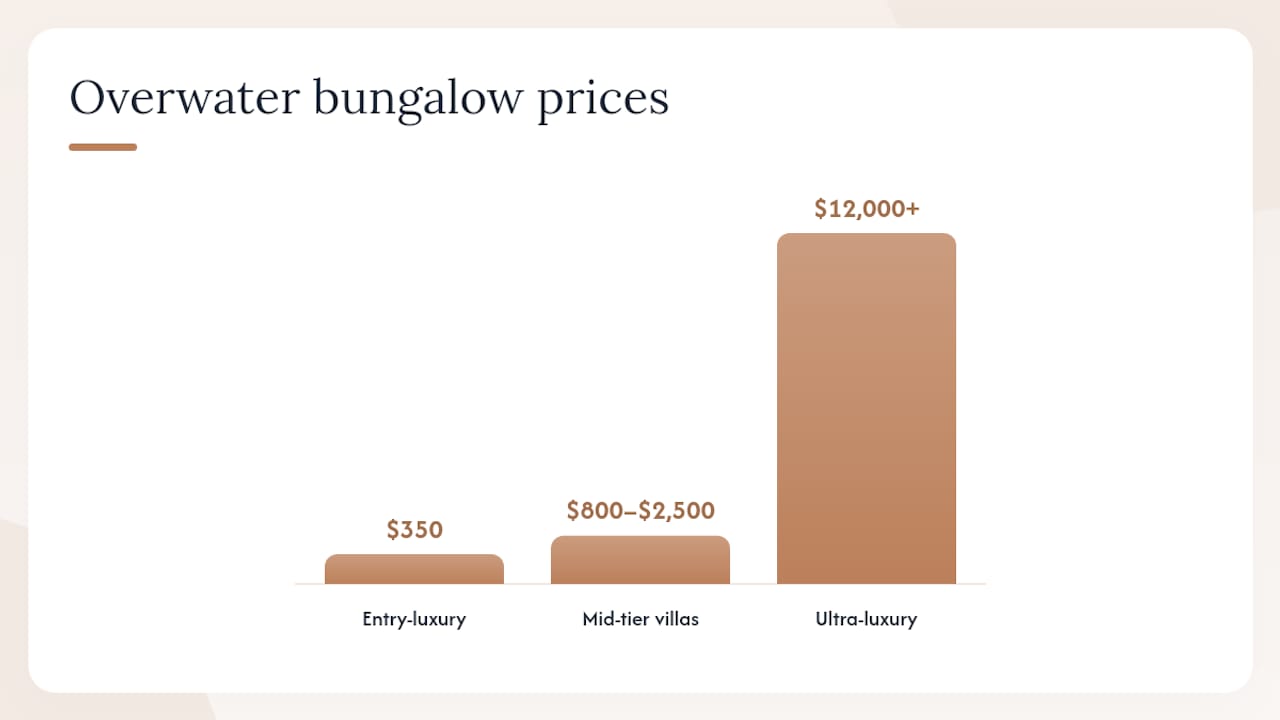
The Maldives has more overwater villas than anywhere else on earth, with more than 100 resort islands offering some form of water accommodation across every price tier. That depth of inventory means the Maldives can satisfy almost any budget or design fantasy, from a $350 a night entry-luxury villa to a $12,000 a night multi-bedroom retreat with its own butler and plunge pool.
Marine life is the real draw here. House reefs tend to outperform other regions for snorkeling directly off the villa, and manta ray and whale shark season (roughly December through May in the central and southern atolls) draws serious divers as much as honeymooners. The catch is logistics: most Maldives resorts require a seaplane transfer that only operates during daylight hours, which means a late-arriving international flight can strand you in Malé overnight before you ever see your villa.
Bora Bora and French Polynesia: the original, and still the most photogenic
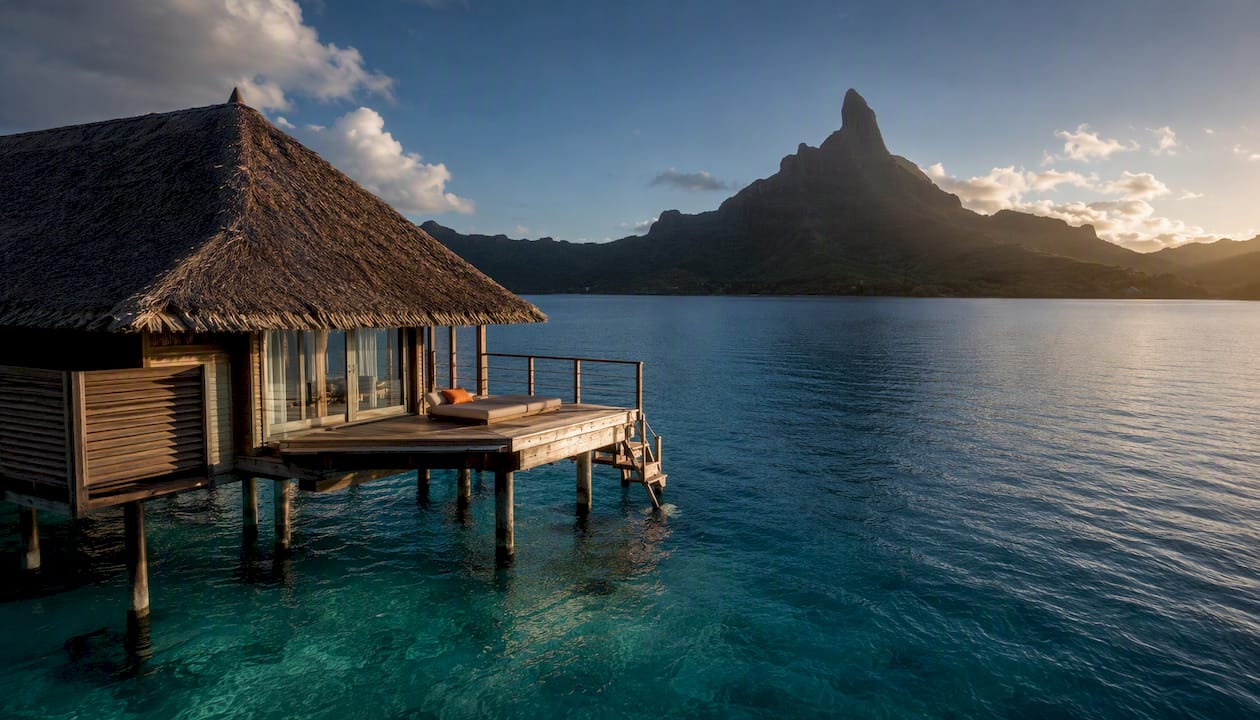
Bora Bora invented the overwater bungalow concept, and it still delivers the single most recognizable image in luxury travel: a thatched roof floating in front of Mount Otemanu’s jagged volcanic peak. Properties here lean into that view relentlessly. The Four Seasons Bora Bora built its overwater suites around private plunge pools and panoramic sightlines toward the mountain, which is the aesthetic every Maldives resort is quietly trying to imitate without the geology to pull it off.
The trade-off is routing. Getting to French Polynesia typically means flying into Tahiti first, then connecting via a short inter-island flight to Bora Bora, adding a full extra travel day compared to a more direct Maldives itinerary from the West Coast.
Fiji: authenticity and diving over pure spectacle
Fiji offers a different value proposition entirely: cultural immersion alongside world-class diving, at a generally lower price point than the Maldives or French Polynesia. The overwater bungalow inventory is smaller, and the aesthetic leans rustic-luxury rather than ultra-modern glass and chrome. Travelers who want a resort experience layered with real village visits, kava ceremonies, and soft coral diving tend to prefer Fiji over the more insulated one-island-one-resort model elsewhere.
Belize and the Caribbean: the value and proximity play
Belize and a handful of Caribbean destinations have built newer, generally more affordable overwater accommodations that cut travel time from the United States dramatically. These properties rarely match Maldivian villa square footage or French Polynesian scenery, but a five-hour flight instead of a twenty-hour one matters for a long weekend, and the savings on airfare alone can fund an upgrade in room category.
The reality of overwater bungalows in the United States
True overwater bungalows barely exist domestically. A few Florida Keys and Louisiana properties market “water villas” or stilted cabins over shallow water, but these differ meaningfully from the open-ocean, reef-adjacent villas found in the Maldives or Bora Bora. Anyone searching for an authentic overwater experience without an international flight should treat U.S. listings as a different category entirely, not a substitute.
- Maldives: broadest inventory, strongest reef access, longest seaplane logistics
- Bora Bora: iconic mountain views, shorter stays recommended due to cost, requires Tahiti connection
- Fiji: cultural depth and diving, lower price point, smaller villa inventory
- Belize/Caribbean: shortest flights from the U.S., strongest value, less dramatic scenery
- United States: limited true overwater inventory; “water villa” listings are a different product
What Does an Overwater Bungalow Actually Cost?
Prices swing enormously depending on tier, and the gap between the bottom and top of the market is larger than most first-time bookers expect. Entry-luxury overwater villas in the Maldives start around $350 a night, while ultra-luxury multi-bedroom retreats, the kind with private pools, dedicated chefs, and standalone spas, run $12,000 or more per night at properties like Soneva Jani. Mid-tier villas, the sweet spot for most affluent leisure travelers, generally land somewhere in the $800 to $2,500 range depending on season and island.
What drives the price beyond square footage: private pool size, distance from the main island (further usually costs more), butler-to-guest ratio, and whether the villa includes a dedicated boat for excursions rather than shared resort transport.
Meal plans are where expectations most often go wrong; understanding all-inclusive packages versus bed-and-breakfast lodging can help set realistic budgeting and dining expectations. Most top-tier overwater resorts operate on bed-and-breakfast or half-board terms, not full all-inclusive. True all-inclusive packages exist but are uncommon at the ultra-luxury level, where resorts prefer à la carte dining across multiple restaurants rather than a single buffet model. Budget accordingly: dinner at a specialty restaurant on a private island can easily run $150 to $300 per person before wine.
Sourced fact: the Maldives holds the largest concentration of overwater villa inventory anywhere in the world, spanning every price tier from entry-luxury to ultra-luxury, which is a major reason it dominates “best of” lists more than any single competing destination.
A few tactics consistently protect your budget without downgrading the experience:
- Pre-book dining credits or experience bundles rather than paying à la carte on-site.
- Travel during shoulder or off-peak season (typically outside the December through February peak) for meaningfully lower rates.
- Let an advisor negotiate resort promotions directly. Properties frequently hold back offers that never reach public booking channels.
- Compare the true landed cost of a shorter, closer trip (Belize, Caribbean) against a longer Maldives or Bora Bora itinerary once flights are factored in.
How Should You Choose the Right Resort?
Work through this sequence before you commit to a deposit:
- Confirm the exact villa location. Ask for the villa number and its position on the jetty, not just the room category name.
- Verify house reef status. Ask directly whether snorkeling is viable from the villa ladder or requires a boat trip.
- Request a sample transfer schedule. Seaplane and boat transfers run on fixed daylight windows; confirm your flight times align.
- Clarify what’s included. Meals, Wi-Fi, water sports, and airport transfers are frequently billed separately even at five-star properties.
- Review cancellation and flexibility terms. Ultra-luxury resorts often carry stricter deposit and rebooking policies than mainstream hotel chains.
Watch for a few recurring red flags. Glass floor panels photographed to look expansive are often a small decorative square. Inner-ring villas marketed as “overwater” can sit close enough to shore and to neighboring rooms that privacy suffers. And multi-leg transfer chains (international flight, domestic connection, seaplane, then boat) can eat an entire travel day if timed poorly.
Timing matters too. Dry season in the Maldives and Fiji generally runs from roughly May through October, while Bora Bora’s driest months fall between May and October as well, though availability at top properties tightens well over six months out for these windows. Booking eight to twelve months ahead is standard practice for the properties worth flying halfway around the world to reach.
Pro Tip: Never trust a resort’s own photography for scale. Ask an advisor for recent guest photos of the exact villa number you’re considering, taken at the actual time of day you’ll be there.
How Hidden Door Travel Elevates an Overwater Bungalow Trip
Booking directly with a resort website gets you a room. Booking through Hidden Door Travel’s luxury travel agency gets you the villa, the timing, and the fallback plan when something changes.
The practical services matter here: villa sourcing down to the specific unit number, preferred-room access that isn’t available on public booking engines, private transfer coordination between international flights and seaplane or boat legs, curated dining reservations at properties that require them, and visa or entry documentation handled ahead of departure rather than discovered at the airport.
Total value comes from stacking advantages a solo booker can’t access alone: negotiated dining credits, bundled experience packages, arrival timing that avoids overnight layovers in transit hubs, and a contingency plan if a seaplane is grounded by weather, which happens more often in the Maldives than most first-timers expect.
A honeymoon couple booking the Maldives independently discovered, two weeks before departure, that their connecting seaplane only operated three days a week and didn’t align with their arrival flight. Rebooking through an agency relationship secured a same-day charter and preserved their full stay, a fix that wouldn’t have existed through the resort’s own booking desk.
This is the practical case for bespoke trip planning over a DIY booking: the villa is only half the trip. The logistics around it decide whether the experience matches the price tag.
- Villa sourcing with specific unit and jetty-position requests
- Preferred-room access unavailable through public booking channels
- Coordinated private transfers across multi-leg international routing
- Curated dining, spa, and excursion bookings arranged before arrival
- Visa, entry documentation, and contingency support if plans change mid-trip
From Booking to Check-In: What the Timeline Actually Looks Like
Most travelers underestimate how long the full arc from booking to bungalow door actually takes. Top-tier villas at properties like Soneva Jani or Four Seasons Bora Bora often sell out eight to twelve months ahead for peak season dates, so the process realistically starts nearly a year out.
Once booked, the travel day itself unfolds in stages. A typical Maldives arrival means an international flight into Malé, a customs and immigration process, then a seaplane transfer that can run anywhere from 20 minutes to over an hour depending on the atoll, landing directly at the resort’s private lagoon dock. Bora Bora follows a similar shape: international arrival in Tahiti, an inter-island flight of roughly 50 minutes, then a short boat transfer to the resort.
Because seaplanes only fly during daylight, arriving on a late-evening international flight often means an overnight in Malé before the final leg, a detail worth building into the itinerary rather than discovering at customs.
For duration, five to seven nights is the sweet spot for Maldives and Bora Bora given the transfer investment; anything shorter makes the travel-to-stay ratio feel lopsided. Belize and Caribbean properties, with shorter flights, work well for three to four night stays.
What Else Should You Expect from the Resort Beyond the Bungalow?
The villa is the headline, but the resort around it determines whether five nights feels like enough. Dining variety separates good properties from great ones: top resorts run multiple specialty restaurants (Japanese, Mediterranean, overwater seafood grills) rather than one central dining room, and some offer private in-villa dining on request for an added fee.
Spa programs at this tier increasingly extend beyond a standard menu, with overwater treatment rooms and, at some properties, wellness retreats built around local ingredients or traditional healing practices. Excursions round out the experience: sunset dolphin cruises, private sandbank picnics, scuba certification courses, and, in Fiji particularly, village visits that add cultural context missing from a purely resort-bound stay.
The resorts worth the premium tend to treat these amenities as an integrated program rather than an upsell menu. A property with three restaurants but no overwater spa access, or excellent diving but a single mediocre dining room, tells you where its investment actually went. Comparing amenity breadth across shortlisted resorts, not just villa photos, is one of the more reliable ways to predict overall satisfaction once you’ve been on-site for three or four days and the initial view has become familiar.
Are Overwater Bungalow Resorts Environmentally Sustainable?
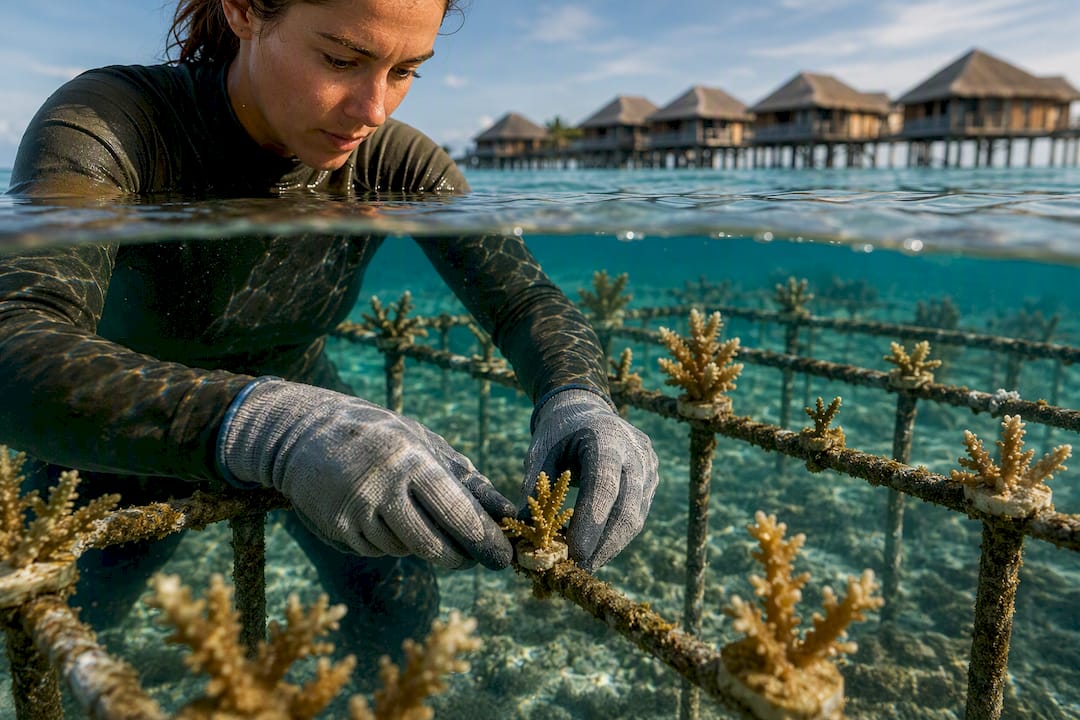
Building permanent structures over living coral lagoons carries an inherent environmental cost, and the resorts worth booking are the ones that address it directly rather than through vague marketing language. Look for specifics: reef restoration programs, marine biologist staff who run guest-accessible coral propagation projects, solar power integration, and desalination systems that reduce reliance on shipped-in freshwater.
Overtourism and construction runoff remain real concerns in both the Maldives and French Polynesia, where dense resort development sits directly atop fragile reef systems. The better-run properties limit water sports zones to protect house reefs and restrict motorized craft speeds near villa jetties, both of which double as guest-experience improvements and conservation measures.
Eco-conscious travelers should ask advisors for a property’s specific sustainability documentation rather than accepting a general “eco-friendly” label. Certifications, staff marine biology programs, and measurable reef health data carry more weight than a resort’s own promotional copy. A resort that can point to a decade of reef monitoring data is a fundamentally different proposition than one that added a recycling bin and called it sustainability.
What I’d Prioritize First and a Trip That Almost Went Wrong
If forced to rank the five criteria from earlier, privacy beats iconic views, which beats raw snorkeling quality, for most affluent travelers booking a once-a-year trip. You can always add a dive excursion to see the reef properly. You can’t undo three days spent staring at foot traffic from an inner-ring villa you didn’t realize you’d booked.
A recent case that stuck with me: a client had booked what looked, on paper, like a straightforward Maldives itinerary, until the connecting seaplane schedule and an international flight delay left a real risk of missing the only same-day transfer window. Untangling that took direct contact with the resort’s transfer desk and a same-day charter alternative, the kind of fix that rarely happens when you’re on hold with a call center from a hotel room. It’s a small story, but it’s the whole argument for having someone in your corner before departure day, not during it.
Start that conversation early. Hidden Door Travel’s luxury advisors exist for exactly this kind of trip.
— Michael
Book the Overwater Bungalow Trip You Actually Want
Resort websites show you a room category. They rarely show you the exact villa number, the real transfer schedule, or the dining credit a property holds back from public booking. Hidden Door Travel closes that gap: expert villa sourcing down to the specific unit, private transfer coordination across multi-leg routing, and curated dining and excursions arranged before you ever land.

That’s the practical advantage of working with a specialist rather than booking direct: someone who has already mapped the jetty, knows which resorts hold back promotions, and can fix a broken transfer chain on the day it happens instead of after your vacation is already compromised. If a Maldives, Bora Bora, or Fiji overwater trip is on your list for this year, the next step is a conversation, not a search bar. Reach out to Hidden Door Travel’s luxury advisors to start sourcing the right villa, dates, and transfers for your trip.
Sources
- Best Overwater Bungalows 2026: Complete World Guide — Travel Tourister (Updated March 2026)
- The Muraka | Conrad Maldives
- Luxury Resort in Bora Bora, French Polynesia | Four Seasons